

Table of Contents
ToggleIntroduction
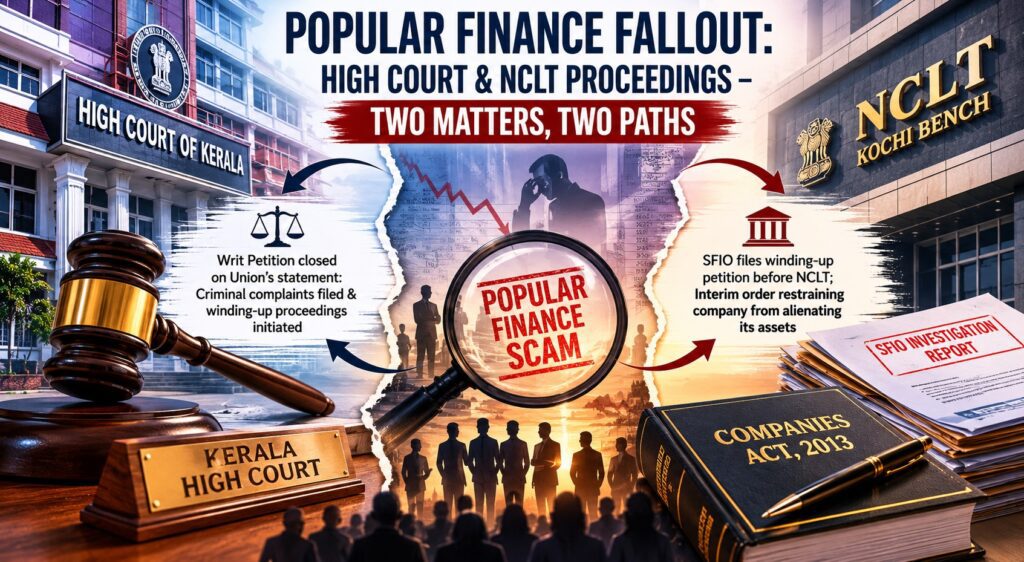
The ongoing fallout from the Popular Finance scam has resulted in multiple proceedings before different judicial and regulatory forums. Recent developments before the Kerala High Court and the National Company Law Tribunal (NCLT), Kochi Bench, have attracted considerable attention. Although both proceedings arise from investigations connected with the Popular Group, they are legally distinct and serve different purposes.
A proper understanding of these proceedings is important because they involve different statutory remedies, different objectives, and different stages of enforcement.
Background: Popular Finance Investigations
Following allegations of large-scale financial irregularities and investor losses associated with entities connected to the Popular Group, several agencies, including the Serious Fraud Investigation Office (SFIO), initiated investigations into the affairs of various companies.
The investigations have given rise to criminal proceedings, regulatory actions, and company law proceedings intended to protect investors and preserve assets pending further action.
Part I – The Kerala High Court Proceedings
Nature of the Case
The first matter was a writ petition filed by the MRPN Minority Shareholders Customers Welfare Association before the Kerala High Court.
The grievance raised by the petitioner association was that, despite the completion of investigations, no further effective proceedings had been initiated based on the final investigation report.
What the Union Government Informed the Court
During the hearing, the Union of India informed the High Court that:
* criminal complaints had already been filed before the Additional Sessions Court, Ernakulam; and
* proceedings for winding up the company were also being initiated.
The Union Government indicated that approximately four weeks would be required for completing the winding-up process initiation.
Outcome
Recording the above submission, the High Court closed the writ petition.
Importantly, the High Court did not itself order the winding up of the company. Nor did it pass any order concerning management of assets or appointment of a liquidator. The Court merely recorded the Government’s statement regarding actions already taken and proposed to be taken.
Thus, the High Court proceeding was essentially a public law proceeding seeking implementation of governmental action following investigation.
Part II – The NCLT Proceedings Against Mary Rani Popular Nidhi Limited
Nature of the Petition
Subsequently, the Union of India through the Serious Fraud Investigation Office filed a company petition before the National Company Law Tribunal, Kochi Bench.
The petition seeks winding up of Mary Rani Popular Nidhi Limited under Sections 271(1)(c), (d) and (e) read with Section 272 of the Companies Act, 2013.
Allegations
According to the petition, the company:
* was incorporated for unlawful purposes;
* conducted its affairs in a fraudulent manner;
* acted in a manner prejudicial to public interest; and
* failed to file financial statements and annual returns for five consecutive financial years.
The petition relies upon the SFIO investigation report and related governmental authorisations.
Reliefs Sought
The Union Government sought both interim and final reliefs, including:
* restraint against alienation or encumbrance of assets;
* appointment of a provisional liquidator;
* taking charge of the company’s affairs; and
* eventual winding up of the company.
Interim Order of the NCLT
After examining the material placed before it, the NCLT held that a prima facie case existed for grant of limited interim protection.
The Tribunal restrained the company from:
* transferring,
* alienating,
* mortgaging,
* encumbering, or
* creating third-party interests over its movable and immovable assets without prior permission of the Tribunal.
At the same time, the NCLT declined to appoint a provisional liquidator at the interim stage, observing that such a drastic measure should not be ordered without first hearing the company.
The matter was thereafter posted for further proceedings after service of notice on the respondent company.
Key Differences Between the Two Proceedings
Different Forums
The High Court proceeding was a writ petition under constitutional jurisdiction.
The NCLT proceeding is a company law action under the Companies Act, 2013.
Different Objectives
The High Court case sought accountability regarding implementation of investigation findings and governmental action.
The NCLT case seeks the substantive remedy of winding up the company and preserving its assets pending adjudication.
Different Reliefs
The High Court did not grant coercive relief against company assets.
The NCLT has already granted an interim asset-preservation order restricting dealings with company property.
Different Procedural Stages
The High Court proceeding concluded after recording the Government’s statement.
The NCLT proceeding is presently at an adjudicatory stage where the allegations and reliefs sought will be examined after hearing the respondent company.
Why the NCLT Order is Significant
The NCLT’s interim restraint order is significant because it seeks to preserve the existing asset position of the company pending adjudication of the winding-up petition. Such preservation measures are often regarded as necessary where allegations of fraud and public interest concerns are raised and where future recovery proceedings may depend upon the availability of identifiable assets.
However, it is equally important to note that the Tribunal has not yet reached any final conclusion on the merits of the allegations. The order expressly records that the observations are only prima facie and that the respondent company must be given an opportunity to present its case.
Conclusion
The Kerala High Court proceeding and the NCLT winding-up action should not be viewed as duplicate proceedings. Rather, they represent different stages of the legal response arising from the Popular Finance investigations.
The High Court proceeding addressed the question whether governmental authorities were acting upon the investigation findings. The NCLT proceeding represents the substantive company law mechanism through which the Union Government seeks winding up of Mary Rani Popular Nidhi Limited and preservation of its assets pending final determination.
The future course of the NCLT proceedings will likely be of particular interest to investors, regulators and stakeholders, as the Tribunal considers whether the statutory grounds for winding up under the Companies Act, 2013 are ultimately established.