

Limits of Judicial Interpretation under Indian Law – Lessons from Princy N.V. v. Union of India (Kerala High Court, 2026)
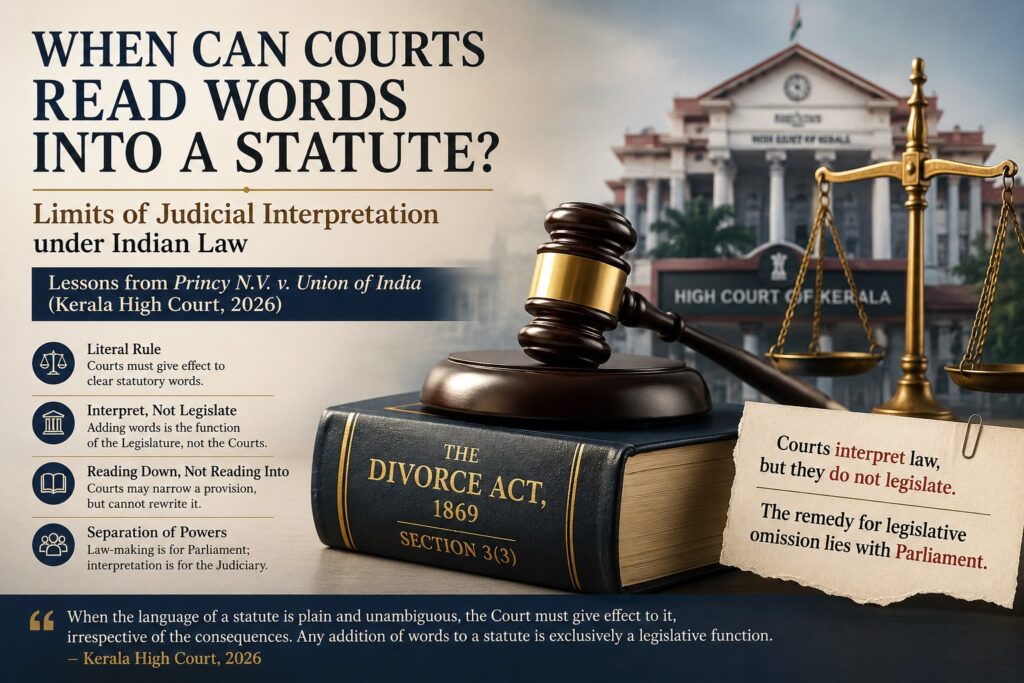
Table of Contents
ToggleAbstract
The Kerala High Court’s decision in Princy N.V. v. Union of India is much more than a matrimonial dispute concerning territorial jurisdiction under the Divorce Act, 1869. The judgment is an important exposition on statutory interpretation and constitutional adjudication. Faced with a plea to interpret Section 3(3) of the Divorce Act to include the place where a wife resides, the Court refused to judicially insert words into the statute despite recognising the hardship caused to Christian women. Instead, the Court reaffirmed one of the oldest principles of statutory interpretation—that courts interpret law but do not legislate. The judgment therefore offers valuable lessons on literal interpretation, judicial restraint, separation of powers, purposive construction, reading down, and legislative omissions.
1.Background
The petitioner had been compelled to leave her matrimonial home after allegations of domestic violence and had taken shelter at her parental home in Wayanad. She instituted divorce proceedings before the Family Court, Kalpetta.
The petition was returned for want of territorial jurisdiction because Section 3(3) of the Divorce Act permits filing only before the District Court where:
- the marriage was solemnised,
- the husband and wife reside, or
- the parties last resided together.
Unlike the Hindu Marriage Act and the Special Marriage Act, the Divorce Act does not permit a wife to institute proceedings where she presently resides.
2.The Real Question Before the Court
The constitutional issue was not whether Parliament ought to amend the Divorce Act.
The real interpretative question was:
- Can a Court, in the guise of interpretation, add words to a statute merely because such an addition would make the provision fairer or more equitable?
This transforms an ordinary matrimonial dispute into an important case on statutory interpretation.
3. The Court’s Approach: Literal Rule Prevails
The Court first examined the language of Section 3(3).
It found the provision to be:
- plain,
- simple,
- unambiguous, and
- capable of only one meaning.
Once this conclusion was reached, the Court held that no further interpretative exercise was permissible.
The Court reiterated the settled principle:
When statutory language is plain, courts must give effect to the words used irrespective of the consequences.
This is a classic application of the Literal Rule of Interpretation.
4.Literal Rule Explained
The literal rule assumes that Parliament expresses its intention through the words it chooses.
Accordingly,
- if the language is clear,
- if only one meaning is possible,
- and if no absurdity results,
the Court has no authority to substitute another meaning merely because another interpretation appears more just.
Justice Bechu Kurian Thomas observed that Section 3(3) satisfied all these conditions.
Hence there was no scope for interpretation beyond the text.
5. Judicial Interpretation versus Judicial Legislation
Perhaps the most important contribution of the judgment is the distinction drawn between interpretation and legislation.
The petitioner requested the Court to read Section 3(3) as though it stated:
“…where the wife resides…”
Those words simply do not exist.
The Court therefore held that this was not interpretation at all.
It was legislation.
This distinction forms the heart of modern statutory interpretation.
Courts may:
- interpret,
- clarify,
- harmonise,
- remove ambiguity,
but they cannot:
- draft,
- amend,
- rewrite,
- expand,
- or improve statutes.
The Court observed that adding words is exclusively a legislative function.
6. Separation of Powers
Underlying the judgment is the constitutional doctrine of Separation of Powers.
- The legislature makes law.
- The judiciary interprets law.
If courts begin inserting words into statutes merely because the law appears inadequate, judicial review would become judicial legislation.
The judgment therefore reinforces constitutional discipline by respecting institutional boundaries.
7. When May Courts Depart from Literal Interpretation?
The judgment is equally valuable because it identifies circumstances where departure from the literal rule is permissible.
According to the Court, courts may adopt purposive or harmonious interpretation only where:
- ambiguity exists;
- two interpretations are reasonably possible;
- literal interpretation defeats legislative purpose;
- absurd or disastrous consequences follow.
None of these conditions existed in the present case.
Therefore, purposive interpretation could not be invoked.
8. Reading Down versus Reading Into
A particularly instructive aspect of the judgment is the distinction between reading down and reading into a statute.
Reading Down
Courts may narrow the meaning of statutory language to preserve constitutional validity.
Reading Into
Courts insert entirely new words or concepts not found in the legislation.
The Court held that the petitioner’s request belonged to the second category.
The judiciary possesses the former power in limited circumstances.
It does not possess the latter.
This distinction deserves careful attention from practitioners and students alike.
9.Legislative Silence is Not Judicial Invitation
Another important principle discussed is legislative omission.
The petitioner argued that Parliament had amended:
- Hindu Marriage Act, 1955
- Special Marriage Act, 1954
to permit wives to file proceedings where they reside.
Therefore the Divorce Act should be interpreted similarly.
The Court rejected this submission.
Parliament was fully aware of those amendments.
Yet it deliberately chose not to amend the Divorce Act.
Such legislative silence cannot authorise courts to rewrite the statute.
This reflects the doctrine of Casus Omissus.
10. Casus Omissus
The doctrine means:
Courts cannot supply omissions in legislation.
If Parliament omitted something—
whether intentionally or accidentally—
the remedy lies with Parliament.
Not with judges.
This doctrine has consistently been affirmed by the Supreme Court and finds fresh reaffirmation in the present judgment.
11.Distinguishing Independent Thought
The petitioner relied heavily on the Supreme Court decision in Independent Thought v. Union of India.
The Court carefully explained why that precedent was inapplicable.
In Independent Thought:
- several statutes fixed eighteen years as the age of a child,
- the IPC created inconsistency,
- constitutional rights of children were directly affected,
- harmonisation was essential.
Here, however,
- no inconsistency existed,
- no ambiguity existed,
- no challenge to constitutional validity had been made,
- and the Court was merely asked to insert words.
Hence the precedent could not justify judicial legislation.
12. Hardship Is Not a Rule of Interpretation
An important lesson emerging from the judgment is that hardship alone cannot justify a new interpretation.
The Court accepted that Christian women may genuinely face practical difficulties.
Yet hardship cannot become a tool for rewriting legislation.
This principle has repeatedly been recognised by the Supreme Court and was reaffirmed in this case.
13. The Court’s Balanced Approach
Interestingly, although the writ petition was dismissed, the Court acknowledged that Parliament ought to consider amending the Divorce Act.
It observed that there was no convincing justification for denying Christian women the same procedural benefit available under other matrimonial statutes.
The Court therefore directed that a copy of the judgment be forwarded to the Ministry of Law and Justice for appropriate consideration.
This demonstrates judicial restraint coupled with constitutional sensitivity.
14. Practical Lessons for Lawyers
The judgment provides several practical lessons:
- Identify ambiguity before invoking purposive interpretation. If the statutory language is clear, courts are unlikely to depart from its ordinary meaning.
- Differentiate interpretation from amendment. Requests that effectively insert new words into a statute are unlikely to succeed unless accompanied by a constitutional challenge.
- Frame constitutional challenges expressly. The Court noted that the petitioner had not sought to strike down Section 3(3) as unconstitutional, which materially influenced the scope of adjudication.
- Use the doctrine of casus omissus cautiously. Courts generally refuse to fill legislative gaps, especially where Parliament has consciously legislated in related statutes but not in the statute under consideration.
- Consider alternative procedural remedies. The Court pointed out that transfer of proceedings under Section 24 of the Code of Civil Procedure could alleviate practical hardship in appropriate cases.
Conclusion
The judgment in Princy N.V. v. Union of India is a valuable reaffirmation of fundamental principles of statutory interpretation. It underscores that the judiciary cannot rewrite legislation under the guise of interpretation, even where a statutory provision appears outdated or inequitable. At the same time, the Court acknowledged the policy gap affecting Christian women and urged Parliament to consider legislative reform. The decision thus exemplifies a careful balance between fidelity to statutory text, respect for the separation of powers, and sensitivity to evolving social realities.