

Table of Contents
Toggle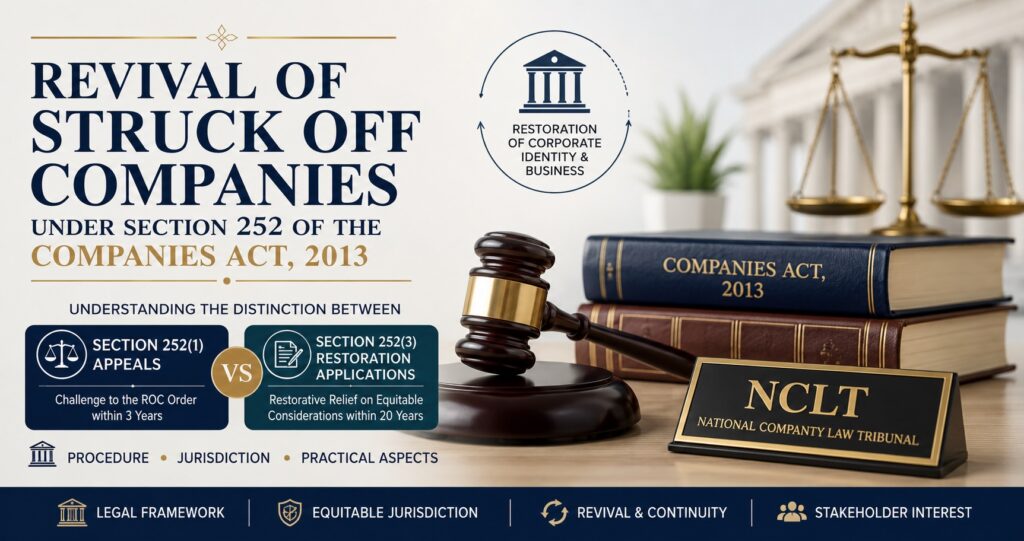
Introduction
Under the Companies Act, 2013, the Registrar of Companies (“ROC”) is empowered under Section 248 to strike off the name of a company from the Register of Companies where the company is not carrying on business or has failed to comply with statutory filing requirements. Once the company is struck off, it ceases to exist as a legal entity unless its name is restored by the National Company Law Tribunal (“NCLT”) under Section 252 of the Act.
Section 252 provides the statutory mechanism for restoration of the name of a struck off company. However, the provision creates two distinct remedies under Section 252(1) and Section 252(3), which are materially different in nature, scope, limitation and procedural character. In practice, these distinctions assume significant importance while drafting and filing restoration proceedings before the NCLT.
The distinction has also become relevant in view of procedural objections sometimes raised by NCLT Registries regarding whether proceedings under Section 252(3) are to be treated as “Company Appeals” or “Company Petitions/Applications”.
I. Strike Off under Section 248
Section 248 empowers the ROC to remove the name of a company from the Register of Companies where:
- the company has failed to commence business within one year of incorporation;
- the company is not carrying on business or operation for a prescribed period;
- the subscribers have not paid subscription money;
- statutory filings have not been made.
Before striking off, the ROC generally issues notice in Form STK-5 inviting objections.
Upon publication of notice under Section 248(5), the company stands dissolved.
II. Remedies under Section 252
Section 252 provides restoration remedies through the NCLT.
The provision is divided into three parts:
- Section 252(1) – Appeal against ROC order;
- Section 252(2) – Application by ROC itself;
- Section 252(3) – Application for restoration by company/member/creditor/workman.
The most commonly invoked provisions are Section 252(1) and Section 252(3).
III. Section 252(1) – Appeal Against ROC Order
(a) Nature of Proceedings
Section 252(1) specifically provides that:
“Any person aggrieved by an order of the Registrar… may file an appeal to the Tribunal…”
Thus, proceedings under Section 252(1) are expressly statutory appeals.
The Tribunal examines the legality and correctness of the ROC’s action in striking off the company.
(b) Who Can File
The following persons may file appeal:
- the company;
- members/shareholders;
- creditors;
- other aggrieved persons.
( c) Limitation Period
The appeal must be filed within 3 years from the date of the ROC order.
This limitation is strict and specifically prescribed in the statute.
(d) Scope of Inquiry
The Tribunal examines whether:
- proper notice was issued;
- principles of natural justice were followed;
- ROC correctly invoked Section 248;
- strike off was legally justified.
Thus, Section 252(1) is primarily appellate and supervisory in nature.
IV. Section 252(3) – Restoration Application
(a) Nature of Proceedings
Section 252(3) uses entirely different language:
“the Tribunal on an application made by the company, member, creditor or workman…”
Unlike Section 252(1), the legislature deliberately uses the expression “application” instead of “appeal”.
This distinction is extremely significant.
Proceedings under Section 252(3) are not confined merely to testing the legality of the ROC action. The provision confers substantive restorative and equitable jurisdiction upon the NCLT.
- Grounds for Restoration
The Tribunal may restore the company if:
the company was carrying on business or in operation at the time of strike off; or
it is otherwise just that the company be restored.
The expression “otherwise just” gives very wide discretionary and equitable powers to the Tribunal.
Even where technical defaults exist, restoration may be granted if equity, business continuity, stakeholder interests or justice so require.
(b) Who Can File
Application may be filed by:
- the company;
- member;
- creditor;
(c) Limitation Period
Application under Section 252(3) may be filed within:
20 years from publication of notice under Section 248(5).
This is substantially wider than Section 252(1).
V. Distinction Between Section 252(1) and Section 252(3)
Particulars | Section 252(1) | Section 252(3) |
Nature | Appeal | Application |
Objective | Challenge ROC order | Seek restoration |
Focus | Legality of strike off | Equitable revival |
Limitation | 3 years | 20 years |
Jurisdiction | Appellate | Restorative & equitable |
Key Test | Whether ROC acted properly | Whether company deserves restoration |
Statutory Language | “Appeal” | “Application” |
Scope | Narrower | Wider |
The legislative distinction is intentional and substantive.
It is a settled principle of statutory interpretation that where the legislature uses different expressions within the same provision, different meanings must ordinarily be assigned.
VI. Rule 87A of the NCLT Rules, 2016
Rule 87A specifically governs proceedings under Section 252.
The Rule provides:
“An appeal under sub-section (1) or an application under sub-section (3) of section 252 may be filed before the Tribunal in Form No. NCLT-9…”
This Rule is highly important because it expressly preserves the distinction between:
“appeal” under Section 252(1); and
“application” under Section 252(3).
Thus, even though a common procedural form (Form NCLT-9) is prescribed, the substantive distinction between the two proceedings continues to exist.
VII. Form NCLT-9 – Common Procedural Form
Both:
appeals under Section 252(1), and
applications under Section 252(3)
are filed in Form NCLT-9.
This sometimes creates procedural confusion before Registry authorities.
However, the use of a common procedural form does not convert a Section 252(3) proceeding into an appeal.
The statutory character of proceedings remains governed by Section 252 itself.
VIII. Practical Grounds Commonly Accepted for Restoration under Section 252(3)
NCLTs generally consider the following factors favourably:
- existence of bank accounts;
- filing of income tax returns;
- ownership of assets;
- pending business contracts;
- ongoing litigation;
- intention to revive business;
- maintenance of books of accounts;
- existence of employees/workmen;
- pending statutory liabilities;
- larger interest of shareholders and creditors.
Even dormant companies are often restored where restoration is considered “just”.
IX.Typical Documents Filed in Restoration Petitions
- Common documents include:
- Certificate of Incorporation;
- Memorandum and Articles;
- STK-5/STK-7 notices;
- financial statements;
- income tax returns;
- bank statements;
- GST records;
- board resolutions;
- special resolutions;
- affidavits;
- proof of business activities;
- purchase orders/work orders;
- asset documents
X.Importance of Proper Pleadings
A restoration petition under Section 252(3) should clearly establish:
- reason for non-filing;
- absence of wilful default;
- business activities or intention to revive;
- prejudice caused by strike off;
- equitable grounds warranting restoration.
Since Section 252(3) involves equitable jurisdiction, pleadings assume considerable importance.
XI. Procedural Classification Controversy
In practice, some Registries administratively classify even Section 252(3) proceedings as “Company Appeals”.
However, this administrative classification cannot override:
- statutory language;
- Section 252 distinction;
- Rule 87A terminology.
The statutory scheme clearly distinguishes between:
- appellate proceedings under Section 252(1); and
- restorative applications under Section 252(3).
Even where the Registry insists upon a particular filing classification, such objection ordinarily pertains only to nomenclature and should not defeat substantive justice.
XII. Conclusion
Section 252 of the Companies Act, 2013 provides an important remedial framework for revival of struck off companies. However, Section 252(1) and Section 252(3) are fundamentally different remedies.
Section 252(1) is an appellate remedy challenging the ROC’s action within a limited period of three years. In contrast, Section 252(3) is a substantive restorative jurisdiction enabling revival of companies on equitable considerations within twenty years.
Rule 87A of the NCLT Rules further reinforces this distinction by separately referring to “appeal” under Section 252(1) and “application” under Section 252(3), even though both are procedurally filed in Form NCLT-9.
The legislative intent is therefore clear: proceedings under Section 252(3) are not merely technical appeals, but independent restorative applications invoking the broad equitable jurisdiction of the NCLT to secure substantial justice.