

Table of Contents
ToggleIntroduction
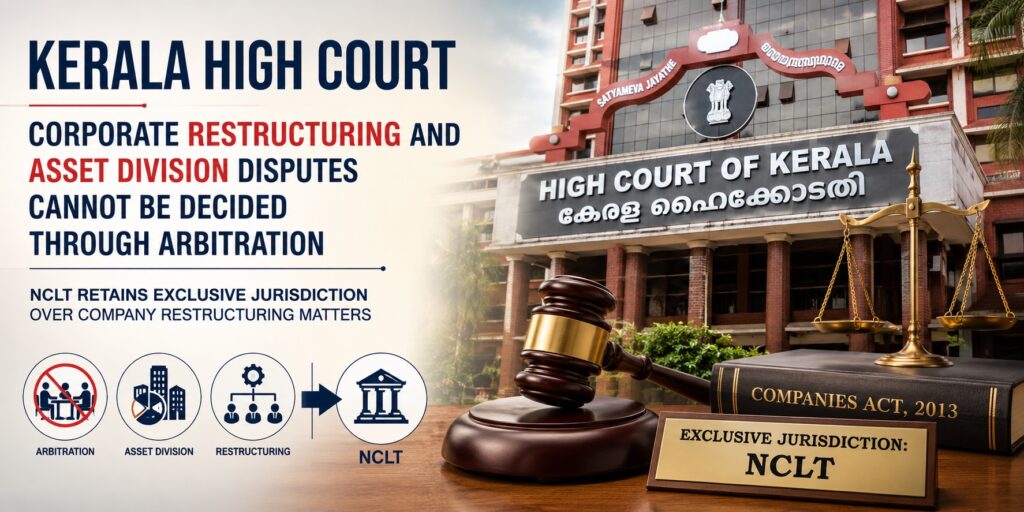
The Kerala High Court has delivered an important ruling on the limits of arbitration in corporate disputes, holding that disputes involving restructuring of companies, division of corporate assets, alteration of management control, and protection of minority shareholder rights fall within the exclusive domain of the National Company Law Tribunal (NCLT) and cannot be adjudicated by an arbitral tribunal.
In Purushothaman Thitta v. Pothan Rajan & Another, Justice Easwaran S. set aside an arbitral tribunal’s decision that had assumed jurisdiction over disputes concerning the division of assets and liabilities of three private limited companies. The Court held that such disputes are inherently non-arbitrable because they affect the structure and functioning of companies and involve statutory powers vested exclusively in the NCLT.
Background of the Dispute
The dispute arose between two brothers who had entered into a Memorandum of Understanding (MOU) in 2021 concerning the division of assets and liabilities connected with several business entities, including three private limited companies:
- Pioneer Cars India Private Limited;
- Pioneer Motors (Kannur) Private Limited; and
- Wayanad Vehicles Private Limited.
The MOU contained an arbitration clause. Following disputes regarding implementation of the arrangement, arbitration proceedings were initiated.
The claimant sought reliefs that included:
- division of company assets and liabilities;
- allocation of specific companies to particular parties;
- buyout of shareholdings;
- restructuring of ownership and management arrangements; and
- consequential financial settlements.
A minority shareholder holding 7% shares in one of the companies challenged the arbitrator’s jurisdiction under Section 16 of the Arbitration and Conciliation Act, 1996, contending that such disputes could only be decided by the NCLT under Sections 241 and 242 of the Companies Act, 2013.
The Preliminary Issue: Can the High Court Interfere with a Section 16 Order?
Before examining the merits, the Court addressed a procedural question.
Under Section 16 of the Arbitration and Conciliation Act, an arbitral tribunal has the power to decide its own jurisdiction. If the tribunal rejects a jurisdictional objection, no appeal is available under Section 37.
The respondents argued that the objecting party should wait until the final arbitral award and then challenge the award under Section 34.
The High Court, however, held that where an arbitral tribunal assumes jurisdiction over a dispute that is patently non-arbitrable or statutorily reserved for another forum, the High Court can exercise supervisory jurisdiction under Article 227 of the Constitution in exceptional cases.
The Court relied upon the principles laid down by the Supreme Court in:
- Deep Industries Ltd. v. ONGC;
- Bhaven Construction v. Sardar Sarovar Narmada Nigam Ltd.; and
- MCM Worldwide Pvt. Ltd. v. Construction Industry Development Council.
The Court observed that although judicial intervention in arbitration must remain minimal, courts cannot remain powerless when an arbitral tribunal proceeds without jurisdiction.
Why the Court Held the Dispute to be Non-Arbitrable
The judgment proceeds on the principle that not every dispute containing an arbitration clause is capable of being resolved through arbitration.
The Court noted that the reliefs sought before the arbitrator were not merely contractual claims between two individuals. Rather, they sought:
- division of corporate assets;
- restructuring of companies;
- allocation of management control;
- alteration of ownership arrangements; and
- potential sale of corporate assets.
Such reliefs directly affect:
- the companies themselves;
- minority shareholders;
- creditors; and
- other stakeholders who are not parties to the arbitration agreement.
Importantly, the companies themselves were not parties to the MOU. The arbitration agreement existed only between the two brothers in their individual capacities. The Court held that private contractual arrangements cannot override statutory mechanisms governing corporate restructuring.
Application of the Supreme Court’s Arbitrability Test
The Court extensively relied upon the Supreme Court’s landmark judgment in Vidya Drolia v. Durga Trading Corporation.
Under Vidya Drolia, disputes are non-arbitrable when:
- they involve rights in rem rather than rights in personam;
- they affect third-party rights;
- they require centralized adjudication by a statutory forum; or
- a statute expressly or impliedly reserves jurisdiction to a special tribunal.
Applying these principles, the High Court held that disputes involving restructuring of companies and division of corporate assets clearly affect third-party rights and require centralized adjudication under the Companies Act. Accordingly, they fail the arbitrability test.
Exclusive Powers of the NCLT Under the Companies Act, 2013
A crucial aspect of the judgment is its examination of Sections 241 and 242 of the Companies Act, 2013.
The Court observed that the NCLT possesses wide-ranging powers to:
- regulate the future conduct of company affairs;
- order purchase or buyout of shares;
- impose restrictions on share transfers;
- alter management structures;
- remove directors;
- modify agreements affecting the company; and
- make any order necessary to end oppressive or prejudicial conduct.
These statutory powers are fundamentally different from the powers of an arbitrator. An arbitral tribunal cannot grant remedies that alter the corporate structure or affect persons who are not parties to the arbitration agreement.
The Court therefore concluded that matters involving corporate restructuring and division of company assets are statutory in nature and belong exclusively to the NCLT.
Rights of Minority Shareholders Receive Judicial Protection
One of the notable features of the judgment is its emphasis on minority shareholder protection.
The petitioner was a minority shareholder who was not a party to the MOU. Nevertheless, the reliefs sought in arbitration would have directly impacted his shareholding rights and interests.
The Court recognised that allowing private arbitration to restructure companies could adversely affect minority shareholders without affording them the protections available under the Companies Act. This was another factor supporting the conclusion that such disputes are non-arbitrable.
Final Decision
The High Court partly allowed the petition and set aside the arbitrator’s order rejecting the jurisdictional challenge.
The Court terminated the arbitration proceedings insofar as they related to the three companies concerned and held that disputes touching upon their restructuring, management, ownership, and assets could not be pursued before the arbitral tribunal. The parties were left free to pursue appropriate remedies before the NCLT under the Companies Act, 2013.
Significance of the Judgment
The ruling provides important guidance on the growing intersection between arbitration law and company law.
Key Takeaways
- Corporate restructuring disputes are generally non-arbitrable.
- Asset division involving company property cannot ordinarily be decided through private arbitration.
- NCLT retains exclusive jurisdiction over matters falling within Sections 241 and 242 of the Companies Act, 2013.
- Minority shareholder rights cannot be bypassed through private agreements between majority stakeholders.
- High Courts may exercise Article 227 jurisdiction in exceptional cases where an arbitral tribunal assumes jurisdiction over a patently non-arbitrable dispute.
- The existence of an arbitration clause does not automatically render every dispute arbitrable.
Conclusion
The Kerala High Court’s decision reinforces a fundamental principle of Indian corporate jurisprudence: while arbitration remains the preferred mechanism for resolving commercial disputes, matters concerning the structure, management, ownership, and governance of companies belong to the statutory framework of the Companies Act and the exclusive jurisdiction of the NCLT.
The judgment serves as an important reminder that private contractual arrangements cannot supplant statutory protections designed to safeguard companies, shareholders, creditors, and the wider corporate ecosystem. For promoters and family-owned businesses, it underscores the need to carefully distinguish between personal contractual disputes that may be arbitrated and corporate restructuring disputes that must be brought before the NCLT.