

Introduction
Interest is often the most contested component of a money claim. In many disputes, the principal amount may not be seriously disputed, but the amount payable towards interest can substantially increase the overall liability.
The Interest Act, 1978 plays an important role in determining when courts and tribunals can award interest in the absence of a contractual provision. Its significance extends beyond ordinary civil suits and frequently arises in insolvency proceedings under the Insolvency and Bankruptcy Code, 2016 (IBC) and cheque dishonour proceedings under the Negotiable Instruments Act, 1881.
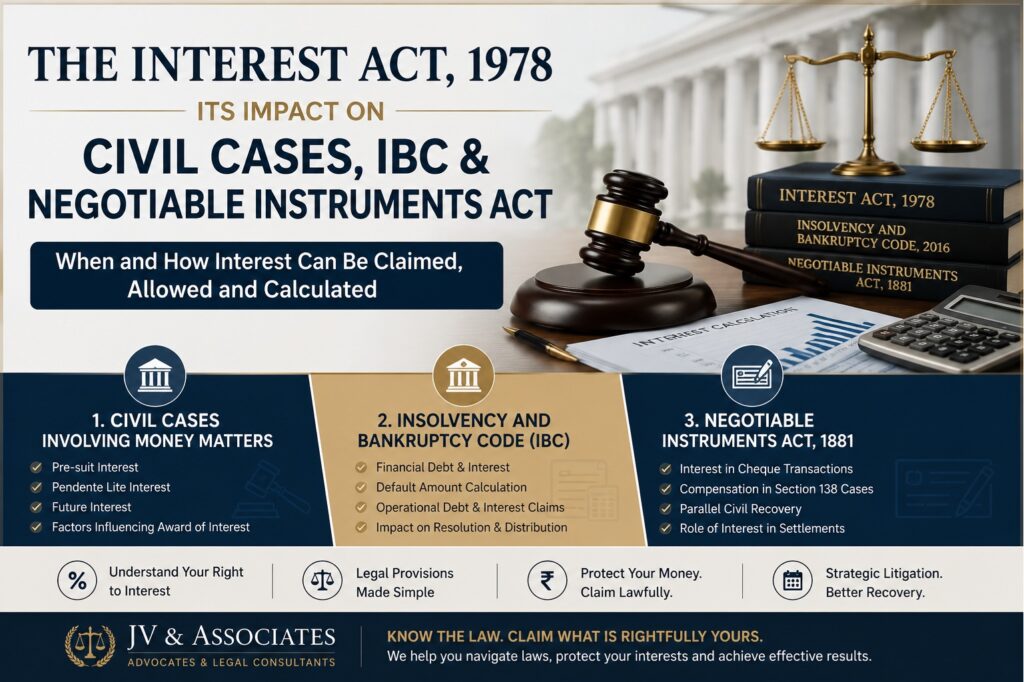
This article examines the implications of the Interest Act in three important areas of commercial litigation.
Understanding the Interest Act, 1978
The Interest Act empowers courts to award interest in certain circumstances even where:
* There is no contractual clause regarding interest;
* No statutory provision specifically provides for interest;
* Interest is claimed as compensation for wrongful withholding of money.
The Act applies to proceedings before courts and certain tribunals and supplements other laws governing interest.
The expression “court” under the Act includes tribunals and arbitrators in specified situations.
Part I: Impact of the Interest Act on Civil Cases Involving Money Claims
1.Recovery Suits
The most common application of the Interest Act arises in recovery suits involving:
* Loans;
* Business transactions;
* Sale of goods;
* Professional fees;
* Construction contracts;
* Commercial disputes.
A plaintiff who establishes that money was wrongfully withheld may seek interest for the period preceding the filing of the suit.
2.Three Different Periods of Interest
Courts generally examine interest under three separate stages:
(i) Pre-Suit Interest
Interest claimed before filing of the suit.
This may arise from:
* Contract;
* Trade usage;
* Statute;
* Interest Act, 1978.
The Interest Act becomes particularly important where there is no contractual clause regarding interest.
(ii) Pendente Lite Interest
Interest during the pendency of the suit.
This is governed primarily by Section 34 of the Code of Civil Procedure.
(iii) Future Interest
Interest awarded from the date of decree until realization.
This is also governed by Section 34 CPC.
3.Requirement of Written Demand
In many cases, interest under the Interest Act becomes claimable when:
* A written notice is issued;
* The notice specifies the amount due;
* The notice indicates that interest will be claimed.
For this reason, properly drafted legal notices become strategically important in recovery matters.
4.Commercial Transactions
Courts generally award higher rates of interest in commercial transactions than in personal disputes.
Factors considered include:
* Nature of business;
* Prevailing banking rates;
* Conduct of parties;
* Delay in payment.
Part II: Relevance of the Interest Act in Insolvency Proceedings under the IBC
1.Determination of Financial Debt
Interest is often central to determining whether a debt qualifies as a “financial debt.”
Where loan documents provide for interest, calculation is relatively straightforward.
Difficulties arise where:
* Documentation is incomplete;
* Interest is not expressly agreed;
* Informal funding arrangements exist.
In such cases, principles underlying the Interest Act may become relevant while determining the true nature and extent of the claim.
2.Computation of Default Amount
Under the IBC, the amount in default often includes:
* Principal amount;
* Contractual interest;
* Accrued interest.
A creditor who fails to establish entitlement to interest may find the claim amount significantly reduced.
3.Operational Creditors
Operational creditors frequently claim:
* Delayed payment charges;
* Commercial interest;
* Compensation for withholding of payments.
Where contractual terms are unclear, adjudicating authorities often examine whether interest can legally form part of the operational debt.
4.Resolution Plans and Distribution
Interest claims can materially affect:
* Voting share calculations;
* Admitted claims;
* Distribution waterfalls;
* Recovery expectations of creditors.
A difference in interest calculation may result in significant variations in admitted claim amounts.
5.Limitation Issues
Acknowledgments of debt often include acknowledgment of interest liability.
Consequently, disputes regarding interest may directly affect:
* Limitation periods;
* Date of default;
* Maintainability of insolvency applications.
Part III: Interest in Proceedings Under the Negotiable Instruments Act
1.Cheque Amount Versus Actual Liability
A cheque dishonour case often begins with a fixed cheque amount.
However, the underlying liability may include:
* Principal debt;
* Interest accrued prior to issuance of cheque;
* Contractual charges.
The Interest Act may therefore become relevant in determining the total legally recoverable amount in connected civil proceedings.
2.Compensation Under Section 138 Cases
While Section 138 is primarily a criminal remedy, courts frequently award compensation.
The amount awarded may take into account:
* Delay in payment;
* Nature of transaction;
* Financial loss suffered by the complainant.
Interest principles often influence such compensation.
3. Parallel Civil Proceedings
Many creditors pursue:
* Criminal complaint under Section 138;
* Simultaneous civil recovery proceedings.
In civil proceedings, the Interest Act may be invoked to recover interest even where the cheque amount itself does not expressly include interest.
4.Settlement Negotiations
Interest frequently becomes the deciding factor in settlement discussions.
For example:
A cheque amount of ₹10 lakh may ultimately result in liability substantially exceeding the principal due to accumulated interest and litigation costs.
This reality often encourages early settlement.
Practical Lessons for Litigants
Before initiating any money recovery action, consider the following:
Preserve Documentation
Maintain:
* Agreements;
* Invoices;
* Account statements;
* Demand notices.
Proper Legal Notice
A carefully drafted demand notice may strengthen a future claim for interest.
Clearly Plead Interest Claims
Courts generally expect parties to specifically plead:
* Rate of interest;
* Basis of claim;
* Period for which interest is claimed.
Distinguish Between Contractual and Statutory Interest
A contractual claim for interest is usually stronger than a claim based solely on equitable principles.
Conclusion
The Interest Act, 1978 remains one of the most important yet frequently overlooked statutes in commercial litigation. Its impact extends far beyond ordinary money recovery suits and can significantly influence insolvency proceedings, cheque dishonour litigation, and corporate disputes.
Whether acting as a creditor seeking recovery or a debtor defending a claim, understanding the law relating to interest can materially affect the outcome of the dispute. In many cases, the battle is not over the principal amount but over the interest that has accumulated over time.
Proper legal strategy at the beginning of a dispute can therefore make a substantial difference in the final recovery or liability.