

Table of Contents
Toggle1.Introduction
The limitation period for filing an appeal before the National Company Law Appellate Tribunal (NCLAT) is governed by Section 61(2) of the Insolvency and Bankruptcy Code, 2016 (IBC).
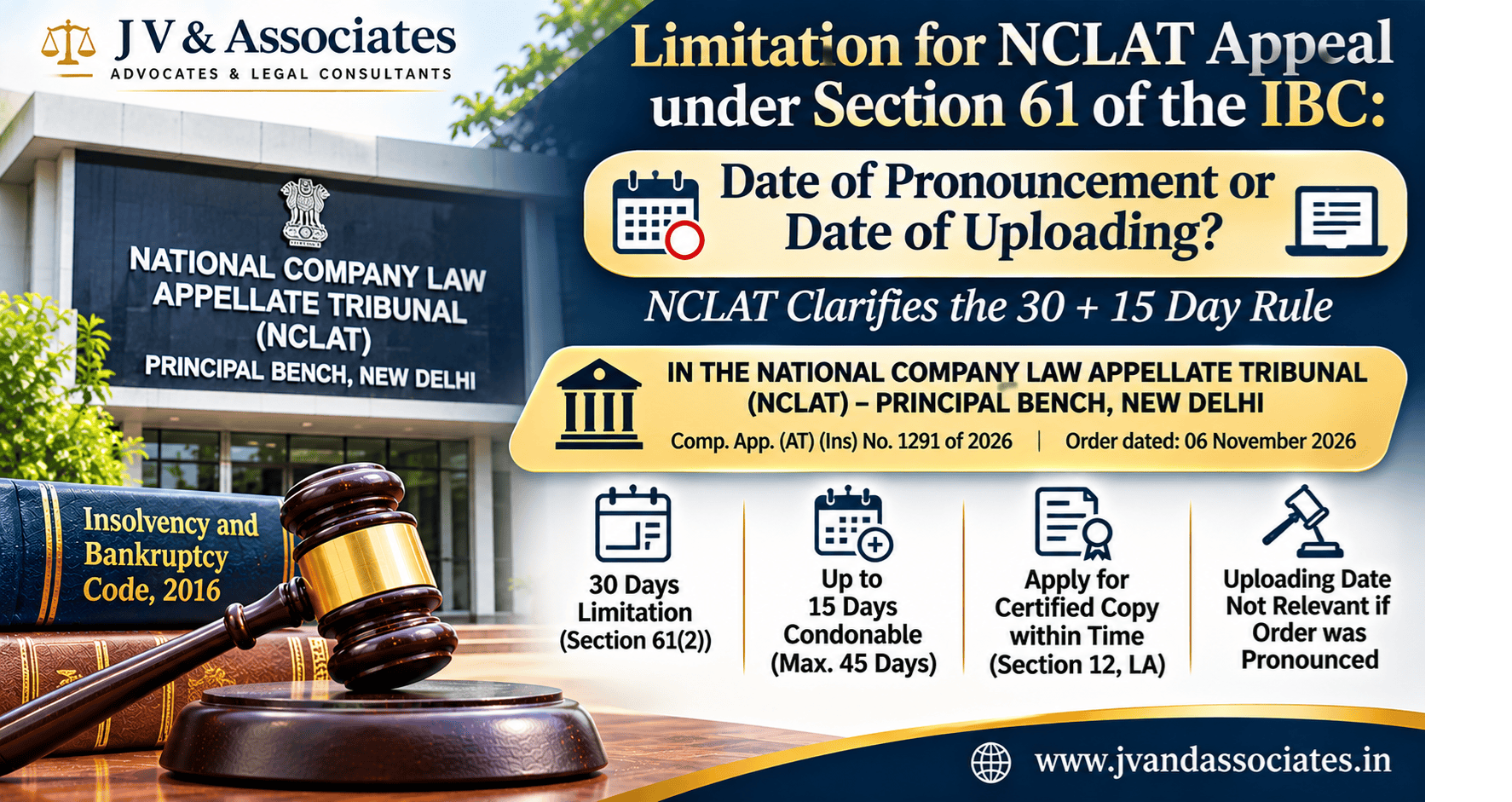
The provision prescribes a period of 30 days for filing an appeal against an order of the National Company Law Tribunal (NCLT). The proviso empowers the NCLAT to condone a delay of up to a further 15 days, provided sufficient cause is established.
An important practical question frequently arises when an NCLT order is pronounced in open court on a particular date but uploaded on the Tribunal’s website several days later.
Can an aggrieved party calculate the limitation period from the date of uploading of the order rather than the date of its pronouncement?
What happens when the party applies for a certified copy only after the expiry of the initial 30-day limitation period?
Can the NCLAT condone a delay exceeding 45 days if the party establishes sufficient cause for not filing the appeal within time?
These questions were considered by the National Company Law Appellate Tribunal, Principal Bench, New Delhi, in Ajay Singh Narania v. Harish Kant Kaushik & Ors., Company Appeal (AT) (Ins.) No. 1291 of 2026, by order dated 6 November 2026.
The decision reiterates the strict limitation framework under Section 61(2) of the IBC and clarifies the circumstances in which the date of uploading an order becomes relevant for computing limitation.
2. Case Details
IN THE NATIONAL COMPANY LAW APPELLATE TRIBUNAL, PRINCIPAL BENCH, NEW DELHI
Company Appeal (AT) (Ins.) No. 1291 of 2026
Along with I.A. Nos. 4968 and 5022 of 2026
Ajay Singh Narania – Appellant
Versus
Harish Kant Kaushik & Others – Respondents
Impugned Order: Order dated 27 March 2026 passed by the National Company Law Tribunal, Mumbai Bench-V, in I.A. No. 1243/MB/2026 in C.P. (IB) No. 203/MB/2021.
Date of NCLAT Order: 6 November 2026
Coram:
Hon’ble Justice Mohd. Faiz Alam Khan, Member (Judicial)
Hon’ble Shri Naresh Salecha, Member (Technical)
Result: Application for condonation of delay rejected. Appeal dismissed as being beyond the maximum condonable period of 45 days prescribed under Section 61(2) of the IBC.
3.Facts of the Case
The Appellant, Ajay Singh Narania, challenged an order dated 27 March 2026 passed by the NCLT, Mumbai Bench-V, in I.A. No. 1243/MB/2026 in C.P. (IB) No. 203/MB/2021.
The impugned order dismissed the application filed by the Appellant.
The Appellant subsequently preferred an appeal before the NCLAT on 21 May 2026, accompanied by an application seeking condonation of delay of 13 days.
The principal controversy concerned the date from which the limitation period for filing the appeal was required to be calculated.
The Appellant’s case
The Appellant contended that although the impugned order bore the date 27 March 2026, it was uploaded on the NCLT website only on 8 April 2026.
It was submitted that:
The matter was not listed for pronouncement of the order on 27 March 2026.
The cause list dated 27 March 2026 showed the matter under the caption “Supplementary”.
The order was not reflected in the cause list dated 8 April 2026 either.
The contents of the order became available to the Appellant only when it was uploaded on 8 April 2026.
The Appellant required time to obtain legal advice and brief an Advocate for filing the appeal.
The Appellant was based in Jammu and Kashmir, while the Advocate and attorney involved in the matter were also not residents of Delhi, resulting in additional communication and coordination difficulties.
The Appellant accordingly contended that the limitation period should be reckoned from 8 April 2026, the date of uploading of the order.
On that basis, the appeal filed on 21 May 2026 involved a delay of only 13 days beyond the initial period of 30 days.
The Appellant relied upon the judgment of the Supreme Court in Sanjay Pandurang Kalate v. Vistra ITCL (India) Limited & Others, 2023 INSC 1063.
The Respondents’ objections
The Respondents opposed the application for condonation of delay.
Their principal contention was that the impugned order had actually been pronounced in open court on 27 March 2026 in the presence of the counsel appearing for both parties.
It was further submitted that:
The application had been listed before the NCLT for the first time on 27 March 2026.
The Adjudicating Authority declined to issue notice and dismissed the application on that date itself.
Since the order had been pronounced in open court, the subsequent uploading of the order on 8 April 2026 was immaterial for calculating limitation.
The Appellant applied for a certified copy only on 20 May 2026, almost two months after pronouncement.
The appeal was filed on 21 May 2026, beyond the maximum condonable period of 45 days.
The Respondents relied upon the Supreme Court’s decision in V. Nagarajan v. SKS Ispat and Power Limited & Others, as well as the NCLAT decisions in Directorate of Enforcement v. Anil Kumar Mittal and Mukesh Sumer Mal Sanghvi v. RD Engineer (India) Private Limited.
The Respondents therefore contended that the NCLAT had no jurisdiction to condone the delay beyond 45 days.
4. Statutory Framework – Section 61(2) of the IBC
The central legal provision considered by the NCLAT was Section 61(2) of the Insolvency and Bankruptcy Code, 2016.
Section 61(2) provides: “Every appeal under sub-section (1) shall be filed within thirty days before the National Company Law Appellate Tribunal:
Provided that the National Company Law Appellate Tribunal may allow an appeal to be filed after the expiry of the said period of thirty days if it is satisfied that there was sufficient cause for not filing the appeal but such period shall not exceed fifteen days.”
The provision creates two distinct periods:
Initial limitation period – 30 days
An appeal against an order of the NCLT must ordinarily be filed within 30 days.
2.Additional condonable period – 15 days
The NCLAT may condone a delay beyond 30 days, subject to a maximum extension of 15 days, where sufficient cause is established.
Accordingly, the maximum period available for filing an appeal under Section 61(2) is 45 days.
Importantly, the proviso does not confer an unrestricted power upon the NCLAT to condone delay whenever sufficient cause is established.
The Tribunal’s power to condone delay is expressly limited to 15 days beyond the prescribed period of 30 days.
5. Computation of Limitation – Rule 3 of the NCLAT Rules, 2016
The NCLAT also considered Rule 3 of the National Company Law Appellate Tribunal Rules, 2016.
Rule 3 provides that, in computing a prescribed period, the day from which the period is to be reckoned shall be excluded.
It further provides that where the last day expires on a day when the office of the Appellate Tribunal is closed, that day and any succeeding day on which the Tribunal remains closed shall also be excluded.
Therefore, the date of pronouncement is excluded while calculating the 30-day limitation period.
Application to the present case
The NCLT order was pronounced on 27 March 2026.
The date of pronouncement was excluded in accordance with Rule 3.
The 30-day limitation period consequently expired on 26 April 2026.
The maximum additional period of 15 days expired on 11 May 2026.
However, the appeal was filed only on 21 May 2026.
Thus, the appeal was filed beyond the maximum condonable period of 45 days.
6.Section 12 of the Limitation Act, 1963 – Exclusion of Time for Obtaining Certified Copy
Another important statutory provision considered by the NCLAT was Section 12 of the Limitation Act, 1963.
Section 12(1) provides that, in computing the period of limitation for any suit, appeal or application, the day from which the period is to be reckoned shall be excluded.
Section 12(2) further provides for exclusion of the time requisite for obtaining a copy of the decree, sentence or order appealed against or sought to be revised or reviewed.
The provision is particularly relevant to appeals against orders of the NCLT.
However, the benefit of excluding the time required for obtaining a certified copy is subject to the legal principles governing the application for such copy.
A litigant cannot ordinarily postpone applying for a certified copy indefinitely and subsequently claim exclusion of the entire intervening period.
The application for a certified copy must be made within the prescribed limitation period if the litigant intends to claim the benefit of exclusion under Section 12.
This principle was central to the NCLAT’s decision.
7. Supreme Court Decision in V. Nagarajan v. SKS Ispat and Power Limited
The NCLAT placed considerable reliance upon the judgment of the Supreme Court in: Nagarajan v. SKS Ispat and Power Limited & Others, (2022) 2 SCC 244; (2021) ibclaw.in 157 SC.
The Supreme Court examined the limitation requirements for filing an appeal under Section 61 of the IBC and the obligation of an aggrieved party to obtain a certified copy of the order.
Important principles laid down by the Supreme Court
The Supreme Court clarified that:
Where an order is pronounced in open court, the limitation period commences from the date of pronouncement.
An aggrieved party is expected to exercise due diligence and apply for a certified copy of the order.
The time requisite for obtaining the certified copy may be excluded under Section 12(2) of the Limitation Act.
The time taken by the Tribunal to prepare the order before an application for a certified copy is made cannot ordinarily be excluded.
Merely having a right to receive a free certified copy does not dispense with the obligation to apply for a certified copy when an appeal is contemplated.
The Supreme Court also emphasised that filing an application for a certified copy is not merely a procedural formality.
It reflects the diligence of the aggrieved party in pursuing the appellate remedy within the statutory period.
Application to the present case
In the present case, the Appellant was represented by counsel before the NCLT on 27 March 2026.
The order itself reflected the presence of the Appellant’s counsel.
However, the application for a certified copy was filed only on 20 May 2026.
The NCLAT observed that the Appellant had failed to apply for the certified copy within the initial 30-day limitation period.
Consequently, the Appellant could not claim exclusion of the period preceding the late application for the certified copy.
The Tribunal therefore applied the principles laid down in V. Nagarajan.
Distinction Between Sanjay Pandurang Kalate and the Present Case
One of the most important aspects of the decision is the NCLAT’s examination of the Supreme Court judgment in:
Sanjay Pandurang Kalate v. Vistra ITCL (India) Limited & Others, (2023) ibclaw.in 154 SC; 2023 INSC 1063.
The Appellant relied upon this decision to contend that limitation should commence from the date of uploading of the order.
However, the NCLAT distinguished the facts of that case from the facts before it.
What did the Supreme Court decide in Sanjay Pandurang Kalate?
In Sanjay Pandurang Kalate, the issue concerned whether limitation for filing an appeal before the NCLAT commenced from:
17 May 2023, the date borne on the NCLT order; or
30 May 2023, the date on which the order was uploaded.
The Supreme Court noticed that the matter had been listed for admission and not for pronouncement on 17 May 2023.
It was also undisputed between the parties that no substantive order had actually been pronounced on that date.
Therefore, the Supreme Court held that limitation could not commence on 17 May 2023 when no order had been passed.
The limitation period commenced only when the order was subsequently pronounced and made available.
Why was Sanjay Pandurang Kalate not applicable?
In the present case, the factual position was materially different.
The NCLAT found that:
The order was pronounced on 27 March 2026.
The Appellant’s counsel was present before the NCLT.
The impugned order recorded the appearance of the Appellant’s counsel.
Nothing was placed before the NCLAT to establish that the order had not been pronounced on 27 March 2026.
The fact that the case was not separately listed for pronouncement did not establish that no order had been pronounced.
The Tribunal therefore held that the decision in Sanjay Pandurang Kalate could not assist the Appellant.
The distinction in principle
The distinction may be summarised as follows:
Particulars | Sanjay Pandurang Kalate | Ajay Singh Narania |
Date borne on NCLT order | 17.05.2023 | 27.03.2026 |
Whether order was pronounced on that date | No substantive order was pronounced | Order was pronounced in open court |
Whether counsel’s presence was material | No pronouncement established | Counsel for Appellant was present |
Subsequent uploading | 30.05.2023 | 08.04.2026 |
Commencement of limitation | When the order was subsequently pronounced | 27.03.2026 |
Applicability of uploading date | Relevant because no earlier pronouncement occurred | Immaterial because order was already pronounced |
The important principle is that the date of uploading does not automatically become the starting point of limitation.
The decisive question is whether the order was actually pronounced on the date borne by it.
Reliance on Sanket Kumar Agarwal v. APG Logistics Private Limited
The NCLAT also referred to the Supreme Court’s decision in:
Sanket Kumar Agarwal v. APG Logistics Private Limited, (2023) ibclaw.in 72 SC.
The Supreme Court reiterated important principles concerning the computation of limitation and filing of appeals under the IBC.
The principles noted by the NCLAT included:
Limitation stops running upon e-filing of the appeal before the NCLAT and not upon subsequent presentation of the physical copy.
The date on which the order is pronounced is excluded while computing the limitation period.
The time taken by the NCLT to provide a certified copy may be excluded, provided the appellant applies for the certified copy within the prescribed limitation period under Section 61(2).
This decision reinforces the importance of timely e-filing and obtaining certified copies without delay.
Tata Steel Ltd. v. Raj Kumar Banerjee – No Extension Beyond 45 Days
The NCLAT also relied upon the Supreme Court’s decision in:
Tata Steel Ltd. v. Raj Kumar Banerjee, (2025) ibclaw.in 177 SC; 2025 SCC OnLine SC 721.
The case involved an appeal filed by a person who was not a party to the proceedings before the NCLT and who claimed to have become aware of the order only subsequently.
The Supreme Court nevertheless examined the limitation period with reference to the date of pronouncement of the NCLT order.
It held that the appeal had been filed beyond the maximum period of 45 days prescribed under Section 61(2).
Important observations of the Supreme Court
The Supreme Court reiterated that:
The limitation period prescribed under Section 61(2) is mandatory.
The NCLAT cannot condone delay beyond the additional period of 15 days.
The maximum condonable period cannot be extended on equitable grounds.
The statutory limitation framework must be strictly followed.
The Supreme Court further observed that once the prescribed and condonable periods expire, the NCLAT has no jurisdiction to entertain the appeal, irrespective of the reasons for the delay.
This principle is particularly important because it establishes that the question is not merely whether sufficient cause exists for the delay.
The more fundamental question is whether the delay falls within the maximum period that the statute permits the NCLAT to condone.
Reliance on Supreme Construction Developers Pvt. Ltd. v. Puranik Builders Ltd.
The NCLAT also referred to its earlier decision in:
Supreme Construction Developers Pvt. Ltd. v. Puranik Builders Ltd., (2024) ibclaw.in 138 NCLAT.
In that case, the NCLAT had considered the applicability of Sanjay Pandurang Kalate.
The Appellate Tribunal observed that the Supreme Court’s decision in Sanjay Pandurang Kalate was distinguishable where an order had actually been passed in the presence of the parties.
It further emphasised that a litigant intending to pursue an appeal must apply for a certified copy within the prescribed limitation period if the benefit under Section 12 of the Limitation Act is sought.
The NCLAT reiterated that the date of uploading cannot be relied upon to extend limitation where the order had already been pronounced in open court.
This decision supported the distinction drawn in the present case.
Findings of the NCLAT in Ajay Singh Narania v. Harish Kant Kaushik
After considering the submissions and the applicable legal principles, the NCLAT recorded the following findings:
The order was pronounced on 27 March 2026
The Tribunal found that the impugned order had been pronounced on 27 March 2026 in the presence of the Appellant’s counsel.
The Appellant failed to establish that the order had not actually been pronounced on that date.
2. Subsequent uploading was immaterial
The Tribunal held that once the order had been pronounced in open court, its subsequent uploading on 8 April 2026 was immaterial for calculating limitation.
3.Certified copy was applied for belatedly
The Appellant applied for the certified copy only on 20 May 2026.
The NCLAT observed that the application had not been made within the initial 30-day limitation period.
Consequently, the Appellant could not claim the benefit of exclusion of time under Section 12 of the Limitation Act for the period preceding the application.
- Sanjay Pandurang Kalate was distinguishable
The Tribunal held that the Appellant could not derive any benefit from Sanjay Pandurang Kalate because, unlike that case, the order in the present matter had actually been pronounced on the date borne by it.
- Delay exceeded the maximum condonable period
The Tribunal calculated the limitation period as follows:
Particulars | Date |
Date of pronouncement of NCLT order | 27.03.2026 |
Date of uploading on NCLT website | 08.04.2026 |
Expiry of initial 30-day limitation | 26.04.2026 |
Expiry of additional 15-day condonable period | 11.05.2026 |
Date of application for certified copy | 20.05.2026 |
Date of filing of NCLAT appeal | 21.05.2026 |
The appeal was filed after expiry of the maximum condonable period of 45 days.
The NCLAT therefore held that it had no jurisdiction to condone the delay.
Final Order
The NCLAT dismissed the application seeking condonation of delay.
Since the delay condonation application was rejected, the appeal itself was also dismissed.
The Tribunal held that the appeal filed on 21 May 2026 was beyond the maximum condonable period prescribed under Section 61(2) of the IBC.
There was no order as to costs.
Practical Implications for Advocates and Litigants
The judgment provides important practical guidance for advocates, insolvency professionals, financial creditors, operational creditors and corporate debtors.
Do not wait for uploading of the order
Where an order is pronounced in open court, limitation ordinarily commences from the date of pronouncement.
The subsequent uploading of the order on the NCLT website does not automatically extend the limitation period.
Verify whether the order was actually pronounced
There is an important distinction between an order bearing a particular date and an order actually pronounced on that date.
Where no substantive order was pronounced, the principles laid down in Sanjay Pandurang Kalate may become relevant.
Therefore, advocates should carefully verify the daily order, cause list, proceedings and the actual pronouncement before determining limitation.
Apply for a certified copy immediately
An advocate intending to challenge an NCLT order should apply for a certified copy without waiting for the order to be uploaded.
Where the benefit of Section 12(2) of the Limitation Act is sought, the application for the certified copy should be made within the prescribed limitation period.
Calculate the maximum 45-day period carefully
The 30-day limitation period and the additional 15-day condonable period should be separately calculated.
A delay beyond the maximum 45-day period cannot ordinarily be condoned by the NCLAT.
E-file the appeal within time
The decision in Sanket Kumar Agarwal also highlights that e-filing is relevant for determining when the appeal is filed.
Advocates should therefore ensure that the appeal is e-filed within the prescribed period rather than assuming that subsequent physical filing will determine limitation.
Maintain proper records of pronouncement
Where there is any uncertainty regarding whether an order was actually pronounced, advocates should preserve relevant cause lists, daily orders and other available records.
These documents may become important in determining the commencement of limitation.
Conclusion
The decision of the National Company Law Appellate Tribunal, Principal Bench, New Delhi, in Ajay Singh Narania v. Harish Kant Kaushik & Others, Company Appeal (AT) (Ins.) No. 1291 of 2026, dated 6 November 2026, reinforces the strict limitation framework governing appeals under Section 61(2) of the Insolvency and Bankruptcy Code, 2016.
The judgment clarifies that where an NCLT order is actually pronounced in open court in the presence of the parties or their counsel, the limitation period commences from the date of pronouncement and not from the subsequent date on which the order is uploaded on the Tribunal’s website.
The decision also reiterates the obligation of an aggrieved litigant to exercise due diligence by applying for a certified copy within the prescribed limitation period if the benefit of exclusion under Section 12 of the Limitation Act is sought.
Most importantly, the judgment reinforces that the NCLAT’s power to condone delay under Section 61(2) is restricted to an additional period of 15 days beyond the initial 30-day limitation period.
Once the maximum period of 45 days expires, the NCLAT has no jurisdiction to condone the delay, even where the appellant may have reasons explaining the delay.
The practical lesson is clear: An advocate should calculate limitation from the actual date of pronouncement, apply for the certified copy immediately and ensure that the appeal is e-filed within the statutory period. Waiting for the order to appear on the NCLT website may result in the loss of the appellate remedy.
*********************************************************************
Case Reference: Ajay Singh Narania v. Harish Kant Kaushik & Others, Company Appeal (AT) (Ins.) No. 1291 of 2026, National Company Law Appellate Tribunal, Principal Bench, New Delhi, order dated 6 November 2026.
Legal Disclaimer: This article is intended for general informational and educational purposes and does not constitute legal advice. The discussion is based on the findings recorded in the particular NCLAT order. The applicability of the legal principles will depend upon the facts and circumstances of each case and subsequent judicial developments.