

Table of Contents
Toggle1.Introduction
The Insolvency and Bankruptcy Code, 2016 (IBC) provides a statutory mechanism for the resolution of insolvency of corporate persons. Section 7 enables a financial creditor to initiate the Corporate Insolvency Resolution Process (CIRP) against a corporate debtor upon the occurrence of a default.
However, the IBC is not intended to function merely as a debt recovery mechanism or as an instrument for exerting commercial pressure upon a corporate debtor.
An important legal question arises when a financial creditor files an application under Section 7 and subsequently enters into a settlement with the corporate debtor before admission of the petition.
Can the financial creditor withdraw the Section 7 application while reserving the right to revive the same insolvency proceedings if the corporate debtor defaults in complying with the settlement agreement?
A related question is whether the financial creditor can make payment obligations involving third parties, who are not parties to the insolvency proceedings, a condition for reviving the insolvency application.
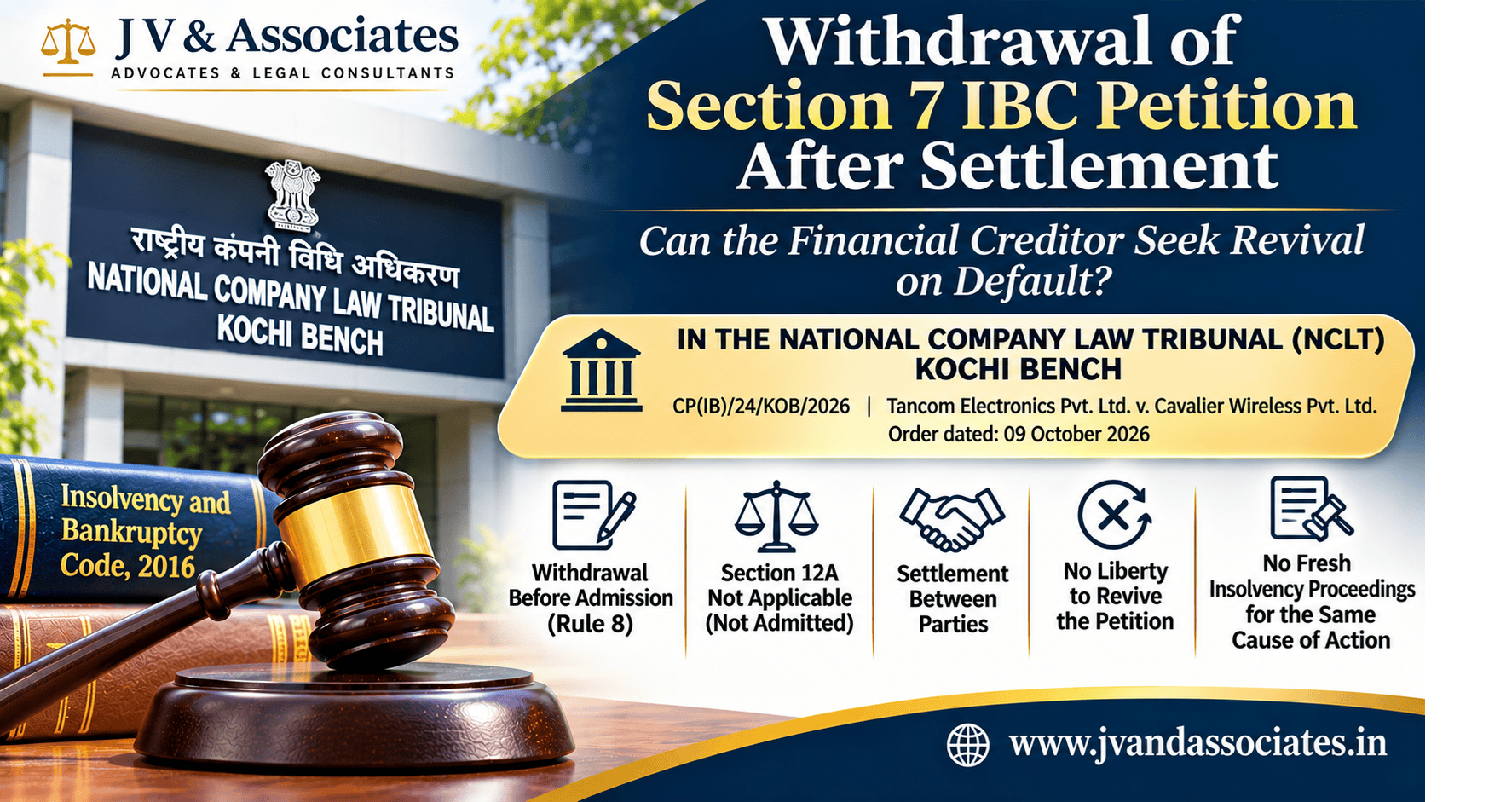
These questions were considered by the National Company Law Tribunal, Kochi Bench, in Tancom Electronics Private Limited v. Cavalier Wireless Private Limited, CP(IB)/24/KOB/2026, by order dated 9 October 2026.
The decision is significant for its examination of withdrawal before admission, the scope of Rule 8 of the Insolvency and Bankruptcy (Application to Adjudicating Authority) Rules, 2016, and the limits of using insolvency proceedings to enforce settlement obligations.
2.Case Details
IN THE NATIONAL COMPANY LAW TRIBUNAL (NCLT) KOCHI BENCH
Company Petition No.: CP(IB)/24/KOB/2026
Under Section 7 of the Insolvency and Bankruptcy Code, 2016, read with Rule 4 of the Insolvency and Bankruptcy (Application to Adjudicating Authority) Rules, 2016
M/s Tancom Electronics Private Limited – Petitioner / Financial Creditor
Versus
M/s Cavalier Wireless Private Limited – Respondent / Corporate Debtor
Date of Order: 9 October 2026
Coram:
- Hon’ble Shri Vinay Goel, Member (Judicial)
- Hon’ble Shri Ravichandran Ramasamy, Member (Technical)
Result: Section 7 petition dismissed as withdrawn, without liberty to revive the proceedings or invoke the insolvency process against the corporate debtor in respect of the same cause of action.
3.Background of the Dispute
The Financial Creditor, Tancom Electronics Private Limited, instituted an application under Section 7 of the IBC against Cavalier Wireless Private Limited, alleging a financial default of ₹20,75,73,848.
According to the withdrawal memo reproduced in the Tribunal’s order, the alleged financial debt arose from the subscription by the Financial Creditor to 20,470 Optionally Convertible Debentures (Bridge OCDs), each having a face value of ₹10,000.
The aggregate subscription amount was ₹20,47,00,000.
The transaction was governed by documents including:
- Securities Subscription Agreement dated 17 December 2025.
- Side Letter Agreement dated 17 December 2025.
- Other transaction documents relating to the Bridge OCDs.
The Financial Creditor claimed an outstanding amount of ₹20,75,73,848 as on 10 August 2026.
A legal termination notice was issued on 19 June 2026, to which the Corporate Debtor replied on 11 July 2026.
The Financial Creditor thereafter e-filed the Section 7 petition on 27 August 2026.
Proceedings before the NCLT
The petition initially contained certain filing defects.
The matter came before the Tribunal for the first time on 21 September 2026, when the Financial Creditor sought time to cure defects in the hard copy of the petition.
The matter was adjourned to 23 September 2026, when further time was sought for rectification.
On 25 September 2026, the Corporate Debtor entered appearance even before issuance of formal notice.
The Tribunal directed the Corporate Debtor to file its reply within two working days and permitted the Financial Creditor to file a rejoinder within two days thereafter.
The matter was adjourned to 1 October 2026.
On that date, counsel for the Financial Creditor informed the Tribunal that the parties had arrived at a settlement.
The Financial Creditor subsequently filed a withdrawal memo along with a Deed of Settlement dated 5 October 2026.
4.Settlement Between the Financial Creditor and Corporate Debtor
The settlement contemplated redemption of the Bridge OCDs and payment of a negotiated settlement amount.
The principal terms recorded in the withdrawal memo were as follows:
Particulars | Terms recorded |
Amount claimed in Section 7 petition | ₹20,75,73,848 |
Settlement amount payable to Financial Creditor | ₹21,32,00,000 |
Deadline for payment | 30 October 2026 |
Additional payment to Syrma SGS Technology Limited | ₹5,10,00,000 |
Deadline for payment to Syrma | 30 October 2026 |
Withdrawal of Section 7 application | Upon execution of the settlement deed |
Consequence of settlement default | Proposed revival of the insolvency application or other proceedings |
The settlement contemplated payment of ₹21.32 crore to the Financial Creditor in full and final settlement of its claims relating to the Bridge OCDs and transaction documents.
It also required the Corporate Debtor to pay ₹5.10 crore to Syrma SGS Technology Limited in settlement of dues arising under a separate Contract Agreement dated 22 December 2025.
The controversial revival clause
The withdrawal memo sought permission to withdraw the Section 7 application while reserving the Financial Creditor’s right to revive or restore the insolvency proceedings if the settlement obligations were not fulfilled.
Significantly, the proposed revival clause was not confined to default in payment of the settlement amount payable directly to the Financial Creditor.
It also contemplated revival if the Corporate Debtor failed to make the agreed payment to Syrma SGS Technology Limited.
This aspect became central to the Tribunal’s decision.
5.Withdrawal of Section 7 Application Before Admission – Rule 8
The first legal issue concerned the statutory provision governing withdrawal of a Section 7 application before its admission.
The Financial Creditor contended that the application had not yet been admitted.
The Financial Creditor therefore relied upon No order under Section 7(5) had been passed, no Interim Resolution Professional had been appointed, no moratorium under Section 14 was in force, and no Committee of Creditors had been constituted.
Rule 8 of the Insolvency and Bankruptcy (Application to Adjudicating Authority) Rules, 2016.
What does Rule 8 provide?
Rule 8 states: “The Adjudicating Authority may permit withdrawal of the application made under rules 4, 6 or 7, as the case may be, on a request made by the applicant before its admission.”
The provision recognises the power of the Adjudicating Authority to permit withdrawal of an insolvency application before admission.
An application under Section 7 is filed in accordance with Rule 4.
Therefore, where a Section 7 application has not been admitted, the financial creditor may request permission to withdraw the application under Rule 8.
Finding of the NCLT Kochi Bench
The Tribunal observed that no order admitting the Section 7 petition had been passed.
Consequently, Section 12A of the IBC was not applicable to the proceedings at that stage.
The Tribunal also observed that the withdrawal memo appeared to be in accordance with the provisions governing withdrawal before admission.
However, the Tribunal proceeded to examine whether the Financial Creditor could be granted the additional liberty sought for revival of the proceedings upon default under the settlement.
Thus, the Tribunal distinguished between two separate matters:
First, the right to request withdrawal of an unadmitted Section 7 application.
Second, the request for permission to revive the insolvency proceedings if the settlement was subsequently breached.
The Tribunal permitted the former but declined the latter.
6.Difference Between Rule 8 and Section 12A of the IBC
The distinction between Rule 8 and Section 12A is important in insolvency proceedings.
Section 12A provides a statutory mechanism for withdrawal of an application admitted under Sections 7, 9 or 10 of the IBC, subject to the prescribed procedure and requirements.
The statutory framework therefore distinguishes between withdrawal before admission and withdrawal after admission.
Particulars | Rule 8 | Section 12A |
Stage | Before admission | After admission |
Nature | Withdrawal of application before commencement of CIRP | Withdrawal of an admitted insolvency application |
Relevant framework | Insolvency and Bankruptcy (Application to Adjudicating Authority) Rules, 2016 | IBC and applicable CIRP Regulations |
Committee of Creditors approval | Not applicable | Generally 90% voting share where CoC has been constituted |
Tribunal’s role | May permit withdrawal before admission | Considers withdrawal under the applicable statutory procedure |
In the present case, the Tribunal specifically held that Section 12A was not attracted because the Section 7 petition had not been admitted.
Accordingly, the request for withdrawal was considered at the pre-admission stage.
7.Can the NCLT Grant Liberty to Revive a Section 7 Petition After Settlement?
This was the central question considered by the Tribunal.
The Financial Creditor requested permission to withdraw the petition while reserving its right to revive the same proceedings in the event of default under the settlement.
The Financial Creditor relied upon Rule 8 and also referred to Rule 11 of the National Company Law Tribunal Rules, 2016.
Rule 11 – Inherent Powers of the Tribunal
Rule 11 preserves the inherent powers of the Tribunal to make orders necessary for meeting the ends of justice or preventing abuse of its process.
The Financial Creditor submitted that these powers included recording the settlement and granting liberty to revive the proceedings upon default.
However, the Tribunal did not accept the requested revival arrangement in the circumstances of the case.
Tribunal’s concern regarding misuse of insolvency proceedings
The Tribunal observed that insolvency proceedings cannot be invoked as an arm-twisting device or as an alternative mechanism for recovery of dues.
It emphasised that the admission of a Section 7 application has serious consequences, not merely for the corporate debtor but also for other stakeholders.
Once CIRP is initiated, the proceedings acquire the character of proceedings in rem.
The Tribunal therefore considered that a financial creditor should seriously examine whether it genuinely intends to pursue insolvency resolution before invoking the jurisdiction of the Adjudicating Authority.
The Tribunal expressed concern that the sequence of events in the present case raised doubts regarding the purpose for which the insolvency proceedings had been instituted.
8.Can a Section 7 Petition Be Filed Immediately After Default?
The Tribunal examined the chronology of events:
- Legal termination notice: 19 June 2026.
- Reply from Corporate Debtor: 11 July 2026.
- Section 7 petition e-filed: 27 August 2026.
- Settlement reported: 1 October 2026.
- Settlement deed executed: 5 October 2026.
The Tribunal observed that the petition had been filed within approximately one and a half months of the alleged cause of action.
However, it expressly acknowledged that there is no legal bar against filing a Section 7 petition upon the occurrence of default.
This distinction is important.
The IBC does not impose a general requirement that a financial creditor must exhaust all settlement negotiations or ordinary recovery remedies before filing a Section 7 application.
Nevertheless, the Tribunal examined the rapid sequence of filing, appearance and settlement as part of its assessment of the circumstances in which the Financial Creditor sought liberty to revive the proceedings.
The Tribunal considered that the sequence raised serious doubts as to whether sincere efforts had been made to resolve the alleged disputes before invoking insolvency jurisdiction.
The observation must be understood in the factual context of the case. It should not be interpreted as creating a general statutory waiting period before a financial creditor can initiate proceedings under Section 7.
9.Why Did the Tribunal Object to the Third-Party Payment Clause?
One of the most significant aspects of the order concerns the settlement obligation involving Syrma SGS Technology Limited.
The settlement required the Corporate Debtor to pay ₹5.10 crore to Syrma in connection with dues under a separate contractual arrangement.
The proposed revival clause contemplated that a default in payment of this amount could also enable the Financial Creditor to seek revival of the Section 7 proceedings.
The Tribunal considered this arrangement objectionable.
Third-party obligations and insolvency proceedings
The Tribunal observed that the settlement included payment obligations concerning third-party entities that were not parties to the Section 7 proceedings.
The proposed arrangement sought to make compliance with those obligations a condition for avoiding revival of the insolvency application.
The Tribunal considered that such an arrangement indicated an attempt to use the insolvency mechanism as a means of securing recovery of alleged dues and exerting pressure upon the Corporate Debtor.
In the Tribunal’s view, this approach was contrary to the object and spirit of the IBC.
Practical significance
A settlement arising from an insolvency dispute may involve multiple commercial obligations and several parties.
However, where a financial creditor seeks judicial permission to revive insolvency proceedings on account of breach of those obligations, the Tribunal may examine whether the proposed arrangement is consistent with the statutory purpose of the Code.
The present decision illustrates the risks associated with making a third party’s payment entitlement a trigger for revival of insolvency proceedings instituted by another creditor.
The mere inclusion of such a clause in a settlement deed does not automatically entitle the financial creditor to revive an insolvency petition.
10.Insolvency Proceedings Are Proceedings In Rem
The Tribunal placed considerable emphasis on the legal character of insolvency proceedings after admission.
Unlike an ordinary civil recovery action between two parties, CIRP affects the rights and interests of multiple stakeholders.
Upon admission of a Section 7 application, the statutory consequences may include:
- Commencement of the Corporate Insolvency Resolution Process.
- Declaration of moratorium under Section 14.
- Appointment of an Interim Resolution Professional.
- Public announcement inviting claims from creditors.
- Suspension of the powers of the Board of Directors, with management vesting in the Interim Resolution Professional.
- Constitution of the Committee of Creditors in accordance with the Code.
The Tribunal observed that, following admission, persons having an interest or stake in the Corporate Debtor may be required by operation of law to participate in the insolvency proceedings irrespective of their willingness.
This explains why insolvency jurisdiction cannot be equated with ordinary recovery proceedings.
The initiation of CIRP affects the corporate debtor as an entity and has consequences extending beyond the individual financial creditor who instituted the proceedings.
11.Final Decision of the NCLT Kochi Bench
After examining the settlement and the circumstances surrounding the filing and withdrawal of the application, the Tribunal declined to grant liberty to revive the insolvency proceedings upon default under the settlement.
The Tribunal expressed its unwillingness to permit revival of the petition on account of alleged default in settlement obligations.
At that stage, counsel appearing for the Financial Creditor submitted that simple withdrawal of the petition may be permitted.
The Tribunal recorded this submission and dismissed the petition as withdrawn.
Important restriction imposed by the Tribunal
The Tribunal further clarified that, in the event of default, the Financial Creditor would remain at liberty to pursue other remedies available under law.
However, the Tribunal expressly directed that the Financial Creditor would not be entitled to invoke the insolvency process against the Corporate Debtor in respect of the same cause of action.
This was not merely an order allowing withdrawal without granting express liberty to revive.
The Tribunal imposed a specific restriction concerning future invocation of the insolvency process in relation to the same cause of action.
That distinction is particularly important when examining the legal consequences of the order.
12. Does Default Under a Settlement Agreement Automatically Revive an Insolvency Petition?
The answer is no.
A settlement agreement may contain a clause providing for revival of insolvency proceedings if the corporate debtor defaults in complying with the agreed terms.
However, the enforceability of such a clause within insolvency proceedings depends upon the applicable statutory framework and the orders passed by the Adjudicating Authority.
A contractual provision cannot, by itself, confer jurisdiction upon the Tribunal or override the requirements of the IBC.
In the present case, the Financial Creditor specifically sought permission to revive the Section 7 petition in the event of settlement default.
The Tribunal refused to grant such permission.
Therefore, the Financial Creditor could not rely upon the settlement deed alone to obtain revival of the withdrawn proceedings.
Further, the final order expressly restricted invocation of insolvency proceedings against the Corporate Debtor in respect of the same cause of action.
Can the creditor initiate fresh proceedings?
The answer requires a careful distinction between the general law and the particular order.
Ordinarily, the maintainability of any fresh insolvency application must be examined with reference to the applicable statutory provisions, the existence of financial debt and default, limitation, and the legal effect of any earlier proceedings.
However, in the present case, the Tribunal expressly prohibited the Financial Creditor from invoking insolvency proceedings against the Corporate Debtor in respect of the same cause of action.
Accordingly, any proposed future proceeding would have to be considered in light of that express restriction and any order passed by a competent appellate forum.
The decision should therefore not be read as establishing an absolute rule that every pre-admission withdrawal permanently bars all future Section 7 proceedings.
13. What Remedies Remain Available to the Financial Creditor?
The Tribunal clarified that the Financial Creditor could pursue other remedies available under law in the event of default.
Depending upon the nature of the underlying transaction, the settlement terms and the applicable law, such remedies may include:
Civil or commercial recovery proceedings
Where legally maintainable, the creditor may pursue recovery through the appropriate civil or commercial forum.
2. Contractual remedies
The creditor may examine the remedies available under the settlement deed and the underlying transaction documents.
3. Arbitration
Where a valid and applicable arbitration agreement exists, disputes may be referred to arbitration in accordance with law.
4. Other statutory remedies
Any other remedy available under the applicable legal framework may be considered, subject to jurisdiction, limitation and maintainability.
It is important to note that the Tribunal did not adjudicate the merits or availability of any particular alternative remedy.
It merely preserved the Financial Creditor’s liberty to pursue other remedies in accordance with law.
Practical Lessons for Financial Creditors
The judgment offers important guidance for financial creditors contemplating insolvency proceedings or settlement of pending Section 7 applications.
Examine the purpose of initiating CIRP
A financial creditor should assess whether the statutory remedy is being invoked for genuine insolvency resolution rather than merely as a means of compelling repayment.
Distinguish between withdrawal and revival
Permission to withdraw an application before admission does not necessarily carry an automatic right to revive the proceedings upon default under a settlement.
Draft settlement clauses carefully
Settlement agreements should clearly identify the obligations of each party and the remedies available upon default.
A clause purporting to confer an unconditional right to revive insolvency proceedings may not be enforceable without the necessary statutory and judicial foundation.
Exercise caution regarding third-party obligations
Where a settlement involves obligations payable to persons who are not parties to the insolvency proceedings, the creditor should carefully consider the legal implications of linking those obligations to revival of the insolvency application.
Consider the consequences of withdrawal
Before seeking withdrawal, the financial creditor should examine whether the proposed order preserves, limits or excludes future remedies.
An express restriction in the withdrawal order may have significant consequences for subsequent proceedings.
Preserve independent legal remedies
The settlement should be drafted with due regard to the legally available remedies for enforcement, rather than assuming that insolvency proceedings can always be restored upon breach.
Practical Lessons for Corporate Debtors
The decision is also relevant to corporate debtors facing insolvency proceedings.
First, the corporate debtor should examine whether the statutory requirements under Section 7 have been satisfied.
Second, where settlement negotiations are undertaken, the debtor should carefully review the consequences of default and the remedies proposed in the settlement deed.
Third, clauses involving payment obligations to third parties should be scrutinised, particularly where breach is proposed as a trigger for insolvency proceedings.
Fourth, the corporate debtor should ensure that the terms of withdrawal and any liberty reserved by the financial creditor are accurately reflected in the Tribunal’s order.
Finally, settlement of a Section 7 application should not be treated merely as a commercial transaction. Its legal consequences must be examined in the context of the IBC and the jurisdiction of the Adjudicating Authority.
Important Legal Principles Emerging from the Decision
The following principles emerge from the NCLT Kochi Bench order:
Legal issue | Principle illustrated |
Withdrawal before admission | Rule 8 permits the Adjudicating Authority to allow withdrawal of a Section 7 application before admission. |
Section 12A | Section 12A was held inapplicable because the petition had not been admitted. |
Revival after settlement | A contractual revival clause does not automatically entitle the creditor to revive withdrawn insolvency proceedings. |
Third-party payments | The Tribunal objected to using default in third-party settlement obligations as a basis for revival. |
Purpose of IBC | Insolvency proceedings should not be used as an arm-twisting device or substitute for debt recovery. |
Proceedings in rem | Admission of CIRP affects stakeholders beyond the individual applicant creditor. |
Alternative remedies | The Financial Creditor was permitted to pursue other remedies available under law. |
Future insolvency proceedings | The Tribunal expressly restricted invocation of insolvency proceedings in respect of the same cause of action. |
Conclusion
The decision of the National Company Law Tribunal, Kochi Bench, in Tancom Electronics Private Limited v. Cavalier Wireless Private Limited, CP(IB)/24/KOB/2026, dated 9 October 2026, provides an important illustration of the limits of settlement-based withdrawal of insolvency proceedings.
The Tribunal recognised that a financial creditor may seek withdrawal of a Section 7 application before admission under Rule 8 of the Insolvency and Bankruptcy (Application to Adjudicating Authority) Rules, 2016.
However, the Tribunal refused to grant liberty to revive the proceedings upon default under the settlement agreement, particularly in view of the obligations involving third parties and the circumstances surrounding the institution and settlement of the petition.
The decision reinforces the principle that insolvency proceedings are not intended to serve as an alternative mechanism for ordinary debt recovery or as a means of exerting commercial pressure.
It also highlights the importance of distinguishing between the contractual rights of parties under a settlement agreement and the statutory jurisdiction of the NCLT under the IBC.
For financial creditors, the decision underscores the need for careful consideration before instituting and withdrawing insolvency proceedings.
For corporate debtors, it demonstrates the importance of scrutinising settlement arrangements that seek to link payment defaults to the revival of insolvency proceedings.
The central lesson is that withdrawal of a Section 7 application and the right to revive insolvency proceedings are legally distinct matters. A settlement agreement cannot, by itself, guarantee revival of insolvency proceedings upon default.
********************************************************************
Case Reference: M/s Tancom Electronics Private Limited v. M/s Cavalier Wireless Private Limited, CP(IB)/24/KOB/2026, National Company Law Tribunal, Kochi Bench, order dated 9 October 2026.
Legal Disclaimer: This article is intended for general informational and educational purposes and does not constitute legal advice. The discussion is based on the facts and findings recorded in the particular order. The applicability of the legal principles depends upon the facts of each case, the applicable statutory provisions and subsequent judicial developments.