

Table of Contents
Toggle1.Introduction
The liquidation process under the Insolvency and Bankruptcy Code, 2016 (IBC) involves the realisation and sale of assets of a corporate debtor for the benefit of its stakeholders. Liquidators are entrusted with the responsibility of conducting the sale of assets in a transparent, fair and commercially reasonable manner.
In liquidation auctions, it is common to include conditions such as “AS IS WHERE IS”, “AS IS WHAT IS” and “WHATEVER THERE IS”. These conditions are generally intended to place the responsibility of inspecting and verifying the assets upon prospective purchasers.
However, an important legal question arises:
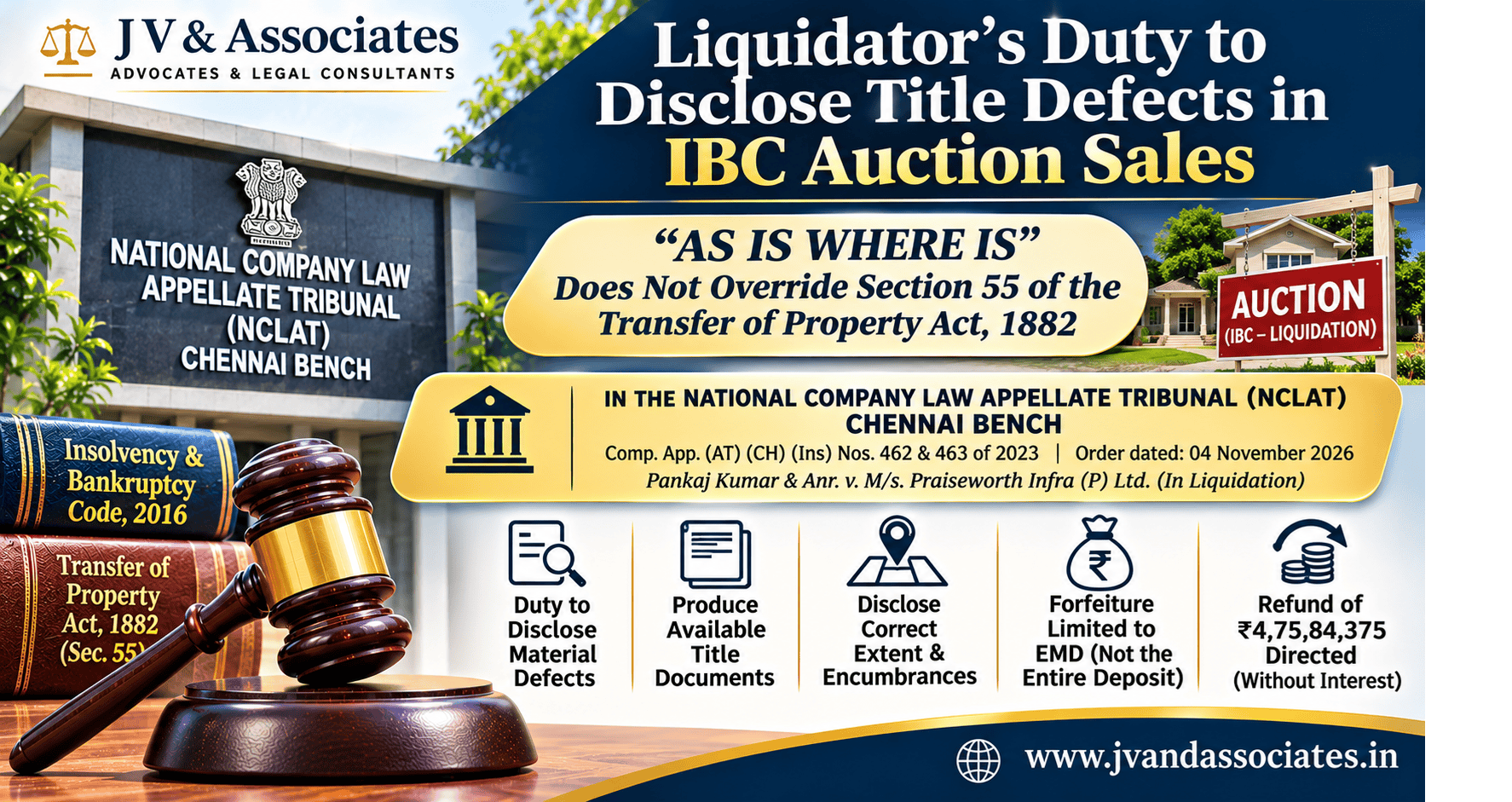
Does an “AS IS WHERE IS” condition absolve a Liquidator from the statutory obligations of a seller under Section 55 of the Transfer of Property Act, 1882, particularly the obligation to disclose material defects in the property and produce available title documents?
A related question is whether the Liquidator can forfeit the entire amount deposited by a successful auction purchaser when the purchaser fails to pay the balance sale consideration, especially when the Liquidator has failed to disclose material deficiencies concerning the title and extent of the property.
These questions were considered by the National Company Law Appellate Tribunal (NCLAT), Chennai Bench, in Pankaj Kumar & Anr. v. M/s. Praiseworth Infra (P) Ltd. (In Liquidation), Company Appeal (AT) (CH) (Ins) Nos. 462 and 463 of 2023, by judgment dated 4 November 2026.
The judgment is significant because the NCLAT held that the statutory obligations under Section 55 of the Transfer of Property Act cannot be avoided merely by incorporating disclaimer clauses in the auction documents.
The Tribunal also examined the distinction between forfeiture of Earnest Money Deposit (EMD) and forfeiture of additional amounts deposited by successful bidders.
Case Details
IN THE NATIONAL COMPANY LAW APPELLATE TRIBUNAL, AT CHENNAI
(APPELLATE JURISDICTION)
Company Appeal (AT) (CH) (Ins) No. 462 of 2023
Along with
Company Appeal (AT) (CH) (Ins) No. 463 of 2023
In the matter of:
Mr. Pankaj Kumar
Mrs. Chandra … Appellants
Versus
M/s. Praiseworth Infra (P) Ltd. (In Liquidation)
Represented through its Liquidator, Mr. C. Ramasubramaniam … Respondent
Impugned Orders: Orders dated 12 October 2023 passed by the NCLT, Chennai Bench, in IA(IBC)/267(CHE)/2021 and IA(IBC)/235(CHE)/2022 in CP/350/IB/2018.
Date of NCLAT Judgment: 4 November 2026
Coram:
Hon’ble Justice Sharad Kumar Sharma, Member (Judicial)
Hon’ble Shri Jatindranath Swain, Member (Technical)
Final Directions: The Liquidator was directed to refund ₹4,75,84,375 within six weeks, without interest, and discharge the Appellants from any other liability arising from their failure to comply with the terms of the Letter of Intent, including any restriction on participating in future tenders.
3. Background of the Case
M/s. Praiseworth Infra Private Limited was ordered to be liquidated by the NCLT, Chennai Bench, by order dated 19 February 2019.
Mr. C. Ramasubramaniam was appointed as the Liquidator of the Corporate Debtor.
On 21 February 2020, the Liquidator issued an advertisement in the newspapers, including Business Standard (English) and Maalai Malar (Tamil), inviting bids for the sale of two immovable properties belonging to the Corporate Debtor.
The properties offered for sale were:
- Vacant land measuring 34,564.30 sq. ft. in Survey No. 1206.
- Marriage hall together with land measuring 14,508 sq. ft. in Survey No. 1062.
Participation in the auction
The Appellants independently submitted their tender documents on 18 March 2020, along with the prescribed EMD.
The first Appellant, Mr. Pankaj Kumar, participated in the auction for the vacant land and deposited an EMD of ₹1,03,38,750.
The second Appellant, Mrs. Chandra, participated in the auction for the marriage hall and land and deposited an EMD of ₹42,45,000.
The e-auction was conducted on 20 March 2020.
Both Appellants were declared successful bidders by the Liquidator through an email dated 21 March 2020.
Subsequently, on 23 March 2020, the Appellants deposited additional amounts towards fulfilment of the requirement to pay 25% of the bid amount:
Appellant | EMD | Additional deposit |
Pankaj Kumar | ₹1,03,38,750 | ₹1,65,08,125 |
Chandra | ₹42,45,000 | ₹64,92,500 |
Total | ₹1,45,83,750 | ₹2,30,00,625 |
The aggregate amount deposited by the Appellants was ₹3,75,84,375.
The total amount ultimately sought to be refunded in the proceedings, as recorded in the NCLAT judgment, was ₹4,75,84,375.
4. Dispute Regarding Title and Documents of the Auctioned Properties
After being declared successful bidders, the Appellants obtained legal advice concerning the title and ownership of the auctioned properties.
Their Advocates informed them that the marketable title of the properties could not be satisfactorily established because certain important title documents were missing.
Consequently, on 11 April 2020, the Appellants requested the Liquidator to furnish the necessary documents.
On 12 June 2020, the Liquidator informed the Appellants that the auctioned properties were under attachment by the Debt Recovery Tribunal (DRT), and that efforts were being made to lift the attachment. The original title documents were stated to be in the custody of the DRT.
Meanwhile, the Liquidator demanded payment of the remaining 75% of the sale consideration.
The Appellants sought an extension of time, citing the COVID-19 pandemic and the difficulties in verifying the title documents.
Deficiencies identified in the title documents
The Appellants subsequently discovered several issues concerning the ownership and identification of the properties.
The principal deficiencies included:
A.Non-availability of parent title documents
The original Sale Certificate dated 31 August 1965, registered as Document No. 422 of 1965 at the Sub-Registrar’s Office, Sembium, was not available in its original form.
The document was reportedly available only in a mutilated condition in the records of the Sub-Registrar.
B.Discrepancies in revenue records
The Appellants discovered that the relevant land records did not clearly establish the ownership of the entire property in the name of the Corporate Debtor.
The Town Survey Land Register showed joint ownership of certain survey numbers by several individuals, including the Corporate Debtor.
C.Differences in the extent of land
There were discrepancies between:
- The extent of land mentioned in the title documents.
- The extent reflected in the revenue records and patta.
- The actual extent of land available at the site.
D. Alleged encroachment on government land
The Appellants also alleged that a portion of the marriage hall had been constructed on government land described as Vandi Pathai.
Importantly, the valuation reports obtained by the Liquidator himself had pointed out inconsistencies in the land measurements and possible encroachments.
The Appellants contended that these material facts should have been disclosed before the auction.
Forfeiture of the Amount Deposited by the Successful Bidders
Despite repeated requests for documents, the Liquidator insisted that the balance sale consideration be paid within the stipulated period.
The Appellants issued legal notices in January 2021, seeking either the necessary title documents or a refund of the amounts deposited, together with interest at 18% per annum.
The Liquidator, however, proceeded to forfeit the entire amount deposited by the Appellants through a letter dated 19 March 2021 on the ground that they had failed to pay the balance sale consideration.
Aggrieved by the forfeiture, the Appellants approached the NCLT, Chennai Bench.
Two separate applications were filed:
IA(IBC)/267(CHE)/2021: Seeking directions to the Liquidator to provide the necessary title documents or, alternatively, refund the amount deposited with interest at 18% per annum.
IA(IBC)/235(CHE)/2022: Challenging the forfeiture of the amount deposited by the Appellants and seeking a declaration that the forfeiture was illegal, non-est and invalid in law.
The NCLT dismissed both applications by orders dated 12 October 2023.
The Appellants thereafter approached the NCLAT through the present appeals.
6. Contentions of the Appellants – Section 55 of the Transfer of Property Act, 1882
The principal contention of the Appellants was that the Liquidator, while acting as the seller of immovable property, was bound by the statutory obligations imposed under Section 55 of the Transfer of Property Act, 1882.
They argued that the expression “AS IS WHERE IS” could not be interpreted as permitting the Liquidator to suppress material defects in the title or withhold relevant documents.
The Appellants relied upon Section 55 of the Transfer of Property Act and contended that the seller was legally obligated to:
- Disclose material defects in the property or title.
- Produce title documents in the seller’s possession or power upon request.
- Answer relevant questions concerning the property and its title.
- Execute a proper conveyance upon payment of the consideration.
- Take reasonable care of the property and title documents until delivery.
They further contended that the Liquidator had knowledge of the deficiencies in the title documents and discrepancies in the property measurements but failed to disclose these matters in the auction notice.
Judicial precedents relied upon
The Appellants relied upon several judicial decisions, including:
- Sridhar v. Authorized Officer, Indian Bank, AIR 2018 Mad 87.
- Sambandan v. Punjab National Bank.
- Karthikeyan v. Chairman, Indian Bank.
- Shariq v. Punjab National Bank, 2023 SCC OnLine SC 392.
- Haryana Financial Corporation v. Rajesh Gupta.
- M/s. Paramount Construction Company v. Authorized Officer & Chief Manager, Punjab National Bank.
The common principle relied upon was that an “AS IS WHERE IS” condition does not automatically absolve the seller from disclosing known material defects and encumbrances affecting the property.
The Appellants also argued that forfeiture of the entire amount was contrary to the terms of the auction and resulted in unjust enrichment.
7. Contentions of the Liquidator
The Liquidator opposed the appeals and argued that the Appellants had participated in the auction with full knowledge of the terms and conditions.
The auction notice expressly provided that the properties were being sold on an “AS IS WHERE IS” and “WHATEVER THERE IS” basis.
The prospective purchasers were required to verify the title and satisfy themselves regarding the properties before participating in the auction.
Failure to pay the balance consideration
The Liquidator contended that the Appellants had failed to pay the balance sale consideration within the stipulated period despite being granted several extensions.
According to the Liquidator, the Appellants raised objections concerning the title only after their requests for further extension were made.
He therefore contended that the title-related objections were merely an attempt to avoid their contractual obligations.
Forfeiture clause in the auction notice
The Liquidator relied upon the auction conditions, which provided that:
- 25% of the sale consideration was payable immediately upon confirmation.
- The balance consideration was payable within 90 days.
- Failure to make payment within the prescribed period would result in cancellation of the sale and forfeiture of the amount paid.
The Liquidator also relied upon the undertaking executed by the Appellants, which permitted forfeiture of the EMD if the successful bidders failed to complete the transaction within the prescribed period.
Judicial precedents relied upon by the Liquidator
The Liquidator relied upon the following decisions:
- Visisth Services Limited v. S.V. Ramani & Others, Company Appeal (AT) (Ins.) No. 896 of 2020.
- Meerut Development Authority v. Association of Management Studies, (2009) 6 SCC 171.
- Westcoast Infra Projects Pvt. Ltd. v. Ram Chandra Dallaram Choudhary, Company Appeal (AT) (Ins.) No. 1258 of 2022.
The Liquidator argued that a successful bidder could not withdraw from contractual obligations after accepting the terms of the auction and that the forfeiture was legally justified.
8. The Main Legal Issue Before the NCLAT
After examining the rival submissions, the NCLAT identified the principal issue as follows:
Whether Section 55 of the Transfer of Property Act, 1882, would apply to the auction sale of immovable property conducted by a Liquidator under the Insolvency and Bankruptcy Code, 2016?
This question was particularly important because the NCLT had held that Section 55 was not applicable to the auction in question, which had been conducted on an “AS IS WHERE IS” and “AS IS WHAT IS” basis.
The NCLAT disagreed with this approach.
9. Section 55 of the Transfer of Property Act, 1882 – Rights and Liabilities of Buyer and Seller
Section 55 of the Transfer of Property Act, 1882, deals with the rights and liabilities of buyers and sellers of immovable property.
The provision establishes certain obligations of the seller in the absence of a contract to the contrary.
Section 55(1) – Duties of the seller
Section 55(1) identifies several obligations of the seller.
The relevant clauses are particularly important in the context of liquidation auctions.
Section 55(1)(a): Disclosure of material defects
The seller is bound to disclose to the buyer any material defect in the property or in the seller’s title thereto, of which the seller is aware and the buyer is not, and which the buyer could not discover with ordinary care.
Section 55(1)(b): Production of title documents
The seller is bound to produce to the buyer, upon request, all documents of title relating to the property which are in the seller’s possession or power.
Section 55(1)(c): Answering relevant questions
The seller is required to answer, to the best of his information, all relevant questions put by the buyer concerning the property or its title.
Section 55(1)(d): Execution of conveyance
Upon payment or tender of the amount due in respect of the purchase price, the seller is bound to execute a proper conveyance of the property.
Section 55(1)(e): Preservation of property and documents
Between the date of the contract of sale and delivery of the property, the seller must take reasonable care of the property and the title documents in his possession.
Section 55(2): Implied contract regarding title
Section 55(2) provides that the seller is deemed to contract with the buyer that the interest which the seller professes to transfer subsists and that the seller has the power to transfer it.
Section 55(3): Delivery of title documents
Where the entire purchase money has been paid, the seller is also bound to deliver the title documents relating to the property which are in the seller’s possession or power, subject to the statutory exceptions.
Section 55(6)(b): Buyer’s charge for purchase money
Section 55(6)(b) provides that, unless the buyer has improperly declined to accept delivery, the buyer is entitled to a charge on the property, as against the seller and persons claiming under the seller, for the purchase money properly paid in anticipation of delivery and interest thereon.
These provisions are important in determining the respective responsibilities of the seller and purchaser in a transaction involving immovable property.
Application to liquidation auctions
The important question was whether these obligations could be excluded merely because the property was sold through an auction conducted under the IBC.
The NCLAT held that the statutory provisions could not be disregarded simply by incorporating general disclaimer clauses in the auction documents.
10. NCLAT’s Finding: “AS IS WHERE IS” Does Not Override Section 55
The NCLAT examined several decisions of the Supreme Court and High Courts dealing with auction sales conducted on an “AS IS WHERE IS” basis.
The Tribunal observed that the expression “AS IS WHERE IS” and “AS IS WHAT IS” was not sufficient, by itself, to absolve the seller from the obligation to disclose material information concerning the property.
The NCLAT particularly relied upon the principles laid down by the Madras High Court in V. Sridhar v. Authorized Officer, Indian Bank, AIR 2018 Mad 87.
In that case, the Court had considered the obligations of a secured creditor conducting an auction under the SARFAESI Act.
The Court held that the mere inclusion of an “AS IS WHERE IS” condition did not absolve the secured creditor from disclosing known encumbrances and relevant information concerning the property.
The NCLAT observed that although the cited decisions largely concerned SARFAESI auctions, the governing principles were relevant to auctions conducted under the IBC as well.
The Tribunal specifically observed that neither the IBC nor the Liquidation Regulations prescribe every term and condition to be included in an auction notice.
Consequently, the Liquidator cannot contend that Section 55 of the Transfer of Property Act is inapplicable merely because the auction was conducted under the IBC.
The NCLAT held that statutory provisions take precedence over the terms of bidding documents, particularly where the bidding documents are drafted in a manner that withholds vital information from prospective bidders.
This is one of the most important findings of the judgment.
11. Liquidator’s Duty to Examine and Disclose Title Deficiencies Before Auction
The NCLAT examined the specific deficiencies relating to the auctioned properties.
The Tribunal observed that the Liquidator had been dealing with the liquidation process for more than two years before conducting the auction.
Although the Liquidator did not possess certain parent title documents, the Tribunal held that he should have made efforts to obtain them before issuing the auction notice.
The Tribunal observed that the Liquidator could have:
- Taken steps to procure the missing mother and great-grandmother title documents.
- Obtained copies of documents deposited with the bank and held by the DRT.
- Examined the sufficiency of the title documents.
- Verified the discrepancies in the extent of the land.
- Examined the inconsistencies between the title documents, patta and actual site measurements.
- Disclosed the relevant deficiencies in the auction notice.
The Tribunal further observed that, if certain documents were unavailable, the Liquidator should have clearly disclosed their non-availability and explained whether such non-availability would materially affect the marketability of the title.
The NCLAT did not accept the Liquidator’s argument that he was not required to produce documents merely because the bidders had not requested them before participating in the auction.
The Tribunal held that the Liquidator had a professional responsibility to make available the complete and valid documents relating to the property being sold.
12. Suppression of Material Information and Information Asymmetry
One of the most significant aspects of the judgment is the NCLAT’s discussion on information asymmetry in public auctions.
The Tribunal observed that withholding material information while relying upon a general due-diligence clause creates an imbalance between the Liquidator and prospective bidders.
The Liquidator, having access to the property records, valuation reports and relevant information, occupies a position in which he is expected to disclose material facts affecting the auction.
The NCLAT observed that information asymmetry can result in:
- Unfair advantages to persons having access to undisclosed information.
- Reduced confidence among prospective bidders.
- Lower-value bids being placed for assets.
- Sub-optimal realisation of the value of assets.
- An unfair auction process.
The Tribunal held that withholding information available to the Liquidator cannot be justified merely by stating that the bidder was responsible for conducting independent due diligence.
The NCLAT relied upon the principles laid down by the Supreme Court in Association of Management Studies v. Meerut Development Authority.
The Tribunal observed that withholding material information could undermine the fairness of the tender process and could be sufficient to invalidate it.
This finding has wider implications for the conduct of liquidation auctions.
13. Failure to Disclose Variations in Land Extent and Encroachment
The NCLAT separately examined the discrepancies relating to the extent and boundaries of the auctioned properties.
The valuation reports obtained by the Liquidator himself had identified several inconsistencies, including:
- Differences between the land area mentioned in the title documents and the actual area available on the ground.
- Differences between the extent of land reflected in the patta and the title documents.
- Encroachments affecting portions of the land.
- Possible construction of part of the marriage hall on adjoining government land.
The Tribunal observed that these were not insignificant matters.
The disclosure of such information could have substantially affected the decision of prospective purchasers to participate in the auction and the price they were willing to offer.
The NCLAT held that the Liquidator should have verified these issues before putting the properties to auction and should have disclosed the relevant facts in the tender notice.
The Tribunal referred to the principles laid down in:
- Karthikeyan v. Chairman, Indian Bank.
- Leelamma Mathew v. Indian Overseas Bank.
- Haryana Financial Corporation v. Rajesh Gupta.
The NCLAT concluded that the failure to disclose material information concerning the properties was contrary to the obligations imposed under Section 55 of the Transfer of Property Act.
14. Can a Liquidator Forfeit the Entire Amount Deposited by a Successful Bidder?
Another important issue concerned the extent of forfeiture permissible under the terms of the auction.
The Liquidator had forfeited the entire amount deposited by the Appellants, including:
- The initial EMD.
- The additional amounts deposited after confirmation of the auction sale.
The NCLAT examined the wording of the auction advertisement and the undertaking executed by the successful bidders.
Difference between the auction advertisement and the undertaking
The newspaper advertisement provided that:
“The sale shall be cancelled if the payment is not received within 90 days and the amount paid will be forfeited.”
On the other hand, the undertaking submitted by the Appellants specifically provided that the EMD would be liable to forfeiture if the bidders failed to complete the transaction within the stipulated period.
The undertaking did not expressly provide for forfeiture of amounts deposited in addition to the EMD.
The NCLAT noticed this inconsistency.
Which document would govern the forfeiture?
The Tribunal held that the signed undertaking submitted by the Appellants represented the applicable tender conditions for the purpose of determining the extent of forfeiture.
The undertaking had been signed by the Appellants and accepted by the Liquidator along with the EMD.
The NCLAT therefore held that, even if the Liquidator was entitled to forfeit an amount on account of the bidders’ failure to complete the transaction, the forfeiture could extend only to the EMD and not to the additional amounts deposited after confirmation of the sale.
The forfeiture of amounts exceeding the EMD was therefore contrary to the terms of the undertaking itself.
This finding is particularly relevant because it demonstrates the importance of examining the exact wording of the auction documents before determining the extent of forfeiture.
15. Distinction Between Visisth Services and Westcoast Infra Projects
The Liquidator relied upon the decisions in Visisth Services Limited v. S.V. Ramani and Westcoast Infra Projects Pvt. Ltd. v. Ram Chandra Dallaram Choudhary.
The NCLAT, however, distinguished these decisions from the facts of the present case.
A. Visisth Services Limited v. S.V. Ramani
In Visisth Services, the bidder had submitted a conditional bid despite being informed that the terms of the information memorandum and auction could not be altered.
The NCLAT had held that the bidder could not subsequently avoid the contractual obligations arising from acceptance of the bid.
However, the Tribunal observed that the present case involved allegations of suppression of material information and non-compliance with Section 55 of the Transfer of Property Act.
The factual and legal issues were therefore different.
B. Westcoast Infra Projects Pvt. Ltd. v. Ram Chandra Dallaram Choudhary
In Westcoast Infra Projects, the bidder had raised objections concerning defects in the title and changes in revenue records.
The NCLAT had held that the alleged defects were curable and had been rectified by the time the appeal was considered.
However, in the present case, the allegations involved more substantial issues, including:
- Non-availability of important parent title documents.
- Failure to disclose material information.
- Discrepancies in the actual extent of the property.
- Possible encroachment on government land.
- Non-compliance with the statutory obligations under Section 55.
The NCLAT therefore held that the principles in Westcoast Infra Projects could not be mechanically applied to the present facts.
The distinction is important: a curable defect in revenue records is not necessarily equivalent to suppression of material information affecting the title and extent of the property.
16. Why Did the NCLAT Reject the NCLT’s Reasoning?
The NCLT had relied upon the auction conditions and the decision in Westcoast Infra Projects to conclude that the Liquidator was entitled to cancel the sale and forfeit the amounts deposited.
However, the NCLAT found that the NCLT had failed to adequately examine the applicability of Section 55 of the Transfer of Property Act to liquidation auctions under the IBC.
The NCLAT observed that the NCLT had not given sufficient reasons for excluding the statutory obligations under Section 55 merely because the property had been sold on an “AS IS WHERE IS” and “AS IS WHAT IS” basis.
The NCLAT held that even where the purchaser agrees to such conditions, the Liquidator cannot withhold material information or disregard the obligations imposed by law.
The Tribunal therefore concluded that the Liquidator’s action in forfeiting the entire amount and the NCLT’s orders confirming the forfeiture were legally unsustainable.
17. Final Decision of the NCLAT
After considering the facts, statutory provisions and judicial precedents, the NCLAT allowed both appeals.
The operative directions were as follows:
Setting aside of NCLT orders
The orders dated 12 October 2023 passed by the NCLT, Chennai Bench, in IA(IBC)/267(CHE)/2021 and IA(IBC)/235(CHE)/2022 were set aside.
Refund of the amount deposited
The Liquidator was directed to refund the entire amount of ₹4,75,84,375 forfeited by him to the Appellants within six weeks from the date of uploading of the NCLAT order.
Claim for interest rejected
The Appellants’ request for interest at 18% per annum was rejected.
The NCLAT observed that the Appellants also had certain shortcomings.
Ideally, they should have paid the entire sale consideration and thereafter sought specific performance from the Liquidator.
Instead, they had participated in the auction and accepted the tender conditions without conducting the due diligence expected of them before submitting their bids.
Consequently, the Tribunal declined to award interest on the refundable amount.
Discharge from further liability
The Liquidator was directed to discharge the Appellants from any other liability that might have accrued because of their failure to comply with the terms and conditions of the Letter of Intent.
This included their eligibility to participate in future tenders.
5,Appeals allowed
Both appeals were allowed in terms of the above directions, and all pending interlocutory applications, if any, were closed.
18. Important Legal Principles Emerging from the Judgment
The decision provides several important principles concerning liquidation auctions under the IBC.
Issue | Legal principle |
Applicability of Section 55 TPA | Section 55 cannot be excluded merely because the property is sold through a liquidation auction under the IBC. |
“AS IS WHERE IS” condition | Such a condition does not automatically absolve the Liquidator from disclosing known material defects. |
Disclosure of title defects | Material defects in the property and title must be disclosed to prospective purchasers. |
Production of title documents | Documents of title in the seller’s possession or power must be produced upon request. |
Missing parent documents | The Liquidator should make reasonable efforts to procure important title documents before conducting the auction. |
Valuation reports | Material deficiencies identified in valuation reports should not be withheld from bidders. |
Information asymmetry | Withholding material information can undermine the fairness and transparency of the auction process. |
EMD forfeiture | The extent of forfeiture must be determined by examining the actual binding tender conditions. |
Additional deposits | In this case, the signed undertaking permitted forfeiture of the EMD, not the additional amounts deposited after confirmation. |
Interest on refund | Refund of the forfeited amount does not automatically entitle the purchaser to interest. |
Liquidator’s responsibility | The Liquidator must conduct the auction with due diligence, transparency and fairness. |
19. Practical Implications for Liquidators
The judgment provides important guidance for Insolvency Professionals acting as Liquidators under the IBC.
1. Conduct proper title due diligence before auction
A Liquidator should examine the available title documents and identify any deficiencies before publishing the auction notice.
2. Obtain missing documents wherever reasonably possible
Where important parent documents are held by a secured creditor, bank or DRT, the Liquidator should make reasonable efforts to obtain copies before inviting bids.
3. Examine valuation reports carefully
Valuation reports may contain important observations regarding the extent, boundaries, encroachments and legal status of the property.
Such observations should be examined and material information should be disclosed to bidders.
4. Disclose material defects expressly
A general statement that the property is being sold on an “AS IS WHERE IS” basis may not be sufficient.
Known material defects and encumbrances should be specifically disclosed in the auction notice and related documents.
5. Avoid inconsistencies in auction conditions
The auction advertisement, tender documents, undertaking and Letter of Intent should contain consistent provisions concerning payment, cancellation and forfeiture.
6. Distinguish EMD from subsequent deposits
The Liquidator should clearly specify the amounts that may be forfeited in the event of a successful bidder’s default.
A general forfeiture clause should not be assumed to permit forfeiture of every amount deposited, irrespective of the actual contractual terms.
20. Practical Implications for Prospective Auction Purchasers
The judgment is equally relevant to persons intending to purchase assets through liquidation auctions.
1. Conduct independent due diligence
Prospective purchasers should examine title deeds, encumbrance certificates, revenue records, survey records, physical possession and pending litigation before submitting bids.
2. Examine the auction conditions carefully
The bidder should specifically examine the provisions relating to:
- Additional deposits.
- Payment of balance consideration.
- Time extensions.
- Cancellation of sale.
- Delivery of possession.
- Execution of sale certificates or conveyances.
3. Raise title objections immediately
Where any discrepancy is discovered, the purchaser should communicate the issue to the Liquidator in writing and preserve all correspondence.
4. Seek clarification before making further payments
Where material title documents are unavailable or the extent of the property is uncertain, the bidder should seek appropriate clarification before proceeding further.
5. Preserve evidence of undisclosed defects
Valuation reports, survey records, correspondence with the Liquidator, revenue authorities and registration authorities may become important evidence in subsequent proceedings.
6. Do not assume automatic refund
The present judgment is based on specific findings of non-disclosure, statutory non-compliance and inconsistency in the forfeiture conditions.
It should not be understood as establishing that every purchaser who fails to pay the balance consideration is automatically entitled to a refund.
21. Conclusion
The judgment of the National Company Law Appellate Tribunal, Chennai Bench, in Pankaj Kumar & Anr. v. M/s. Praiseworth Infra (P) Ltd. (In Liquidation), Company Appeal (AT) (CH) (Ins) Nos. 462 and 463 of 2023, dated 4 November 2026, is significant for its examination of the statutory responsibilities of a Liquidator when conducting the sale of immovable properties under the IBC.
The Tribunal made it clear that the expression “AS IS WHERE IS” or “AS IS WHAT IS” cannot be used as a blanket defence to avoid the statutory obligations arising under Section 55 of the Transfer of Property Act, 1882.
A Liquidator must take reasonable steps to examine the title documents, disclose material defects, provide available documents and ensure that prospective bidders receive sufficient information to make informed decisions.
The judgment also demonstrates that forfeiture of amounts deposited by successful bidders must be strictly examined in the light of the actual terms and conditions governing the auction. The Liquidator cannot automatically forfeit amounts beyond what is permitted under the binding undertaking.
At the same time, the Tribunal declined to award interest because the purchasers had also failed to exercise the degree of due diligence expected before participating in the auction.
The central principle emerging from the judgment is that a liquidation auction is not exempt from the ordinary legal obligations governing the sale of immovable property. A disclaimer clause cannot be treated as a licence to withhold material information or disregard statutory duties.
For Liquidators, the decision reinforces the need for transparency, adequate due diligence and proper disclosure before conducting an auction.
For prospective purchasers, it highlights the importance of independent title verification and careful examination of auction conditions before submitting bids.
********************************************************************
Case Reference: Pankaj Kumar & Anr. v. M/s. Praiseworth Infra (P) Ltd. (In Liquidation), Company Appeal (AT) (CH) (Ins) Nos. 462 and 463 of 2023, National Company Law Appellate Tribunal, Chennai Bench, judgment dated 4 November 2026.
Legal Disclaimer: This article is intended for general informational and educational purposes and does not constitute legal advice. The discussion is based on the facts and findings recorded in the NCLAT judgment. The applicability of the legal principles will depend upon the facts and circumstances of each case and subsequent judicial developments.