

Table of Contents
ToggleIntroduction
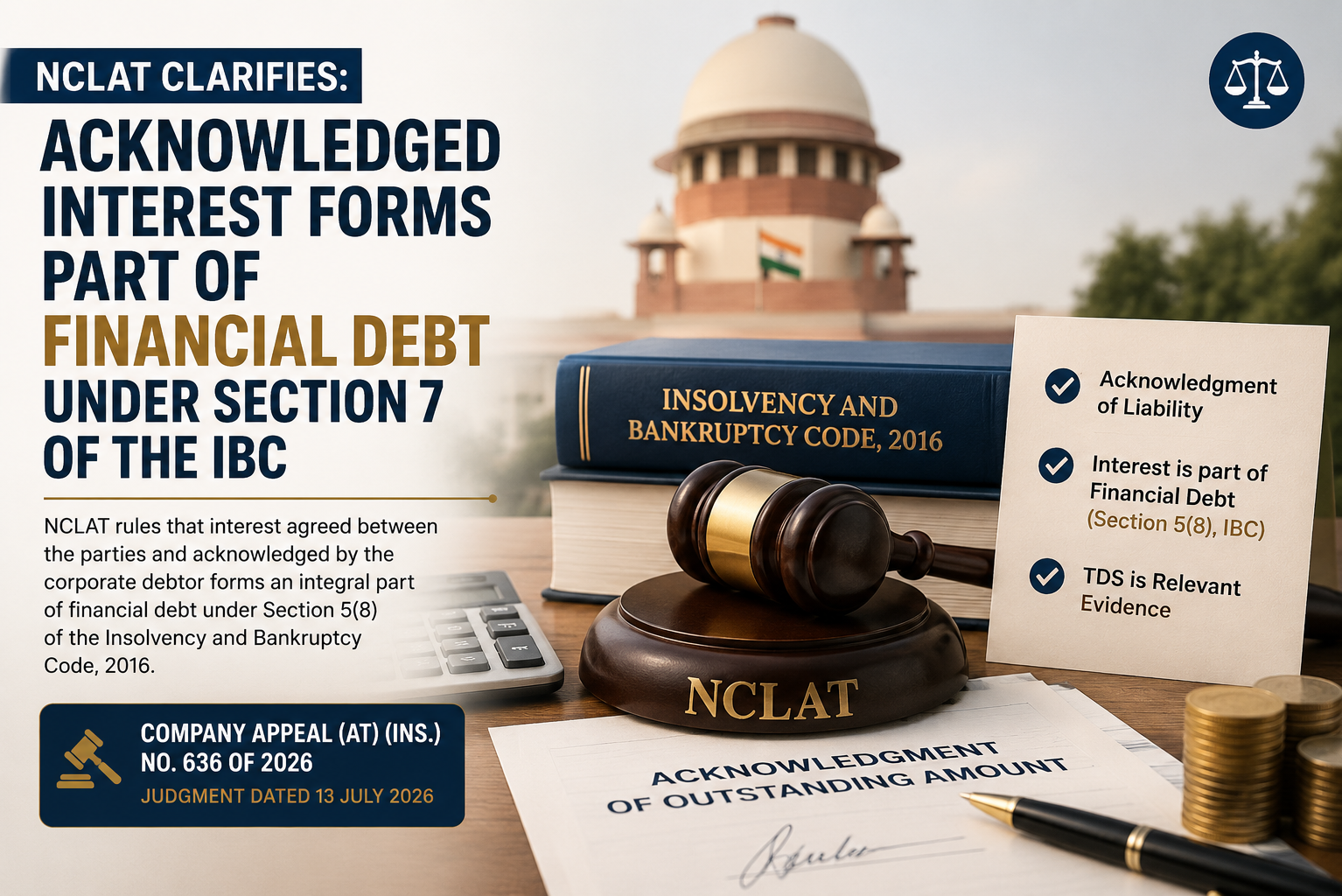
The National Company Law Appellate Tribunal (NCLAT), Principal Bench, New Delhi, has delivered an important judgment reiterating that interest agreed between the parties forms an integral part of a “financial debt” under the Insolvency and Bankruptcy Code, 2016 (IBC). The Tribunal further held that while Tax Deducted at Source (TDS) alone may not establish liability to pay interest, an acknowledgment by the Corporate Debtor of the entire outstanding amount, including interest, is sufficient to establish the existence of financial debt exceeding the statutory threshold prescribed under Section 4 of the IBC.
The decision provides significant guidance on how the Adjudicating Authority should assess financial debt at the admission stage of a Section 7 application.
Background
The Financial Creditor had advanced several Inter-Corporate Deposits (ICDs) to the Corporate Debtor over a period of years. According to the parties’ oral arrangement, the ICDs carried interest, initially at 11.50% per annum, later revised to 8% per annum.
Although substantial repayments of principal were made, the Corporate Debtor allegedly failed to pay the agreed interest. Consequently, the Financial Creditor claimed:
- Outstanding Principal: ₹62,00,000
- Accrued Interest: ₹45,08,010
- Total Financial Debt: ₹1,07,08,010
Why the NCLT Rejected the Section 7 Petition
The NCLT, Chandigarh Bench dismissed the Section 7 application on the ground that:
- the principal outstanding was only ₹62 lakhs; and
- the claimed interest could not be added merely because the Corporate Debtor had deducted TDS on the interest component.
Since the principal amount alone did not cross the statutory threshold under Section 4 of the IBC, the Adjudicating Authority held that no default meeting the threshold had been established.
NCLAT’s Analysis
The Appellate Tribunal found that the Adjudicating Authority had adopted an unduly narrow approach.
The Tribunal observed that the Financial Creditor’s case was not based solely on TDS deductions. Rather, the record disclosed several independent pieces of evidence establishing liability, including:
- admitted ICD transactions;
- the agreed payment of interest;
- the Corporate Debtor’s conduct in deducting and depositing TDS on interest; and
- more importantly, written acknowledgments by the Corporate Debtor admitting the entire outstanding amount and seeking time to make payment.
Acknowledgment of Liability Became the Decisive Evidence
A significant feature of the case was the correspondence exchanged between the parties.
The Financial Creditor issued a demand letter claiming ₹1,07,08,010, comprising both principal and interest.
Instead of disputing either the principal or the interest, the Corporate Debtor replied that it was arranging funds and requested two weeks’ additional time to pay the entire amount. Even thereafter, upon receiving a second demand notice, the Corporate Debtor again sought further time without disputing the liability.
According to the NCLAT, this correspondence clearly amounted to an acknowledgment of the entire outstanding debt, including the interest component.
Interest is Part of “Financial Debt”
The Tribunal relied upon the statutory definition contained in Section 5(8) of the IBC, which defines financial debt as:
“a debt along with interest, if any, which is disbursed against the consideration for the time value of money.”
The Tribunal observed that where interest forms part of the agreed commercial arrangement, it cannot be artificially separated from the principal while computing the amount of financial debt. The legislative intention is to include the complete financial obligation arising out of the transaction.
Oral Agreement Does Not Automatically Defeat Interest Claims
Another noteworthy aspect of the judgment is the Tribunal’s recognition that absence of a written agreement does not necessarily extinguish the creditor’s claim for interest.
Although there was no written contract recording the agreed rate of interest, the Tribunal held that surrounding circumstances may sufficiently establish the understanding between the parties.
Among the relevant circumstances were:
- deduction of TDS on interest;
- calculation of interest consistently maintained by the creditor;
- acknowledgments by the Corporate Debtor;
- previous repayment conduct; and
- absence of any contemporaneous denial of interest liability.
TDS Alone Is Not Enough—But It Is Relevant Evidence
The Tribunal carefully clarified that TDS deduction by itself does not create an obligation to pay interest.
However, TDS forms an important evidentiary circumstance when considered together with other materials demonstrating the parties’ contractual understanding.
In other words, TDS should not be viewed in isolation but as part of the cumulative evidence establishing financial debt.
Scope of Inquiry Under Section 7
The judgment also reiterates the limited scope of inquiry at the admission stage under Section 7.
The Adjudicating Authority is only required to determine:
- whether a financial debt exists;
- whether default has occurred; and
- whether the application is complete.
The proceeding is not intended to function as a recovery mechanism, but neither should the Tribunal disregard clear documentary acknowledgments of liability.
The Final Decision
Allowing the appeal, the NCLAT held that:
- the Financial Creditor had established the existence of financial debt exceeding the statutory threshold;
- the Adjudicating Authority erred in excluding the interest component;
- the impugned order deserved to be set aside.
Interestingly, instead of directing immediate admission of the insolvency application, the Appellate Tribunal granted the Corporate Debtor 15 days’ time to make full payment of the outstanding amount with interest, failing which the NCLT was directed to admit the Section 7 petition and initiate CIRP.
Practical Takeaways
This judgment reinforces several important principles for insolvency practitioners:
- Interest, where contractually agreed, forms part of financial debt under Section 5(8) of the IBC.
- Acknowledgment of the entire outstanding amount by the Corporate Debtor is powerful evidence of liability.
- TDS deduction is corroborative evidence and should be considered along with surrounding circumstances.
- Even in the absence of a written interest agreement, consistent conduct and acknowledgments may establish the obligation to pay interest.
- While Section 7 proceedings are not recovery proceedings, genuine acknowledgments of debt cannot be ignored while determining whether the statutory threshold has been crossed.
Conclusion
The NCLAT’s decision underscores that insolvency adjudication must be based on the overall commercial relationship between the parties rather than an isolated examination of individual documents. Where the Corporate Debtor has unequivocally acknowledged liability, including the interest component, the Adjudicating Authority should consider the entire financial debt while assessing the maintainability of a Section 7 application.
For financial creditors, this judgment serves as an important reminder that well-documented correspondence acknowledging outstanding dues can significantly strengthen insolvency proceedings, particularly where formal written loan agreements are absent but the parties’ conduct consistently reflects a commercial lending arrangement.