

Table of Contents
Toggle1.Introduction
Section 7 of the Insolvency and Bankruptcy Code, 2016 (IBC) provides a statutory mechanism through which a financial creditor can initiate Corporate Insolvency Resolution Process (CIRP) against a corporate debtor upon the occurrence of a default in repayment of financial debt.
However, the existence of a monetary transaction between two parties does not, by itself, establish the existence of a financial debt within the meaning of the Code. Equally, the production of a promissory note, memorandum of agreement or acknowledgement of liability does not automatically establish that the underlying transaction constitutes a legally enforceable financial debt owed by the corporate debtor.
The Adjudicating Authority is required to examine the substance of the transaction, the identity of the actual creditor, the source of funds, the authority of the person who purportedly acted on behalf of the corporate debtor, and the other statutory requirements for admission of a Section 7 application.
An important illustration of these principles is found in the following decision of the National Company Law Tribunal, Kochi Bench.
2. Case Details
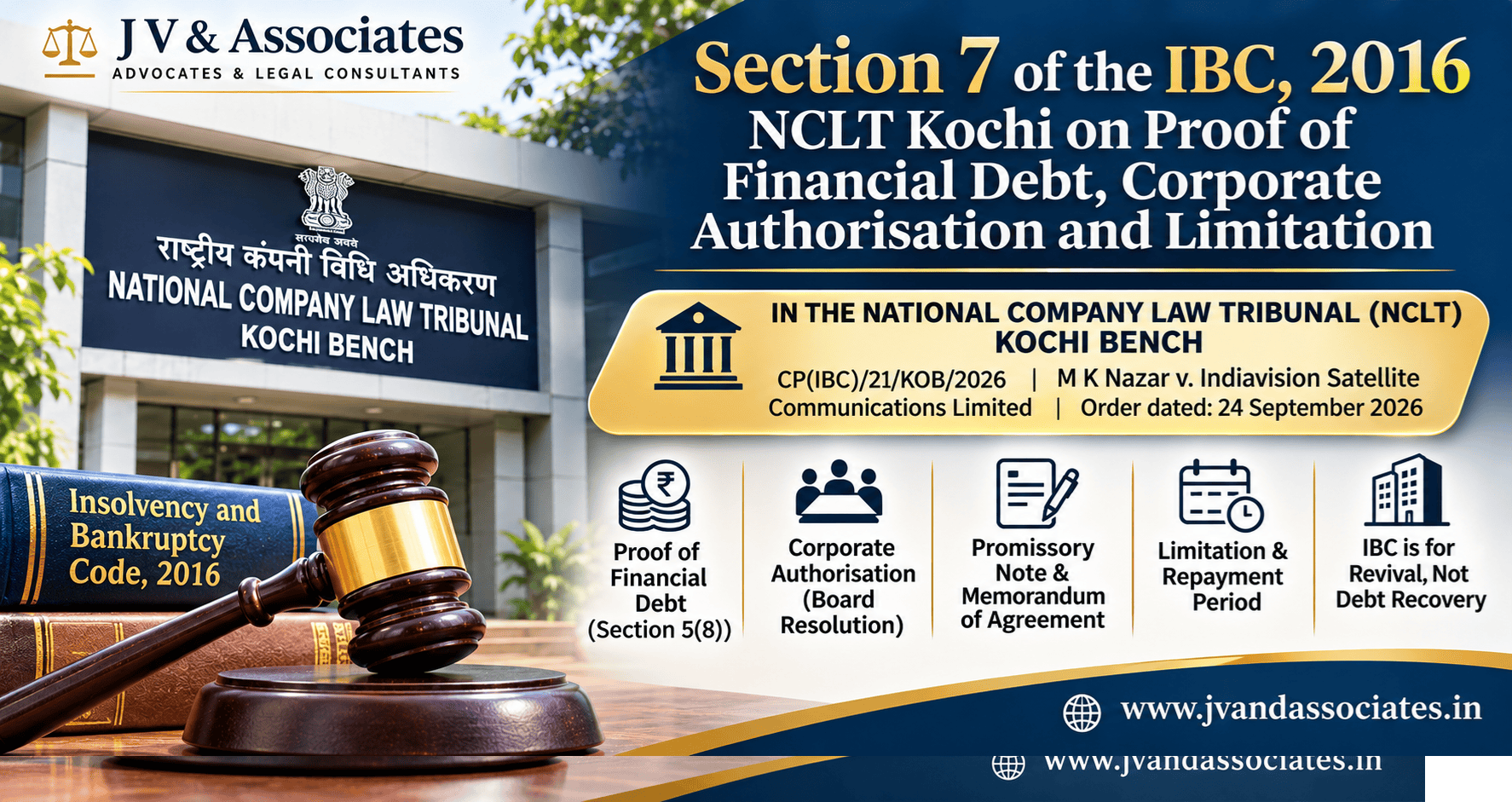
IN THE NATIONAL COMPANY LAW TRIBUNAL (NCLT) KOCHI BENCH
Company Petition No.: CP(IBC)/21/KOB/2026
Under Section 7 of the Insolvency and Bankruptcy Code, 2016
M K Nazar – Financial Creditor / Petitioner
Versus
Indiavision Satellite Communications Limited – Corporate Debtor / Respondent
Date of Institution: 10 August 2026
Date of Order: 24 September 2026
Coram:
- Shri Vinay Goel – Member (Judicial)
- Shri Ravichandran Ramasamy – Member (Technical)
Result: Section 7 petition rejected.
3.Facts of the Case
The Financial Creditor, Mr. M K Nazar, is an individual businessman engaged in automobile trading and the Managing Director of Lexus Auto Corporation.
The Corporate Debtor, Indiavision Satellite Communications Limited, was incorporated on 17 May 2000 under the Companies Act, 1956, and was engaged in the business of transport, storage and communications.
i.Financial accommodation of ₹1.50 crore
According to the petitioner, the Corporate Debtor was facing financial difficulties and had incurred substantial statutory liabilities towards the Service Tax Department.
Due to the attachment and freezing of its bank accounts, the Corporate Debtor allegedly approached the Financial Creditor seeking financial assistance of ₹1.50 crore for discharging its statutory liabilities.
At the request of the Corporate Debtor, the Financial Creditor allegedly remitted ₹1.50 crore directly to the Service Tax Department on behalf of the company.
The petitioner contended that this payment constituted a financial accommodation extended to the Corporate Debtor and was treated by the parties as a loan.
ii.Promissory Note
The petitioner relied upon a Demand Promissory Note dated 23 March 2015, which was stated to have been executed in connection with the amount advanced.
The Tribunal, while examining the document, observed that the Demand Promissory Note appeared to have been executed by Mr. Jamaludheen Farooquee in his individual capacity.
Although the seal and stamp of the company appeared on the document, the language used and the manner in which the borrower and lender were described indicated that the signatory had undertaken the obligation in his individual capacity.
The Tribunal also noticed that the promissory note contemplated repayment within 365 days and did not contain any stipulation regarding interest.
iii.Memorandum of Agreement
The petitioner further relied upon a Memorandum of Agreement allegedly executed between the Financial Creditor and the Corporate Debtor in December 2015.
Under the agreement, the Corporate Debtor purportedly acknowledged its liability to repay ₹1.50 crore together with additional compensation as may be agreed between the parties.
The agreement also provided for a repayment period of ten years and contained clauses relating to acknowledgement of debt, continuity of liability, extension of limitation and default.
The petitioner contended that the repayment period expired on 19 December 2025, resulting in default on that date.
iv.Amount claimed and default
The Financial Creditor claimed that, as on 20 July 2026, the total amount due was ₹1,88,40,329, comprising:
- Principal amount: ₹1,50,00,000
- Agreed compensation: ₹30,00,000
- Interest calculated at the agreed rate of 8% per annum.
The petitioner issued a legal notice dated 15 June 2026 demanding repayment. Since the Corporate Debtor allegedly failed to discharge the liability, the petitioner instituted the Section 7 application before the NCLT Kochi Bench seeking initiation of CIRP.
4.Proceedings before the NCLT – Corporate Debtor Proceeded Ex Parte
One of the interesting aspects of this case concerns the manner in which the proceedings progressed before the Tribunal.
The notice sent to the Corporate Debtor was returned unclaimed. The promoter/managing director had earlier entered appearance through an advocate but expressed his inability to appear on behalf of the company, primarily on the ground that there was no functioning Board and that the financial affairs of the company had not been properly maintained.
In view of the circumstances, the Tribunal directed publication of a public notice in two newspapers:
- Mangalam – Malayalam daily.
- Financial Express – English daily.
The publication was effected on 25 August 2026, calling upon the Corporate Debtor to appear on 7 September 2026.
However, nobody appeared on behalf of the Corporate Debtor. The Tribunal accordingly proceeded against the Corporate Debtor ex parte by order dated 10 September 2026.
-Does an ex parte proceeding mean automatic admission of a Section 7 petition?
The Tribunal made an important observation in this regard.
In paragraphs 23 and 24 of the order, the Tribunal held that the absence of the Corporate Debtor cannot, by itself, be treated as an admission of the Financial Creditor’s claim.
The Adjudicating Authority observed that its responsibility to scrutinise the documents and surrounding circumstances becomes more significant when the Corporate Debtor remains absent.
The Tribunal emphasised that the statutory requirements for admission of a Section 7 application must be independently examined even when the application is uncontested.
This is an important procedural principle. An ex parte proceeding does not dispense with the Financial Creditor’s obligation to establish the foundational requirements of Section 7.
5.Issues Examined by the Tribunal
The Tribunal undertook a detailed examination of the transaction and the documents produced by the Financial Creditor.
The principal questions that arose for consideration included:
- Whether the alleged payment of ₹1.50 crore to the Service Tax Department established a financial accommodation advanced by the petitioner to the Corporate Debtor.
- Whether the Demand Promissory Note established the liability of the Corporate Debtor.
- Whether the Memorandum of Agreement was a valid and enforceable corporate document.
- Whether the alleged compensation of ₹30 lakh was supported by sufficient evidence.
- Whether the petitioner had established the source of funds.
- Whether the repayment period had validly been extended to ten years.
- Whether the application was within limitation.
- Whether the statutory requirements under Sections 4, 5(8) and 7 of the IBC had been satisfied.
The Tribunal examined these aspects cumulatively rather than treating the production of individual documents as conclusive proof of financial debt.
6.Financial Debt under Section 5(8) – Whether the Alleged Transaction Qualified?
Section 5(8) of the Insolvency and Bankruptcy Code, 2016, defines “financial debt” as a debt along with interest, if any, which is disbursed against the consideration for the time value of money and includes the categories of transactions specified in the provision.
The existence of a financial debt is the foundation of an application under Section 7.
In the present case, the petitioner contended that the payment of ₹1.50 crore directly to the Service Tax Department constituted financial accommodation extended to the Corporate Debtor.
The Tribunal, however, found that the material placed before it did not satisfactorily establish the alleged financial accommodation.
Direct payment to a third party does not automatically establish financial debt
The petitioner relied upon the fact that the amount had been remitted directly to the Service Tax Department towards the statutory liabilities of the Corporate Debtor.
The Tribunal examined whether the payment had actually been made by the petitioner from his own funds and whether it was made pursuant to a financial accommodation sought or authorised by the Corporate Debtor.
The Tribunal noticed the following deficiencies:
- There was no formal written request from the Corporate Debtor seeking the alleged financial accommodation.
- There was no Board Resolution authorising or approving the payment of statutory dues by the petitioner.
- The petitioner’s bank statements for the relevant dates were not produced.
- The source and movement of the amount allegedly advanced had not been satisfactorily established.
The Tribunal held that the mere fact that the payment was made to the Tax Department could not, by itself, establish that the entire amount constituted financial accommodation independently advanced by the petitioner to the Corporate Debtor.
This observation highlights the importance of proving not merely the payment, but also the legal and factual connection between the payment and the alleged financial debt.
7.Corporate Authorisation – Importance of Board Resolution
One of the most significant aspects of this judgment is the Tribunal’s examination of corporate authorisation.
The alleged financial accommodation involved ₹1.50 crore and was purportedly undertaken on behalf of a company.
The Tribunal observed that there was no satisfactory evidence of a Board Resolution authorising the borrowing or accepting the terms contained in the Demand Promissory Note or the subsequent Memorandum of Agreement.
The Tribunal also noticed that the agreement purported to extend the repayment arrangement for ten years, thereby materially affecting the company’s repayment obligations.
In such circumstances, the absence of a reference to a Board Resolution, its number or date, or other satisfactory evidence of authority assumed considerable significance.
-Why is corporate authorisation important?
A company is a separate legal entity and acts through persons authorised to represent it.
The fact that a person is a director, promoter or managing director does not necessarily establish that every financial arrangement entered into by that person is a valid and binding corporate transaction.
Where a financial creditor seeks to establish a financial debt on the basis of an agreement executed on behalf of a company, the authority of the person executing the document may become a material question.
The Tribunal’s examination demonstrates that a creditor should establish:
- The identity and capacity of the person who requested the financial accommodation;
- The authority of such person to act on behalf of the company;
- The relevant Board Resolution or other appropriate corporate authorisation, where required;
- The company’s acceptance of the financial arrangement; and
- The reflection and treatment of the liability in the company’s books of account.
The absence of corporate authorisation was one of the material circumstances considered by the Tribunal while rejecting the petition.
8.Evidentiary Value of Promissory Note and Memorandum of Agreement
The petitioner relied upon two important documents:
- Demand Promissory Note.
- Memorandum of Agreement.
However, the Tribunal did not treat these documents as conclusive proof of the financial debt.
A.Demand Promissory Note
The Tribunal observed that the Demand Promissory Note appeared to have been executed by Mr. Jamaludheen Farooquee in his individual capacity.
The wording of the document described the borrower and lender in their individual capacities.
Although the company’s seal and stamp appeared on the document, the Tribunal found that the language and manner of execution indicated that the undertaking was given by the individual signatory.
Consequently, the document did not, by itself, establish the alleged corporate liability in the manner claimed by the petitioner.
B.Memorandum of Agreement
The Tribunal examined the Memorandum of Agreement in detail and identified several circumstances which affected its evidentiary value.
First: Absence of corporate authorisation
There was no satisfactory material establishing that the Board of Directors had authorised the signatory to enter into the agreement on behalf of the company.
Second: Stamp paper purchased in the name of a third person
The stamp paper on which the Memorandum of Agreement was executed had been purchased in the name of Mr. Jamaludheen Farooquee, who was not shown as a party to the agreement in his individual capacity.
Third: Absence of a definite compensation mechanism
The agreement referred to additional compensation as might be agreed between the parties. However, neither the nature nor the quantum, percentage, mode of payment or basis of calculation of such compensation had been specified.
Fourth: Unusual extension of repayment period
The Demand Promissory Note contemplated repayment within 365 days, whereas the subsequent Memorandum of Agreement purported to extend the repayment period to ten years.
The Tribunal found that there was no satisfactory explanation for such an extraordinary extension.
Fifth: Doubt regarding the circumstances of execution
The Tribunal also noticed the difference in the stamps appearing on the Demand Promissory Note and the Memorandum of Agreement and the circumstances surrounding the execution of the latter document.
The cumulative effect of these circumstances created serious doubts regarding the evidentiary value of the alleged Memorandum of Agreement.
Can an agreement acknowledging an earlier transaction automatically establish a financial debt?
The Tribunal observed that the Memorandum of Agreement could, at the most, be examined for the limited collateral purpose of determining whether an earlier transaction existed and whether there was an acknowledgement of such transaction.
However, in the circumstances of the case, the document could not automatically be treated as establishing a fresh or independently enforceable financial debt incorporating all the terms and conditions contained therein.
This distinction is important when a subsequent agreement is relied upon to establish or modify the liability arising from an earlier transaction.
9.Source of Funds and Discrepancies in Financial Statements
Another important aspect of the judgment concerns the source of the alleged financial accommodation.
The petitioner claimed that he had independently advanced ₹1.50 crore to the Corporate Debtor.
However, the Tribunal examined the financial statements of the Corporate Debtor for the financial years 2013-14, 2014-15 and 2015-16 and noticed a discrepancy concerning the identity of the creditor.
In the financial statements for FY 2014-15, an amount of ₹1 crore was reflected against the name of P. A. Hamza.
In the financial statements for FY 2015-16, the same amount appeared to have been reflected against the name of the present petitioner, with reference to P. A. Hamza.
The petitioner failed to place satisfactory supporting material explaining how and why the amount originally appearing in the name of P. A. Hamza was subsequently reflected in his name.
More importantly, the petitioner did not produce his bank statements for the relevant dates to establish the source and movement of the funds allegedly advanced.
Why were the bank statements important?
The Tribunal observed that the source of the alleged financial accommodation remained unestablished.
The bank statements were particularly relevant because the financial statements initially attributed the amount of ₹1 crore to another person.
Without contemporaneous banking records, the Tribunal found it difficult to determine whether the payment to the Tax Department had actually originated from the petitioner or from P. A. Hamza.
The Tribunal therefore held that the mere reflection of an amount in financial statements, without satisfactory supporting evidence explaining the transaction and the identity of the actual creditor, was insufficient in the circumstances of the case.
This finding has considerable practical significance for financial creditors who rely upon direct payments to third parties as the basis of their Section 7 applications.
A creditor should be in a position to establish the actual source of the funds, the movement of money and the legal character of the transaction.
10. Statutory Threshold under Section 4 of the IBC
Section 4 of the Insolvency and Bankruptcy Code, 2016, prescribes the minimum amount of default required for the application of the insolvency provisions.
The statutory minimum default was enhanced from ₹1 lakh to ₹1 crore by Notification No. S.O. 1205(E) dated 24 March 2020.
In the present case, the petitioner claimed an amount of ₹1,88,40,329, which was above the prescribed threshold.
However, the Tribunal noticed that if the amount of ₹1 crore originally reflected against the name of P. A. Hamza was excluded from the alleged liability of the petitioner, the amount attributable to the petitioner could fall below the statutory threshold.
The Tribunal clarified that it was not making a final determination merely on the basis of that financial statement entry.
Nevertheless, the petitioner was required to satisfactorily explain the discrepancy because the threshold requirement under Section 4 is a condition precedent for invoking the jurisdiction under Section 7.
The decision demonstrates that the statutory threshold must be established with reference to the debt actually attributable to the applicant financial creditor and not merely the total amount appearing in a disputed claim.
11.Limitation – Whether the Ten-Year Repayment Period Was Validly Established?
The question of limitation was another important issue considered by the Tribunal.
The original payments were allegedly made in March 2015.
The Demand Promissory Note contemplated repayment within 365 days.
However, the subsequent Memorandum of Agreement purported to extend the repayment period to ten years, with the petitioner claiming that the default occurred on 19 December 2025.
The Tribunal examined whether the subsequent agreement could legally extend the repayment period in the manner claimed.
Section 18 of the Limitation Act, 1963
Section 18 of the Limitation Act, 1963, deals with the effect of acknowledgement of liability in writing and signed by the party against whom the right is claimed, before the expiration of the prescribed period of limitation.
Where the statutory requirements are satisfied, a fresh period of limitation is computed from the time when the acknowledgement was signed.
In the present case, the Tribunal observed that if the Memorandum of Agreement was considered only as an acknowledgement of the earlier transaction, its effect would have to be examined in the light of Section 18 of the Limitation Act.
The mere recital in the agreement that the parties intended to extend limitation could not, by itself, override the statutory requirements governing limitation.
The Tribunal further observed that in the absence of a valid and enforceable corporate agreement extending the repayment period, the subsequent document could not mechanically be treated as postponing the accrual of liability for all purposes.
Consequently, the petitioner could not rely upon the nomenclature of the subsequent agreement alone to create a fresh date of default in December 2025.
This is a significant aspect of the judgment because it highlights the distinction between:
- An agreement validly modifying the repayment obligations of a company;
- A written acknowledgement of an existing liability under Section 18 of the Limitation Act; and
- A document which merely records an earlier transaction without satisfying the legal requirements necessary to alter the original repayment arrangement.
12.Whether a Dormant or Non-Functioning Company Can Be Admitted into CIRP?
The Tribunal also examined the corporate status and statutory compliance history of the Corporate Debtor.
The Tribunal had called for a report from the Registrar of Companies.
According to the report, the Corporate Debtor had filed its financial statements only up to the year 2014, although its status continued to be shown as “Active”.
The Tribunal observed that the company had not regularly filed its balance sheets and financial statements for several years and appeared to have remained dormant or non-functioning for a considerable period.
Object of CIRP – Revival of a Going Concern
The Tribunal observed that the object of the resolution process is to revive a going concern.
It referred to the decision of the Hon’ble NCLAT in:
FedEx Express Transportation and Supply Chain Services (India) Pvt. Ltd. v. Zipker Online Services Pvt. Ltd., [2024] ibclaw.in 326 NCLAT.
The NCLAT reiterated that the Insolvency and Bankruptcy Code is not a debt recovery mechanism but a mechanism intended to revive a company which has fallen into debt.
The judgment emphasised the primary objective of protecting the Corporate Debtor as a going concern, maximising the value of its assets and balancing the interests of stakeholders.
The NCLT Kochi Bench also referred to the decision of the Hon’ble Supreme Court in:
Anjani Technoplast Ltd. v. Shubh Gautam, [2026] ibclaw.in 209 SC.
As noted in the NCLT order, the Supreme Court reiterated that the IBC is not a debt recovery legislation and that its primary object is the revival and continuation of the Corporate Debtor as a going concern.
Is dormancy by itself a ground for rejecting a Section 7 application?
The Tribunal specifically clarified that the mere fact that a Corporate Debtor is dormant or non-functioning cannot, by itself, constitute an independent ground for refusing to initiate CIRP where the statutory requirements under Section 7 are otherwise clearly established.
However, in the present case, the dormant status of the company was considered together with several other circumstances, including:
- Doubts concerning the source of the alleged financial accommodation;
- Absence of satisfactory corporate authorisation;
- Inconsistencies in the financial statements;
- Unexplained compensation;
- Unusual extension of the repayment period; and
- Uncertainty regarding the underlying financial liability.
Thus, the Tribunal did not treat the dormant status as an independent ground for rejection but considered it as part of the cumulative circumstances surrounding the application.
13.Cumulative Effect of the Deficiencies – Why the Section 7 Petition Was Rejected
After examining the documents and surrounding circumstances, the Tribunal identified the following material deficiencies:
Sl. No. | Issue | Tribunal’s observation |
1 | Source of funds | The petitioner failed to establish the source and movement of the alleged ₹1.50 crore. |
2 | Financial statements | The ₹1 crore liability was initially reflected against P. A. Hamza and subsequently against the petitioner, without satisfactory explanation. |
3 | Corporate authorisation | No satisfactory evidence of Board Resolution or corporate authorisation was produced. |
4 | Memorandum of Agreement | The circumstances surrounding its execution remained unexplained. |
5 | Stamp paper | The stamp paper was purchased in the name of a person who was not a party to the agreement in his individual capacity. |
6 | Compensation | The alleged compensation of ₹30 lakh was not supported by evidence establishing its basis or manner of calculation. |
7 | Repayment period | The extension from 365 days to ten years was not satisfactorily established. |
8 | Limitation | The alleged default date of 19 December 2025 was not satisfactorily established. |
9 | Statutory threshold | The amount attributable to the petitioner could fall below the Section 4 threshold if the disputed ₹1 crore was not established. |
10 | Corporate status | The company had not regularly filed financial statements for several years and appeared dormant or non-functioning. |
11 | Financial debt | The material did not satisfactorily establish that the amount constituted financial debt under Section 5(8). |
The Tribunal observed that individual circumstances might not, when considered separately, be sufficient to prevent the initiation of CIRP.
However, their cumulative effect created substantial doubts regarding the foundational requirements of the alleged financial debt.
The Tribunal held that insolvency proceedings could not be initiated merely to satisfy a recovery claim when the existence of a genuine and legally enforceable financial debt had not been satisfactorily established.
14. Final Order of the NCLT Kochi Bench
In view of the foregoing findings, the Tribunal concluded that the petitioner had failed to establish the foundational requirements for admission of the application under Section 7 of the Insolvency and Bankruptcy Code, 2016.
The Tribunal rejected the petition and dismissed CP(IBC)/21/KOB/2026.
The Tribunal also observed that the petitioner might have other remedies available under law, if otherwise maintainable, for establishing and recovering any legally enforceable amount.
However, the extraordinary remedy under Section 7 could not be used as a substitute for ordinary debt recovery proceedings when the statutory foundation for commencement of CIRP had not been satisfactorily established.
15.Practical Lessons for Financial Creditors and Corporate Debtors
The judgment provides several important practical lessons for parties involved in financial transactions and insolvency proceedings.
-For Financial Creditors
1.Establish the source of funds
A financial creditor should maintain contemporaneous bank statements and supporting documents demonstrating the actual source and movement of funds.
Where money is paid directly to a third party on behalf of the corporate debtor, the creditor should establish the request, authorisation and legal character of such payment.
2.Obtain proper corporate authorisation
Financial accommodation extended to a company should be supported by appropriate corporate approvals and authorisations.
A creditor should verify the authority of the person executing loan documents or acknowledging liability on behalf of the company.
3.Maintain consistency in financial records
The creditor should ensure that the liability is correctly reflected in the books of account of the corporate debtor and that any subsequent change in the identity of the creditor is properly documented.
4.Draft clear repayment agreements
The repayment period, interest, compensation and consequences of default should be clearly specified.
Vague expressions such as additional compensation to be agreed between the parties may create unnecessary disputes.
5.Do not rely solely on acknowledgements
A promissory note or memorandum of agreement should not be treated as a substitute for establishing the underlying transaction.
The creditor should preserve the original transaction documents, payment evidence, corporate approvals and supporting financial records.
–For Corporate Debtors
1. Examine the identity of the actual creditor
Where a financial creditor claims an amount based on historical transactions, the corporate debtor should examine whether the amount was actually advanced by that creditor.
2. Examine corporate authorisation
The validity of agreements executed by directors, promoters or other representatives should be examined with reference to their authority to bind the company.
3.Verify the financial statements
Discrepancies between successive financial statements, changes in creditor identities and unexplained liabilities may become material in insolvency proceedings.
4.Raise limitation objections
The validity of any subsequent acknowledgement or repayment arrangement should be examined with reference to the Limitation Act, 1963.
5. Do not ignore NCLT proceedings
Even where the company is non-functional or its management is not actively operating, appropriate representation before the Tribunal is important.
The present judgment also demonstrates that the absence of the Corporate Debtor does not automatically result in admission of the petition.
Nevertheless, relying on the Tribunal to identify deficiencies in the creditor’s case is not a substitute for filing a proper defence.
16.Conclusion
The decision of the National Company Law Tribunal, Kochi Bench, in M K Nazar v. Indiavision Satellite Communications Limited, CP(IBC)/21/KOB/2026, dated 24 September 2026, highlights an important principle governing applications under Section 7 of the Insolvency and Bankruptcy Code, 2016.
The mere existence of a monetary transaction, a promissory note, an acknowledgement of liability or a subsequent memorandum of agreement does not automatically establish a financial debt within the meaning of Section 5(8) of the Code.
The Financial Creditor must establish the foundational requirements of the alleged financial debt and default through reliable and legally sustainable evidence.
The judgment is particularly significant for its examination of the source of funds, corporate authorisation, discrepancies in financial statements, validity of subsequent repayment arrangements and limitation.
It also reiterates that the absence of the Corporate Debtor in proceedings does not relieve the Adjudicating Authority of its obligation to independently examine the statutory requirements for admission of a Section 7 application.
Most importantly, the decision reinforces the fundamental distinction between insolvency proceedings and ordinary debt recovery proceedings.
The Insolvency and Bankruptcy Code is intended to facilitate the resolution and revival of financially distressed corporate entities, and not merely to provide an alternative mechanism for recovering disputed monetary claims.
For financial creditors, the judgment underscores the importance of proper documentation and establishing the genuineness of the underlying transaction. For corporate debtors, it demonstrates the importance of examining the legal enforceability of the alleged financial debt and the evidentiary foundation of a Section 7 application.
**********************************************************************
Case Reference: M K Nazar v. Indiavision Satellite Communications Limited, CP(IBC)/21/KOB/2026, National Company Law Tribunal, Kochi Bench, order dated 24 September 2026.
Legal Disclaimer: This article is intended for general informational and educational purposes and does not constitute legal advice. The observations discussed above are based on the facts and findings in the particular case. The applicability of the legal principles will depend upon the facts and circumstances of each case.