

Table of Contents
ToggleIntroduction
Businesses frequently encounter financial, commercial and managerial difficulties. An LLP may be unable to pay its debts on time, disputes may arise among partners, or the business may require restructuring to survive changing market conditions. In many such situations, winding up is neither desirable nor necessary. A negotiated settlement between the LLP, its creditors and its partners may provide a more practical and commercially viable solution.
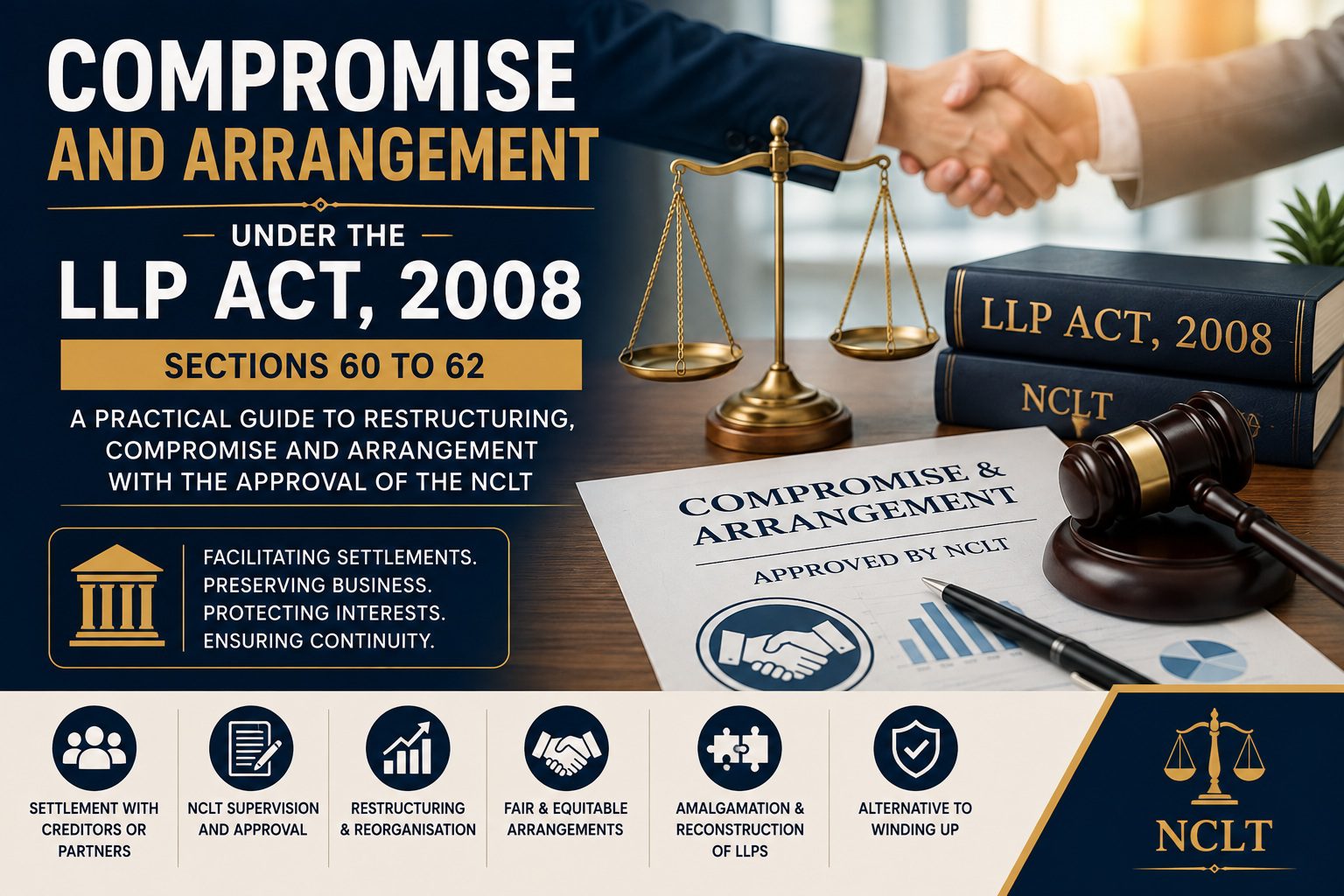
Recognising this reality, the Limited Liability Partnership Act, 2008 incorporates provisions enabling an LLP to enter into a compromise or arrangement with its creditors or partners. These provisions are contained in Sections 60 to 62 of the Act and confer important supervisory powers upon the National Company Law Tribunal (“NCLT”).
The object of these provisions is to facilitate the continuation of viable LLPs by permitting restructuring under judicial supervision rather than compelling dissolution.
This article examines the statutory scheme relating to compromises and arrangements, the jurisdiction of the NCLT, the rights of creditors and partners, the procedure prescribed by law, and the practical situations in which these provisions may be invoked.
What is a Compromise or Arrangement?
Although the LLP Act uses the expressions “compromise” and “arrangement,” it does not define either term.
In legal parlance, a compromise generally means a settlement of existing disputes through mutual concessions by the parties.
An arrangement is a wider concept. It includes any reorganisation of the rights and obligations of partners or creditors, including restructuring of debts, alteration of business arrangements, settlement of claims or other commercial reorganisations approved by the Tribunal.
The expression “arrangement” has consistently received a broad interpretation under company law, and the same principles are likely to guide its interpretation under the LLP Act.
Legislative Purpose
The provisions relating to compromise and arrangement are intended to preserve economically viable LLPs.
Instead of forcing every financially distressed LLP into winding up, the Legislature permits the parties to restructure their commercial relationship under the supervision of the Tribunal.
This benefits:
- the LLP;
- the partners;
- the creditors;
- employees; and
- the economy as a whole.
The underlying philosophy is that a commercially viable business should be given an opportunity to survive wherever possible.
Section 60 – Power of the Tribunal
Section 60 is the principal provision governing compromises and arrangements.
Where a compromise or arrangement is proposed between:
- an LLP and its creditors; or
- an LLP and its partners,
an application may be made to the National Company Law Tribunal.
Upon receiving the application, the Tribunal may direct meetings of creditors or partners, as the case may be, to consider the proposed scheme.
Thus, the Tribunal does not itself prepare the scheme. Its role is to supervise the statutory process and ensure that the proposal is fair, transparent and in accordance with law.
Who can Apply?
An application under Section 60 may generally be made by:
- the LLP;
- any partner;
- the liquidator, where the LLP is under liquidation.
The application should contain complete particulars of the proposed compromise or arrangement together with supporting documents explaining the necessity for the scheme.
Role of the National Company Law Tribunal
The Tribunal occupies a central position throughout the process.
Its functions include:
- directing meetings of creditors or partners;
- prescribing the manner in which such meetings are to be conducted;
- considering whether statutory requirements have been complied with;
- examining whether the scheme is fair and reasonable;
- sanctioning or refusing the scheme.
The Tribunal does not substitute its commercial wisdom for that of the parties. However, it must ensure that the proposed compromise is lawful, bona fide and not prejudicial to creditors, partners or public interest.
Approval of the Scheme
A compromise or arrangement becomes binding only after satisfying the statutory voting requirements and receiving the approval of the Tribunal.
The Tribunal must be satisfied that:
- the meetings were properly convened;
- adequate notice was given;
- the statutory majority approved the proposal;
- the scheme is fair and reasonable;
- the arrangement does not violate any provision of law.
Once sanctioned, the compromise becomes binding on all persons covered by the scheme.
Section 61 – Power of the Tribunal to Supervise the Arrangement
The Tribunal’s role does not necessarily end with approval of the compromise.
Section 61 empowers the Tribunal to supervise the implementation of the arrangement.
This is an important safeguard.
If difficulties arise during implementation, the Tribunal may issue appropriate directions to ensure that the scheme is effectively carried out.
Where implementation becomes impossible or impracticable, the Tribunal may pass further orders in accordance with law.
Thus, the Tribunal’s jurisdiction extends beyond mere approval of the scheme.
Section 62 – Reconstruction and Amalgamation of LLPs
Section 62 deals with reconstruction and amalgamation.
Business realities sometimes require two LLPs to merge, or an existing LLP to be reorganised through reconstruction.
The Tribunal may sanction such schemes after examining their legality and fairness.
The provision enables:
- amalgamation of LLPs;
- transfer of assets;
- transfer of liabilities;
- continuation of legal proceedings;
- dissolution of the transferor LLP without winding up, where appropriate.
These powers facilitate corporate restructuring while protecting the interests of creditors and partners.
Practical Situations Where Sections 60 to 62 Become Useful
The provisions relating to compromise and arrangement assume importance in several practical situations.
Financial Restructuring
An LLP experiencing temporary financial stress may negotiate revised repayment terms with its creditors instead of facing litigation.
Settlement of Partner Disputes
Partners engaged in prolonged disputes may agree to restructure their rights and obligations through a Tribunal-approved arrangement rather than dissolving the LLP.
Business Reorganisation
An LLP may reorganise its business operations by transferring specific undertakings or restructuring ownership.
Merger of LLPs
Two LLPs carrying on similar businesses may amalgamate into a single entity to improve operational efficiency.
Avoiding Winding Up
Where the LLP remains commercially viable, a compromise may enable the business to continue instead of entering into winding-up proceedings.
Compromise versus Winding Up
One of the most important strategic decisions is whether to pursue a compromise or seek winding up.
Generally,compromise is appropriate where:
- the business remains viable;
- creditors are willing to negotiate;
- partners desire continuation of the business;
- restructuring is commercially feasible.
Winding up may become appropriate where:
- business has completely failed;
- mutual confidence among partners has irretrievably broken down;
- fraud renders continuation impossible;
- no workable compromise can be achieved.
Compromise versus Investigation
The LLP Act provides different remedies for different situations.
Nature of Problem | Appropriate Remedy |
Fraud, oppression or unlawful conduct | Investigation under Sections 43 and 44 |
Financial restructuring | Compromise under Section 60 |
Merger or business reorganisation | Section 62 |
Complete deadlock | Winding up under Section 64 |
Contractual disputes | Civil proceedings or arbitration |
Choosing the correct remedy at the outset is often critical to achieving a successful outcome.
Advantages of Compromise and Arrangement
A successful compromise offers several advantages.
- It preserves the business as a going concern.
- It protects employment.
- It avoids prolonged litigation.
- It enables repayment of creditors in an organised manner.
- It provides certainty to partners.
- It reduces the need for winding up.
For these reasons, compromise and arrangement have become important tools for commercial restructuring.
Conclusion
Sections 60 to 62 of the Limited Liability Partnership Act, 2008 provide an effective statutory mechanism for restructuring the affairs of an LLP through compromises, arrangements, reconstruction and amalgamation under the supervision of the National Company Law Tribunal. Instead of compelling the dissolution of every financially distressed or commercially reorganising LLP, these provisions enable viable businesses to continue while protecting the interests of creditors and partners.
For LLPs facing financial difficulties, internal disputes or the need for corporate reorganisation, a properly structured compromise or arrangement may often provide a more practical and commercially beneficial solution than winding up. The supervisory role of the NCLT ensures that such schemes are implemented fairly, transparently and in accordance with law.
Frequently Asked Questions (FAQ)
Can an LLP enter into a compromise with its creditors?
Yes. Sections 60 to 62 of the LLP Act permit compromises and arrangements between an LLP and its creditors, subject to the approval of the NCLT.
Can partners settle disputes through an NCLT-approved arrangement?
Yes. A compromise or arrangement may also be entered into between an LLP and its partners where the statutory requirements are satisfied.
Can two LLPs merge?
Yes. Section 62 empowers the NCLT to sanction schemes of reconstruction and amalgamation.
Is compromise better than winding up?
Where the LLP is commercially viable and creditors and partners are willing to cooperate, a compromise is often a more beneficial solution than winding up.