

Introduction
The incorporation of a company marks the birth of a new legal entity. Once a Certificate of Incorporation is issued by the Registrar of Companies, the company acquires a separate legal personality distinct from its shareholders and directors. The certificate is generally regarded as conclusive evidence that all the requirements of the Companies Act relating to incorporation have been complied with.
But what happens if the incorporation itself was obtained by fraud?
Suppose the promoters submit forged documents, use false identity proofs, conceal material facts, forge the signatures of subscribers, or incorporate a company by impersonating another person. Does the mere issuance of a Certificate of Incorporation make the company immune from challenge? Can the Registrar cancel the registration? More importantly, can the National Company Law Tribunal (NCLT) intervene?
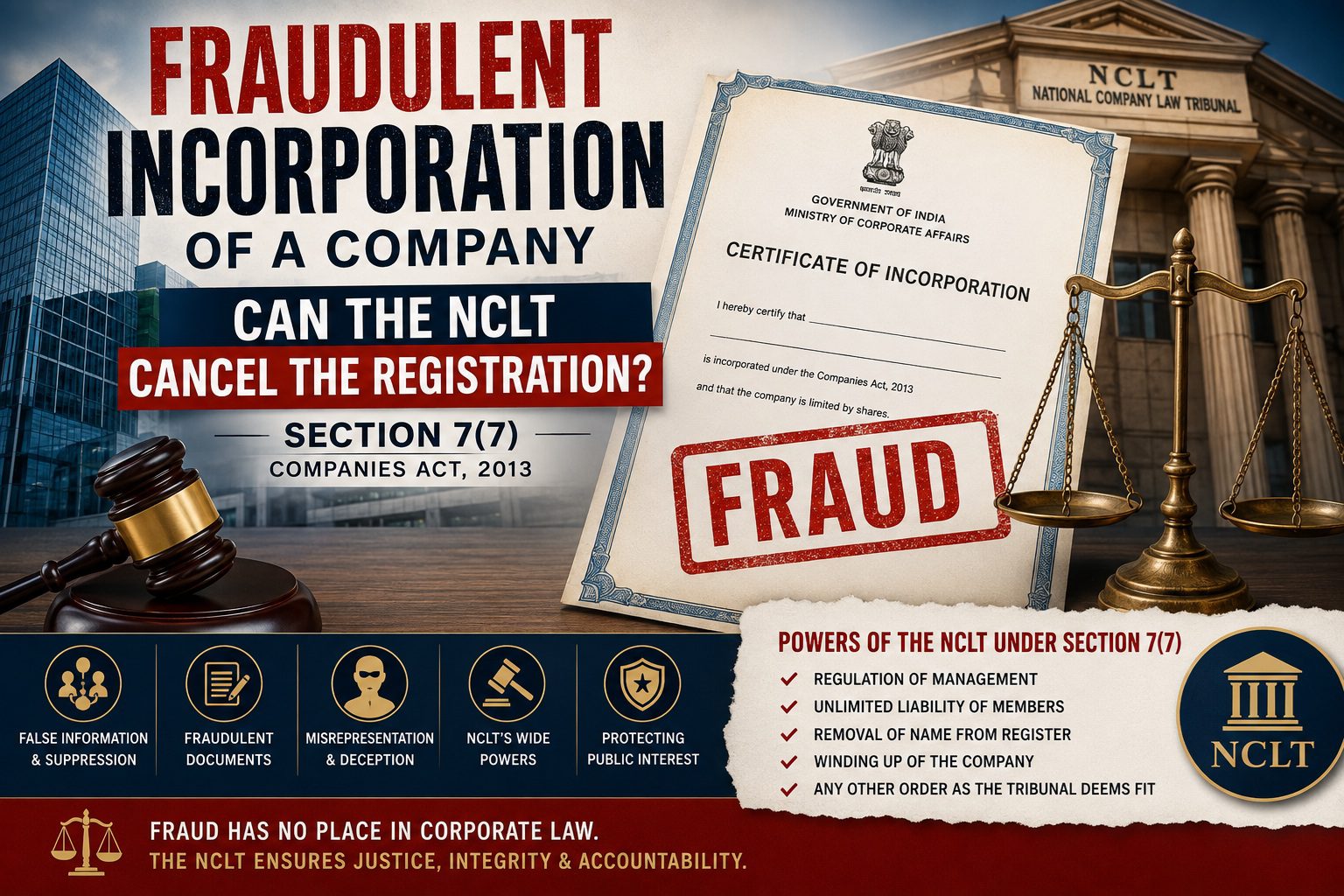
The Companies Act, 2013 provides a clear answer. Section 7(7) empowers the NCLT to pass wide-ranging orders where it is established that a company has been incorporated by furnishing false information, suppressing material facts, or by any fraudulent action. These powers extend far beyond merely cancelling the registration. Depending on the facts of the case, the Tribunal may regulate the future management of the company, make the liability of members unlimited, remove the company’s name from the register, order winding up, or pass any other order that it considers just and equitable.
This article examines the scope of Section 7(7), the circumstances in which it can be invoked, and the nature of the Tribunal’s jurisdiction.
Why Was Section 7(7) Introduced?
The incorporation process under the Companies Act is largely document-driven. The Registrar grants incorporation based on the documents and declarations submitted by the promoters. The Registrar is not expected to conduct a detailed investigation into the correctness of every statement before issuing the Certificate of Incorporation.
This system works efficiently only if the documents filed are genuine.
Where incorporation is secured by fraud, the very foundation of the company’s legal existence becomes questionable. Parliament therefore considered it necessary to create a mechanism enabling the NCLT to intervene in appropriate cases.
Section 7(7) seeks to balance two competing principles. On the one hand, the law recognises the sanctity and certainty attached to a Certificate of Incorporation. On the other hand, it refuses to permit a corporate personality obtained through fraud to continue unchecked.
What is Fraudulent Incorporation?
Section 7(7) applies where it is proved that a company has been incorporated:
- by furnishing false or incorrect information;
- by suppressing material facts;
- by making false declarations; or
- by any fraudulent action.
The provision is aimed at deliberate deception. Every clerical error or inadvertent omission will not amount to fraudulent incorporation. The fraud must relate to the incorporation process itself and must involve an intention to mislead the Registrar or to obtain incorporation by dishonest means.
Examples include:
- forging the signatures of subscribers;
- using forged identity or address proofs;
- impersonating directors or shareholders;
- concealing disqualifications or material facts;
- filing fabricated declarations or affidavits;
- incorporating a shell company through fictitious persons.
Each case must ultimately be decided on its own facts.
Who Can Approach the NCLT?
Section 7(7) does not permit every private dispute to be brought directly before the Tribunal. Proceedings are initiated upon an application made by the Registrar of Companies, the Central Government, or another authorised authority in accordance with the statutory framework.
However, an aggrieved shareholder, creditor, or person whose identity has been misused is not without a remedy. Such a person may lodge a complaint before the Registrar or the Central Government, furnish supporting evidence, and request initiation of proceedings under Section 7(7). Depending on the nature of the allegations, parallel civil or criminal remedies may also be available.
The Wide Powers of the NCLT under Section 7(7)
One of the striking features of Section 7(7) is the breadth of the Tribunal’s powers. Unlike many provisions of the Companies Act that prescribe a specific consequence, Section 7(7) gives the Tribunal considerable flexibility to mould relief according to the gravity of the fraud.
The Tribunal is not required to adopt a single course of action. It may choose the remedy most appropriate to the facts of the case.
(i) Regulation of the Management of the Company
Where the company has genuine business operations and the interests of creditors, employees or innocent shareholders require protection, the Tribunal may permit the company to continue while issuing directions regulating its future management.
This enables the Tribunal to address the fraud without unnecessarily destroying an otherwise viable business.
(ii) Making the Liability of Members Unlimited
Ordinarily, one of the principal advantages of incorporation is limited liability.
Section 7(7), however, empowers the Tribunal to make the liability of members unlimited in appropriate cases.
This is an extraordinary power. It reflects the legislative policy that the privilege of limited liability cannot be claimed by persons who have obtained incorporation through fraud.
(iii) Removal of the Company’s Name from the Register
Where the incorporation itself is fundamentally tainted and continuation of the company would be contrary to law or public interest, the Tribunal may direct that the company’s name be removed from the register.
This effectively brings the company’s existence to an end, subject to compliance with the statutory procedure.
(iv) Winding Up of the Company
Instead of removing the company’s name, the Tribunal may consider it appropriate to order winding up.
This remedy may be preferable where the company has acquired assets, incurred liabilities, entered into contracts or has numerous stakeholders whose interests require an orderly liquidation rather than an immediate cancellation of registration.
(v) Any Other Order Considered Just and Equitable
Perhaps the widest power is contained in the concluding words of Section 7(7), which authorise the Tribunal to pass such other orders as it may deem just and equitable.
This residuary power enables the Tribunal to fashion appropriate relief according to the peculiar facts of each case. It underscores the equitable nature of the Tribunal’s jurisdiction in matters of fraudulent incorporation.
Will Every Fraud Lead to Cancellation of Registration?
The answer is No.
Section 7(7) does not require the Tribunal to cancel the registration in every case.
The Tribunal is expected to consider several factors, including:
- the nature and seriousness of the fraud;
- whether innocent shareholders or creditors would be prejudiced;
- whether the company is carrying on a genuine business;
- the interests of employees and other stakeholders;
- the larger public interest.
The remedy must therefore be proportionate to the misconduct established.
Practical Examples
The operation of Section 7(7) can be better understood through a few illustrations.
Example 1 – Forged Signatures
A promoter forges the signatures of two subscribers to the Memorandum of Association and obtains incorporation.
Upon discovery of the fraud, the Registrar may initiate proceedings before the NCLT seeking appropriate relief under Section 7(7).
Example 2 – Identity Theft
An individual’s PAN and Aadhaar are misused to show him as a director without his knowledge.
Once the fraud comes to light, the affected individual may approach the Registrar, who may invoke the Tribunal’s jurisdiction.
Example 3 – Shell Company
A company is incorporated using fictitious addresses and dummy shareholders solely for money laundering or other unlawful purposes.
Depending on the facts, the Tribunal may order removal of the company’s name or winding up.
Practical Consequences of an Order under Section 7(7)
An order passed under Section 7(7) may have far-reaching consequences.
Depending upon the relief granted by the Tribunal:
- the company’s management may be restructured;
- members may lose the protection of limited liability;
- contracts and commercial arrangements may require reconsideration;
- lenders, creditors and regulatory authorities may take consequential action;
- the company may ultimately be wound up or removed from the register.
Accordingly, proceedings under Section 7(7) are of considerable significance both for the promoters and for persons dealing with the company.
Practical Guidance
If you discover that a company has been incorporated by using forged documents, false declarations or by misusing your identity, you should act promptly.
The following steps may be considered:
- Obtain the incorporation documents from the MCA records.
- Preserve all evidence demonstrating the fraud.
- Submit a detailed complaint to the Registrar of Companies.
- Where appropriate, lodge a criminal complaint for offences such as forgery, cheating or impersonation.
- Seek legal advice regarding proceedings before the NCLT and any other civil or criminal remedies.
Prompt action often prevents further misuse of the corporate structure.
Conclusion
Section 7(7) of the Companies Act, 2013 is one of the most important anti-fraud provisions in Indian company law. While the law accords great sanctity to a Certificate of Incorporation, it does not permit the corporate form to become a shield for fraud. By conferring wide discretionary powers upon the National Company Law Tribunal, Parliament has ensured that incorporation obtained through deception can be effectively addressed while balancing the interests of innocent stakeholders and the public.
The Tribunal’s jurisdiction under Section 7(7) is therefore not merely punitive. It is remedial, preventive and equitable. Depending on the facts, the Tribunal may preserve the company by regulating its affairs, or it may bring its existence to an end by ordering winding up or removal of its name from the register. The provision thus plays a vital role in maintaining the integrity of India’s corporate registration system.
Frequently Asked Questions (FAQ)
Can the NCLT cancel the registration of a company?
Yes. Where a company has been incorporated by furnishing false information, suppressing material facts or committing fraud, the NCLT may pass appropriate orders under Section 7(7), including removal of the company’s name or winding up.
Does every incorrect statement amount to fraudulent incorporation?
No. Section 7(7) is aimed at deliberate fraud or intentional deception. Mere clerical errors or inadvertent mistakes would not ordinarily attract the provision.
Can the Tribunal make the liability of members unlimited?
Yes. Section 7(7) expressly empowers the Tribunal to make the liability of members unlimited where the circumstances justify such an order.
Can a person whose identity has been misused seek action?
Yes. Such a person may lodge a complaint with the Registrar or the competent authority, which may initiate proceedings under Section 7(7). Civil and criminal remedies may also be available depending on the facts.