

Table of Contents
ToggleIntroduction
Disputes among partners are becoming increasingly common in Limited Liability Partnerships (LLPs). Allegations of diversion of business, siphoning of funds, manipulation of accounts, exclusion of partners from management, misuse of LLP assets and breach of fiduciary duties frequently arise in closely held LLPs.
Whenever such disputes arise, one of the first questions asked by an aggrieved partner is:
- Can the NCLT investigate the affairs of an LLP?
- Can a minority partner seek protection against fraudulent acts?
- Can the Tribunal order an investigation into the conduct of designated partners?
- What happens after the investigation is completed?
Many professionals assume that since the LLP Act does not contain provisions similar to Sections 241 and 242 of the Companies Act dealing with oppression and mismanagement, there is no effective statutory remedy.
That assumption is incorrect.
Although the LLP Act does not contain a separate chapter dealing with oppression and mismanagement, it provides an important statutory remedy in the form of investigation into the affairs of the LLP under Sections 43 and 44.
These provisions enable the National Company Law Tribunal (NCLT) and the Central Government to investigate serious allegations of fraud, unlawful conduct, oppression and unfair prejudice. In many situations, they provide the most effective legal remedy available to an aggrieved partner.
This article explains the scope of Sections 43 and 44, the procedure for seeking an investigation, the powers of the Inspector, the role of the Central Government, the legal consequences of the Inspector’s Report and the remedies available to affected partners.
Why are Investigation Provisions Necessary?
Unlike a company, an LLP is primarily governed by the LLP Agreement entered into among the partners. Most disputes relating to management, profit sharing and internal administration are therefore resolved through contractual remedies, arbitration or civil proceedings.
However, there are situations where the allegations go beyond an ordinary contractual dispute.
For example:
- diversion of LLP funds,
- falsification of accounts,
- creation of fictitious liabilities,
- transfer of LLP assets to related parties,
- fraudulent conduct,
- oppression of minority partners,
- conduct prejudicial to creditors.
Such allegations cannot always be effectively investigated by an ordinary civil court.
Parliament therefore created a statutory mechanism enabling an independent investigation into the affairs of the LLP.
Sections 43 and 44 – The LLP Equivalent of an Investigation Mechanism
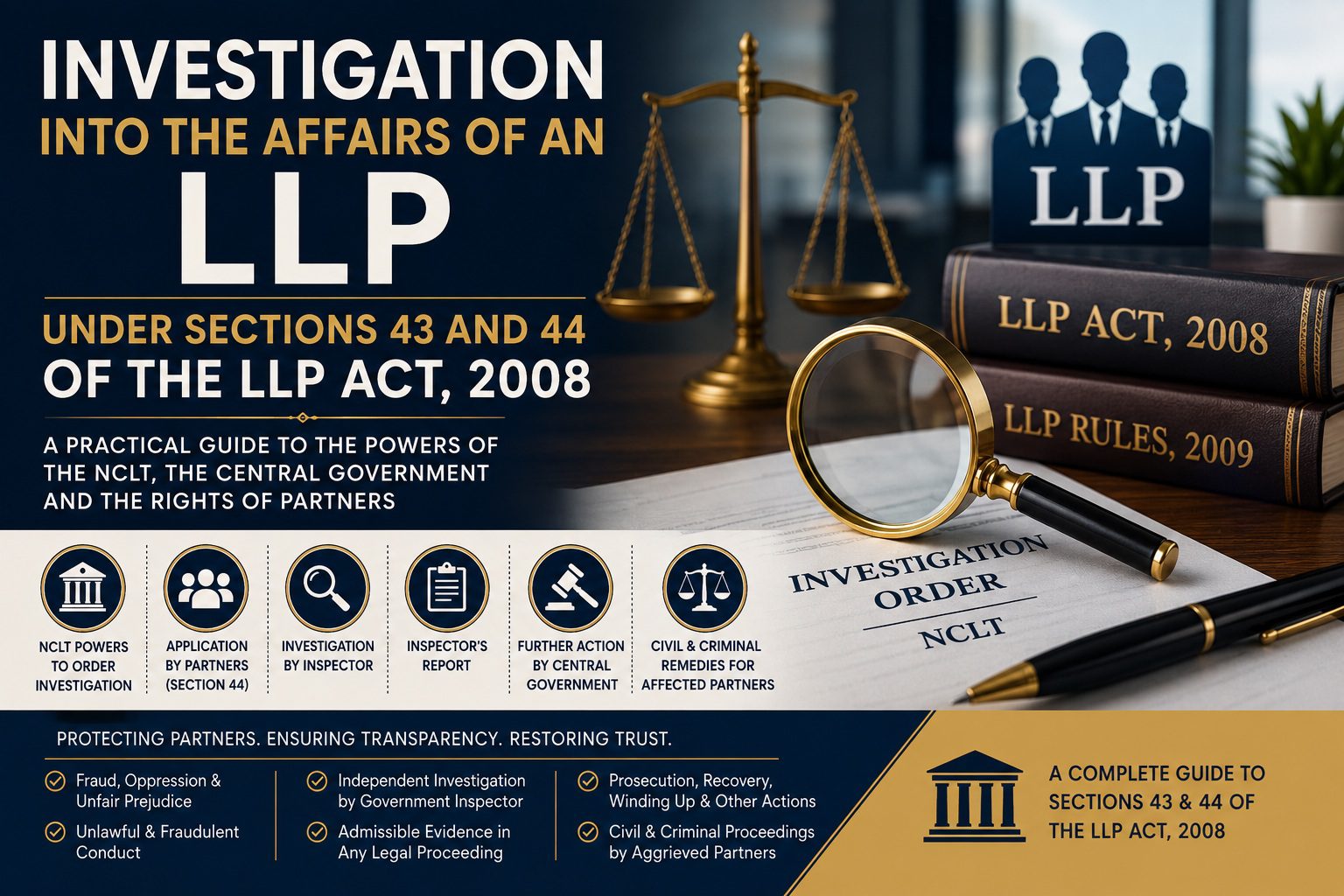
Sections 43 and 44 together constitute the investigation chapter of the LLP Act.
Although these provisions are much shorter than the corresponding provisions under the Companies Act, they are extremely significant.
Section 43 creates the substantive power to investigate.
Section 44 prescribes the procedure for partners seeking such investigation.
Together they provide one of the most important statutory remedies available under the LLP Act.
Two Different Methods of Investigation
A careful reading of Section 43 shows that investigation may commence in two different ways.
(1) Investigation on the Direction of the NCLT
The first method is through an order of the National Company Law Tribunal.
The Tribunal may direct that the affairs of the LLP should be investigated:
- on its own motion; or
- on an application made by not less than one-fifth of the total number of partners.
Once such an order is passed, the Central Government appoints one or more Inspectors to investigate the affairs of the LLP.
Thus, while the Tribunal directs the investigation, the investigation itself is carried out by Inspectors appointed by the Central Government.
(2) Investigation by the Central Government
The second method does not require a prior order of the Tribunal.
The Central Government may itself appoint Inspectors where:
- one-fifth of the partners apply;
- the LLP itself requests investigation;
- circumstances indicate fraud or unlawful conduct;
- the Registrar recommends investigation;
- another regulatory authority recommends investigation.
This shows that Parliament intended investigation to be available through multiple statutory routes depending upon the circumstances.
The Most Important Provision – Oppression and Unfair Prejudice
Perhaps the most important part of Section 43 is clause (3)(c)(i).
Very few people notice that Parliament itself uses the expressions:
“oppressive or unfairly prejudicial to some or any of its partners.”
These are the very expressions that have long been associated with minority protection under company law.
Although the LLP Act does not contain provisions similar to Sections 241 and 242 of the Companies Act, Parliament has recognised that similar situations may arise within an LLP.
Instead of empowering the Tribunal to regulate the management of the LLP directly, the Act permits an independent statutory investigation into allegations of oppression or unfair prejudice.
In that sense, Section 43 may be regarded as the closest statutory equivalent to an oppression and mismanagement remedy under the LLP Act.
What Type of Conduct May Justify Investigation?
Investigation is not confined to fraud alone.
The statute contemplates investigation where:
- business is conducted fraudulently;
- business is conducted unlawfully;
- creditors are defrauded;
- partners are defrauded;
- affairs are conducted oppressively;
- affairs are conducted unfairly prejudicially;
- affairs are not conducted in accordance with the LLP Act;
the Registrar or another authority recommends investigation.
Thus, the scope of investigation is much wider than many practitioners realise.
Section 44 – How Can Partners Seek Investigation?
Section 44 prescribes the procedure for applications made by partners.
An application must be supported by evidence showing that there are good reasons for investigation.
The Tribunal may also require the applicants to furnish security towards investigation expenses.
This safeguard prevents frivolous complaints while ensuring that genuine grievances receive judicial consideration.
Practical Examples
The practical importance of Sections 43 and 44 can best be understood through a few illustrations.
Example 1 – Diversion of Business
An LLP has three partners.
Two partners establish another LLP and gradually divert all profitable contracts to the new entity.
The minority partner is denied access to accounts and excluded from management.
These facts may justify investigation.
Example 2 – Siphoning of Funds
The designated partner creates false invoices, transfers LLP money to companies owned by relatives and misappropriates LLP assets.
These allegations may warrant investigation apart from civil and criminal proceedings.
Example 3 – Manipulation of Accounts
Annual Statements are deliberately falsified.
Books of account are manipulated.
Profits are concealed.
Again, investigation becomes an appropriate remedy.
Example 4 – Complete Deadlock
The partners stop communicating.
Business decisions cannot be taken.
The LLP becomes dysfunctional.
Investigation may expose the underlying causes and, depending upon the circumstances, the Inspector’s Report may ultimately support proceedings for winding up under Section 64.
What Happens After the Investigation?
Many readers assume that the Inspector submits the report to the NCLT.
That is not correct.
The Inspector submits the report to the Central Government.
The Central Government then examines the report and decides what further action should be taken.
This is one of the major differences between the LLP Act and the Companies Act.
The Tribunal’s role is generally confined to directing the investigation. Once the Inspector’s Report is submitted, the statutory responsibility shifts primarily to the Central Government.
What Can the Central Government Do?
Depending upon the findings in the Inspector’s Report, the Central Government may:
initiate criminal prosecution;
- seek recovery of damages or LLP property;
- institute other legal proceedings;
- present a petition for winding up of the LLP on the just and equitable ground.
Thus, the investigation is not an end in itself. It is the starting point for further statutory action.
Can the NCLT Continue to Monitor the Matter?
The LLP Act does not expressly require the Inspector to submit the report to the NCLT or confer continuing supervisory powers on the Tribunal after the investigation is completed.
Ordinarily, the Tribunal’s role ends once it directs the investigation.
If further proceedings, such as a winding-up petition, are initiated, the Tribunal once again assumes jurisdiction in relation to those proceedings.
This is an important structural feature of Chapter IX of the LLP Act.
Can Aggrieved Partners Initiate Their Own Proceedings?
Yes.
This is one of the most significant consequences of an Inspector’s Report.
The report is not useful only to the Central Government.
Section 54 provides that the Inspector’s Report is admissible as evidence in any legal proceeding.
Consequently, where the report establishes fraud, diversion of assets, falsification of accounts or other misconduct, an aggrieved partner may rely upon the report while initiating:
- a civil suit for damages;
- proceedings for rendition of accounts;
- injunction proceedings;
- criminal proceedings, where offences are disclosed.
It is important to remember that the Inspector’s Report is admissible evidence, but it is not conclusive evidence. The court will consider it along with the other evidence produced by the parties.
Investigation Is Not the Final Remedy.
The investigation is only the beginning of the statutory process.
Typically, the sequence is:
Application
↓
Investigation
↓
Inspector’s Report
↓
Central Government
↓
Further Proceedings
↓
Civil Action / Criminal Prosecution / Recovery Proceedings / Winding Up
Thus, investigation becomes the foundation for subsequent legal action.
Conclusion
Sections 43 and 44 constitute one of the most important yet least understood provisions of the LLP Act. Although the Act does not contain a separate chapter dealing with oppression and mismanagement, it provides a powerful statutory mechanism for investigating fraud, unlawful conduct, oppression and unfair prejudice.
The significance of these provisions extends beyond the investigation itself. The Inspector’s Report may become the foundation for criminal prosecution, recovery proceedings, winding-up petitions and even independent civil or criminal actions initiated by aggrieved partners. For this reason, Sections 43 and 44 deserve careful consideration whenever serious governance issues arise within an LLP.
For partners, designated partners and legal practitioners, these provisions are not merely procedural. They are among the most effective statutory tools available for uncovering misconduct, protecting legitimate interests and preserving confidence in the LLP form of business organisation.