

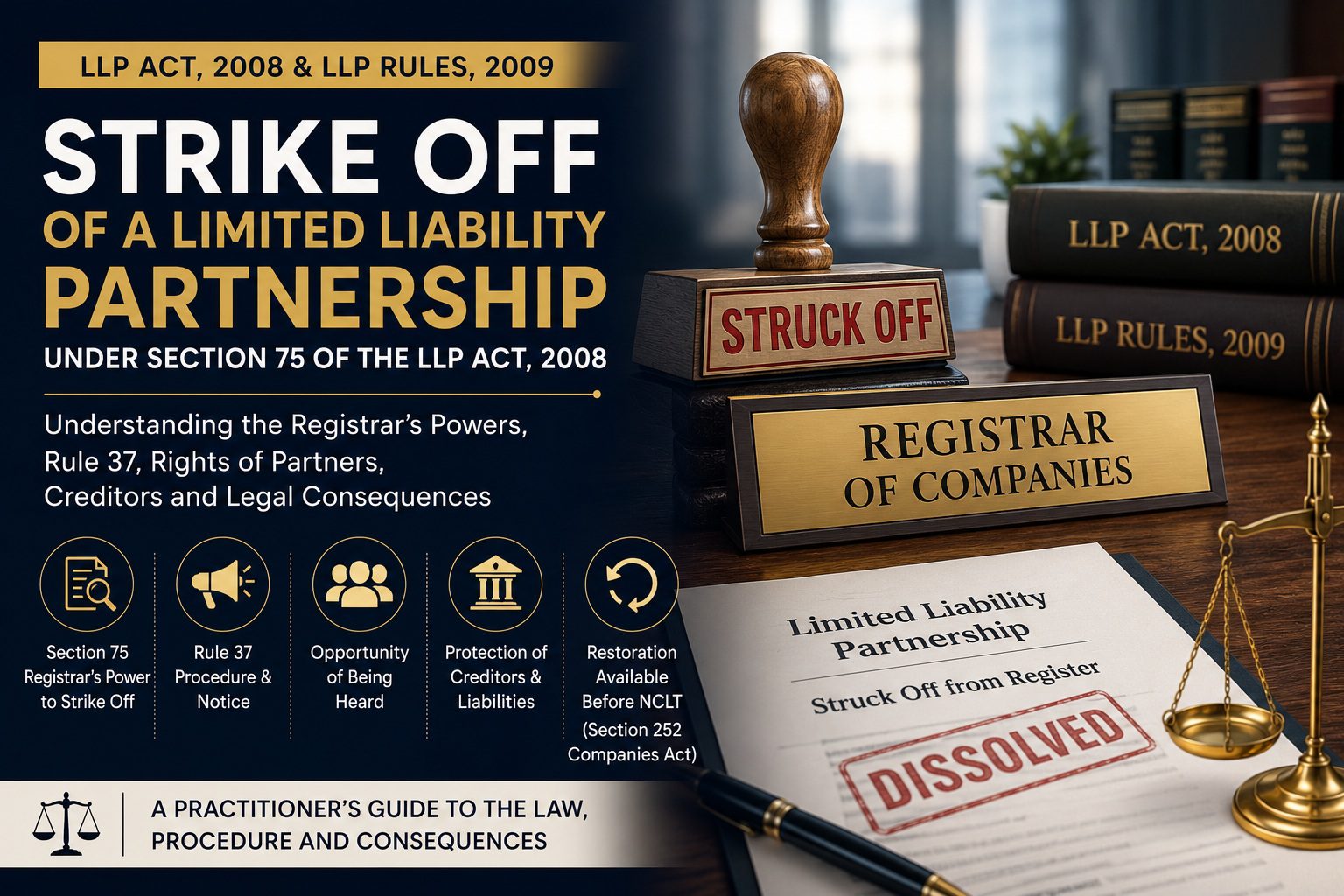
Table of Contents
Toggle1. Introduction
The Limited Liability Partnership (“LLP”) has emerged as one of the most preferred forms of business organisation in India because it combines the flexibility of a traditional partnership with the advantages of a body corporate. Nevertheless, like every business organisation, an LLP may become commercially inactive, cease its operations, or simply remain on the Register without carrying on any business.
To maintain the integrity and accuracy of the Register of Limited Liability Partnerships, the Legislature has empowered the Registrar to remove the names of defunct LLPs from the Register.
This power is contained in Section 75 of the Limited Liability Partnership Act, 2008.
However, Section 75 merely creates the substantive power. It does not prescribe the manner in which the power is to be exercised. The procedural framework is contained in Rule 37 of the Limited Liability Partnership Rules, 2009, which prescribes the detailed mechanism for striking off the name of an LLP.
Accordingly, Section 75 and Rule 37 must always be read together.
This article examines the legislative scheme governing strike off of LLPs, analyses the scope of the Registrar’s powers, discusses the safeguards available to LLPs, partners and creditors, and explains the practical implications of striking off an LLP from the Register.
2.Why is a Strike-Off Provision Necessary?
Every legislation governing business organisations contains provisions for removing entities that have ceased to function.
The objective is not to punish the business entity.
Rather, it is to ensure that statutory records accurately reflect entities that are genuinely carrying on business.
For example,
Sections 248 to 252 of the Companies Act, 2013 provide for strike off and restoration of companies.
Similarly, Section 75 performs the same function in relation to LLPs.
The existence of such provisions prevents the Register from becoming cluttered with thousands of dormant entities that neither conduct business nor comply with statutory requirements.
Thus, the provision is essentially regulatory rather than penal.
3.Legislative Framework
The statutory scheme governing strike off is contained in three different legal instruments.
First, Section 75 of the LLP Act creates the substantive power.
Secondly, Rule 37 of the LLP Rules, 2009 prescribes the procedural machinery.
Thirdly, after the MCA Notification No. G.S.R. 109(E) dated 11 February 2022, effective from 1 April 2022, Section 252 of the Companies Act, 2013 has been made applicable to LLPs, thereby providing a statutory mechanism for restoration before the National Company Law Tribunal.
Thus, the present legal framework is spread across multiple enactments and must be understood as one integrated statutory scheme.
4.Section 75 – Power of Registrar to Strike Off Defunct LLPs
Section 75 provides that where the Registrar has reasonable cause to believe that an LLP is not carrying on business or its operations, the Registrar may strike its name off the Register in the prescribed manner.
The proviso mandates that before doing so, the Registrar must give the LLP a reasonable opportunity of being heard.
Although the provision is brief, every expression used by the Legislature is legally significant.
Three expressions deserve particular attention:
- reasonable cause to believe
- not carrying on business or its operation
- reasonable opportunity of being heard
Each of these expressions imposes an important limitation upon the Registrar’s powers.
5.“Reasonable Cause to Believe” – A Jurisdictional Requirement
The Registrar cannot act merely because statutory filings are pending.
Nor can he strike off an LLP merely because it has remained inactive for some period.
The Legislature deliberately employs the expression “reasonable cause to believe.”
This expression occurs in several statutes and has consistently been interpreted by courts as requiring an objective satisfaction founded on relevant material.
It excludes arbitrary action.
Accordingly, before initiating strike-off proceedings, the Registrar must possess material capable of leading a reasonable person to conclude that the LLP has genuinely ceased carrying on business or operations.
6.What Does “Not Carrying on Business or Operations” Mean?
The Act does not define this expression.
Consequently, every case must be decided on its own facts.
Temporary inactivity cannot automatically justify strike off.
For example,
- an LLP engaged in litigation,
- an LLP holding valuable immovable property,
- an LLP awaiting statutory approvals,
- an LLP temporarily suspending commercial activities,
may still be regarded as an operational LLP depending upon the surrounding circumstances.
The Registrar must therefore distinguish between a genuinely defunct LLP and one that is merely commercially inactive for a temporary period.
7.Rule 37 – The Procedural Framework
Section 75 itself states that strike off shall be carried out “in such manner as may be prescribed.”
The prescribed manner is contained in Rule 37 of the Limited Liability Partnership Rules, 2009.
Accordingly, Rule 37 is not merely procedural.
It is the machinery through which Section 75 operates.
Without Rule 37, the statutory power under Section 75 cannot be effectively exercised.
8.Legislative Evolution of Rule 37
This aspect deserves particular attention.
Rule 37 originally formed part of the Limited Liability Partnership Rules, 2009, framed under Section 79 of the LLP Act.
However, the Rule underwent a significant transformation through the Limited Liability Partnership (Amendment) Rules, 2017, notified vide Notification No. G.S.R. 470(E) dated 16 May 2017.
The substituted Rule introduced a comprehensive procedure for striking off LLPs, including voluntary applications by LLPs through Form 24, documentary requirements, declarations by designated partners, protection of creditors, and preservation of liabilities.
Subsequently, the Limited Liability Partnership (Amendment) Rules, 2022, notified vide Notification No. G.S.R. 109(E) dated 11 February 2022, which came into force on 1 April 2022, complemented the statutory framework by implementing wider reforms to the LLP regime, including the application of Section 252 of the Companies Act to LLPs.
Therefore, the present Rule 37 represents the result of progressive legislative development rather than the original 2009 framework.
9.Two Distinct Modes of Strike Off
Rule 37 contemplates two entirely different situations.
(A) Strike Off by the Registrar
The Registrar may initiate proceedings on his own motion where he has reason to believe that the LLP has ceased carrying on business.
This is an exercise of statutory power under Section 75.
(B) Voluntary Strike Off
The partners themselves may apply for striking off the LLP.
This is accomplished by filing Form 24 together with the prescribed declarations, statements and supporting documents.
Many practitioners overlook this distinction.
The first is an exercise of statutory power.
The second is a voluntary exit mechanism.
10. Principles of Natural Justice
Perhaps the most important safeguard under Section 75 is the proviso requiring the Registrar to provide a reasonable opportunity of being heard.
This embodies the well-established doctrine of audi alteram partem.
The opportunity of hearing enables the LLP to establish that:
- it continues to carry on business,
- valuable assets exist,
- litigation is pending,
- commercial activities are likely to resume,
- or the Registrar has proceeded on an incorrect factual basis.
Failure to comply with this mandatory requirement may render the strike-off proceedings vulnerable to judicial review.
11. Is Strike Off a Penalty?
The answer is No.
Strike off is frequently misunderstood as a punishment for non-filing of annual returns.
That is not the legislative purpose.
The object is to remove defunct LLPs from the Register.
Penal consequences for statutory defaults are separately provided under the LLP Act.
Section 75 operates in an entirely different field.
12. Consequences of Strike Off
Removal of an LLP from the Register has far-reaching consequences.
Among other things,
- the LLP ceases to exist,
- it loses its legal identity,
- business operations come to an end,
- GST, PAN and banking operations may be affected,
- contractual difficulties may arise,
- partners and creditors may be compelled to seek restoration before the Tribunal.
The practical implications therefore extend far beyond mere removal of the LLP’s name from the Register.
13. Rights of Creditors and Continuing Liabilities
One of the important safeguards contained in Rule 37 is that strike off does not automatically extinguish liabilities.
Partners frequently assume that dissolution wipes out all obligations.
This assumption is legally incorrect.
The statutory scheme preserves liabilities notwithstanding dissolution and protects the rights of creditors.
Accordingly, strike off cannot be used as a mechanism for escaping legitimate liabilities.
14. Can the Registrar’s Decision Be Challenged?
This is the question most frequently asked by partners.
Unlike the Companies Act, the LLP Act itself does not contain an appeal provision immediately after Section 75.
For several years this created uncertainty.
The position changed after the MCA Notification dated 11 February 2022, effective from 1 April 2022, whereby Section 252 of the Companies Act, 2013 was made applicable to LLPs.
Accordingly, today the remedy against strike off is no longer confined to the LLP Act.
Restoration is now governed by the integrated operation of:
- Section 75 of the LLP Act,
- Rule 37 of the LLP Rules, and
- Section 252 of the Companies Act, 2013 (as made applicable to LLPs).
15. Conclusion
Section 75 of the LLP Act and Rule 37 of the LLP Rules together constitute a carefully balanced statutory framework. While they empower the Registrar to maintain an accurate and reliable Register of Limited Liability Partnerships by removing defunct entities, they also impose significant safeguards to prevent arbitrary exercise of power. The requirements of “reasonable cause to believe,” adherence to the principles of natural justice, and protection of the interests of partners and creditors demonstrate that the power of strike off is intended to be exercised with fairness and circumspection.
The evolution of Rule 37 through the 2017 amendments, together with the 2022 extension of Section 252 of the Companies Act to LLPs, reflects the Legislature’s intention to create a complete legal framework governing both the removal and restoration of LLPs. Strike off is therefore not the end of the legal journey of an LLP, but one stage in a broader statutory scheme that balances administrative efficiency with the protection of legitimate commercial interests.