

Table of Contents
ToggleIntroduction
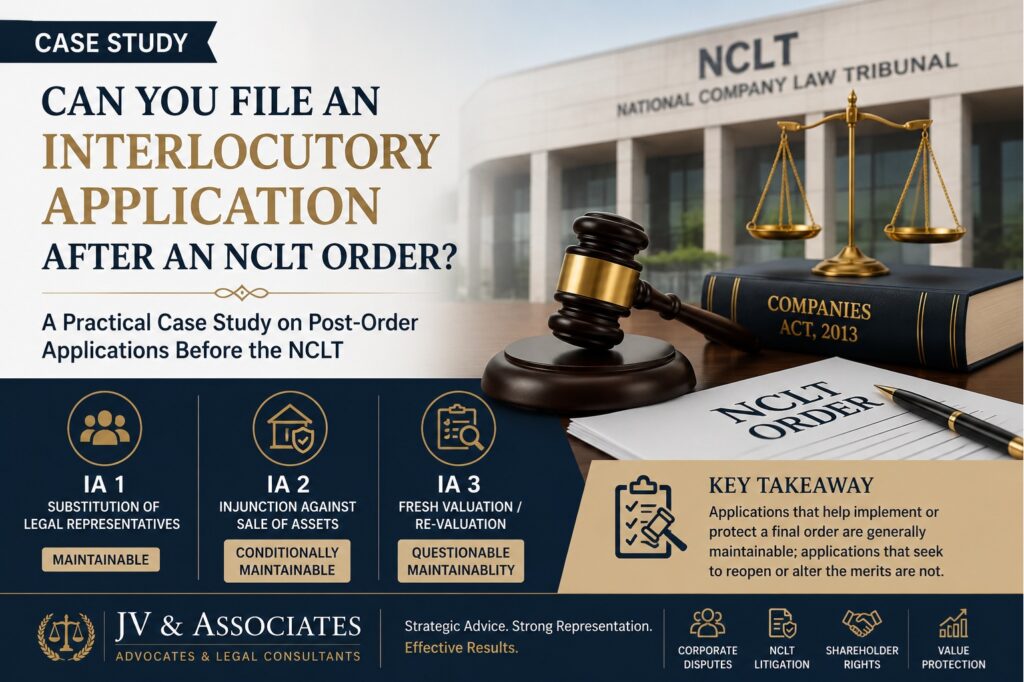
A common misconception among litigants is that once the National Company Law Tribunal (NCLT) passes a final order, the matter comes to an end and no further applications can be filed before the Tribunal.
In reality, the position is more nuanced.
While a Tribunal generally becomes ‘functus officio’ after deciding a case, it may still entertain certain applications that are necessary for implementing, protecting, or giving effect to its final order. On the other hand, applications seeking to reopen issues already decided by the Tribunal may not be maintainable.
This article examines the issue through a real-life oppression and mismanagement dispute and analyses the maintainability of three different interlocutory applications filed after the final disposal of the company petition.
Background of the Case
A shareholder holding 14% of the equity shares of a private company approached the NCLT under Sections 241 and 242 of the Companies Act, 2013 alleging oppression and mismanagement.
After hearing the parties, the Tribunal found that:
* The company was in a state of deadlock;
* The relationship between the shareholders had irretrievably broken down;
* It was appropriate to provide an exit to the minority shareholder;
* The majority shareholders should purchase the minority shareholder’s shares at fair value determined by an independent valuer.
The Tribunal accordingly directed valuation of the shares and ordered the majority shareholders to purchase the minority shareholder’s stake.
The valuation exercise was completed and the share value was determined by the Tribunal-appointed Registered Valuer.
However, despite the valuation being completed, payment was allegedly not made within the time stipulated by the Tribunal.
This led to the filing of three separate interlocutory applications.
Application No. 1: Substitution of Legal Representatives of a Deceased Respondent
What Happened?
During the pendency of proceedings after the final order, one of the respondents died.
The applicant sought:
* Bringing the legal heirs on record;
* Continuation of the proceedings against the legal representatives;
* Consequential amendment of the cause title.
Is Such an Application Maintainable?
Generally, yes.
This type of application does not seek:
* Review of the final order;
* Reopening of evidence;
* Modification of findings.
Instead, it merely ensures that the proceedings can continue despite the death of a party.
Legal Principle
An application necessary for continuation of proceedings or implementation of an existing order is ordinarily maintainable even after final disposal of the main case.
Practical Takeaway
Where a respondent dies after a final order but before complete implementation of the order, substitution of legal heirs is generally a procedural necessity and not an attempt to reopen the dispute.
Application No. 2: Injunction to Prevent Sale of Company Assets
What Happened?
The applicant alleged that despite the Tribunal’s direction to purchase his shares, the respondents had failed to make payment.
At the same time, the respondents allegedly initiated steps to sell the company’s principal asset.
The applicant therefore sought:
* An injunction against sale of the company property;
* Suspension of certain board resolutions;
* Protection of the company’s assets until compliance with the Tribunal’s order.
Is Such an Application Maintainable?
The answer is not entirely straightforward.
On one hand, the application does not seek to alter the final order.
On the other hand, it seeks fresh interim relief after disposal of the main petition.
Why It May Be Maintainable
The applicant’s argument is that:
* The Tribunal’s order has not been complied with;
* Sale of the asset would defeat implementation of the order;
* Protective directions are necessary to preserve the subject matter of the dispute.
Many tribunals have recognised that inherent powers may be exercised to protect the efficacy of their own orders.
Potential Objection
The respondents may contend that:
* The final order has already been passed;
* The applicant must pursue execution or enforcement remedies;
* A fresh interlocutory application is not maintainable.
Practical Takeaway
Applications seeking protection of assets for effective implementation of a final order stand on a stronger footing than applications seeking to reopen issues already decided.
Application No. 3: Request for Fresh Valuation
What Happened?
The applicant contended that:
* Significant time had elapsed since the original valuation;
* Property values had increased;
* Certain liabilities had changed;
* A fresh valuation should therefore be conducted.
The applicant sought appointment of another valuer and preparation of a revised valuation report.
Is Such an Application Maintainable?
This application faces the greatest legal difficulty.
The Tribunal had already:
* Appointed a valuer;
* Received the valuation report;
* Accepted the valuation exercise;
* Determined the amount payable.
The valuation process contemplated by the final order had therefore already been completed.
Why Maintainability Becomes a Problem
A fresh valuation may effectively amount to:
* Reopening a concluded issue;
* Modifying the financial consequences of the final order;
* Revisiting findings that have already attained finality.
Tribunals are generally reluctant to permit such reopening through an interlocutory application.
Applicant’s Argument
The applicant may argue that a defaulting party should not be allowed to benefit from its own delay and that equity requires valuation on the actual exit date.
While the argument may be attractive from an equitable perspective, maintainability remains a significant hurdle.
Practical Takeaway
Applications seeking a second valuation after completion of the valuation exercise are likely to face serious objections unless supported by exceptional circumstances.
Lessons for Shareholders and Company Directors
This case study highlights an important distinction.
Applications Usually Maintainable After Final Orders
* Substitution of legal heirs;
* Correction of procedural defects;
* Clarification of orders;
* Protection of assets;
* Measures necessary to implement the final order.
Applications Likely to Face Maintainability Challenges
* Reopening evidence;
* Reconsideration of findings;
* Fresh valuation of matters already adjudicated;
* Attempts to secure a different outcome from the one already ordered.
Conclusion
The maintainability of an interlocutory application after disposal of a case does not depend on its title but on its substance.
If the application merely seeks to implement, protect, or facilitate compliance with an existing order, the Tribunal may entertain it.
However, where the application seeks to reopen issues already decided, alter substantive rights, or obtain a fresh adjudication on matters that have attained finality, maintainability becomes doubtful.
Before filing any post-disposal application before the NCLT, parties should carefully evaluate whether the relief sought supports implementation of the final order or seeks to revisit the merits of the dispute.
That distinction often determines the fate of the application itself.