

Table of Contents
ToggleIntroduction
Many litigants assume that once a civil court pronounces a judgment and passes a decree, the case comes to an end and no further applications can be filed before the same court. While this is generally true, the law recognizes several situations where parties may still approach the court through an Interlocutory Application (IA) even after the suit has been disposed of.
Understanding these post-decree remedies is important because filing the wrong application can lead to dismissal and unnecessary delay. This article explains the circumstances in which an IA may be maintainable after a judgment and decree have been passed.
What Happens After a Judgment and Decree?
After a civil court decides a suit and passes a decree, the court generally becomes ‘functus officio’, meaning it has completed its adjudicatory function. As a rule, the court cannot reopen the case or reconsider the merits of its decision.
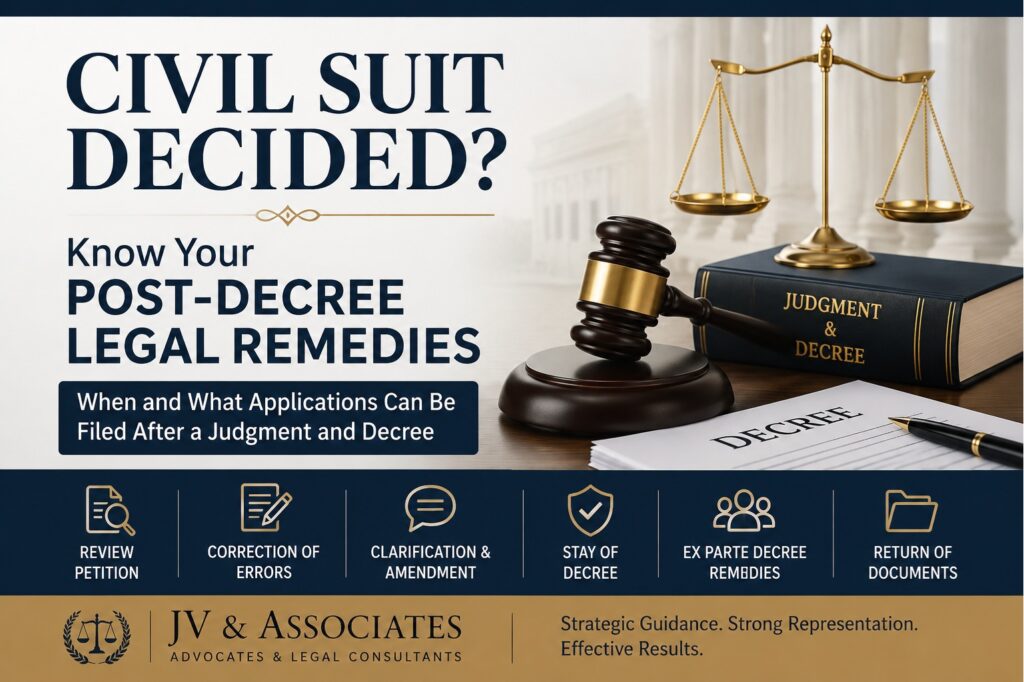
However, certain applications relating to correction, clarification, review, or implementation of the decree may still be filed before the same court.
Situations Where an IA May Be Filed After Disposal of the Suit
1.Review Petition
A party may seek a review of the judgment under Order XLVII Rule 1 of the Code of Civil Procedure, 1908.
A review may be maintainable where:
* New and important evidence has been discovered.
* There is an error apparent on the face of the record.
* There exists any other sufficient reason recognized by law.
A review is not an appeal in disguise and cannot be used merely because a party is dissatisfied with the judgment.
2.Correction of Clerical or Arithmetical Mistakes
Section 152 of the CPC empowers courts to correct:
* Typographical errors;
* Clerical mistakes;
* Arithmetical mistakes;
* Accidental slips or omissions.
For example:
* Wrong survey number mentioned in the decree;
* Incorrect calculation of amounts;
* Mistakes in property description caused by accidental omission.
3.Clarification of the Judgment or Decree
In some cases, the decree may be ambiguous or difficult to implement.
The court may entertain an application seeking clarification of the decree. However, such an application cannot be used to modify the findings or alter the substantive rights determined by the judgment.
4.Amendment of the Decree to Conform to the Judgment
Occasionally, the decree prepared by the court staff may not accurately reflect the judgment delivered by the court.
In such situations, a party may seek amendment of the decree so that it correctly represents the judgment.
5.Drawing Up or Completion of the Decree
Where a judgment has been pronounced but the decree has not been properly prepared, a party may move the court for preparation, correction, or completion of the decree.
This often arises in property disputes and declaratory suits.
5.Stay of Decree Pending Appeal
A party who has filed an appeal may seek a stay of the decree under Order XLI Rule 5 CPC.
Depending on the circumstances, the application may be filed before:
* The trial court; or
* The appellate court.
A stay is not automatic merely because an appeal has been filed.
7.Setting Aside an Ex Parte Decree
If the decree was passed ex parte, the defendant may file an application under Order IX Rule 13 CPC seeking to set aside the decree.
The applicant must generally show that:
* Summons were not duly served; or
* There was sufficient cause preventing appearance before the court.
8.Return of Original Documents
After disposal of the suit, parties may apply for return of:
* Original title deeds;
* Agreements;
* Financial records;
* Other documents produced during trial.
Courts usually permit return after compliance with procedural requirements.
9. Refund of Court Fee
In appropriate cases, parties may seek refund of court fees where permitted by law or pursuant to specific orders of the court.
10.Applications in Final Decree Proceedings
Certain categories of suits do not completely conclude with the passing of a preliminary decree.
Examples include:
* Partition suits;
* Mortgage suits;
* Administration suits.
In such matters, various applications may continue to be filed until the final decree proceedings are completed.
Applications That Are Generally Not Maintainable After Judgment
Once a suit has been finally decided, a party ordinarily cannot file an IA seeking:
* Reopening of evidence;
* Re-examination of witnesses;
* Production of additional evidence before the trial court;
* Framing of additional issues;
* Modification of findings on merits;
* Rehearing of the suit.
In such situations, the appropriate remedy is usually an appeal or, where legally permissible, a review petition.
A Practical Test for Litigants
Before filing an application after disposal of a suit, ask the following question:
Does the application require the court to reconsider the merits of the judgment?
If the answer is ‘Yes’, the proper remedy is generally an appeal or review.
If the answer is ‘No’, and the application merely seeks correction, clarification, implementation, or procedural relief relating to the decree, an IA may be maintainable before the same court.
Conclusion
Although a civil suit ordinarily concludes upon the passing of a judgment and decree, the law recognizes several post-decree applications that may still be filed before the trial court. These include review petitions, correction of mistakes, clarification of decrees, stay applications, applications to set aside ex parte decrees, and other procedural remedies.
Since maintainability depends on the nature of the relief sought, litigants should obtain legal advice before filing any post-judgment application. Choosing the correct remedy at the right stage can save significant time, costs, and procedural complications.