

Table of Contents
Toggle1. Introduction
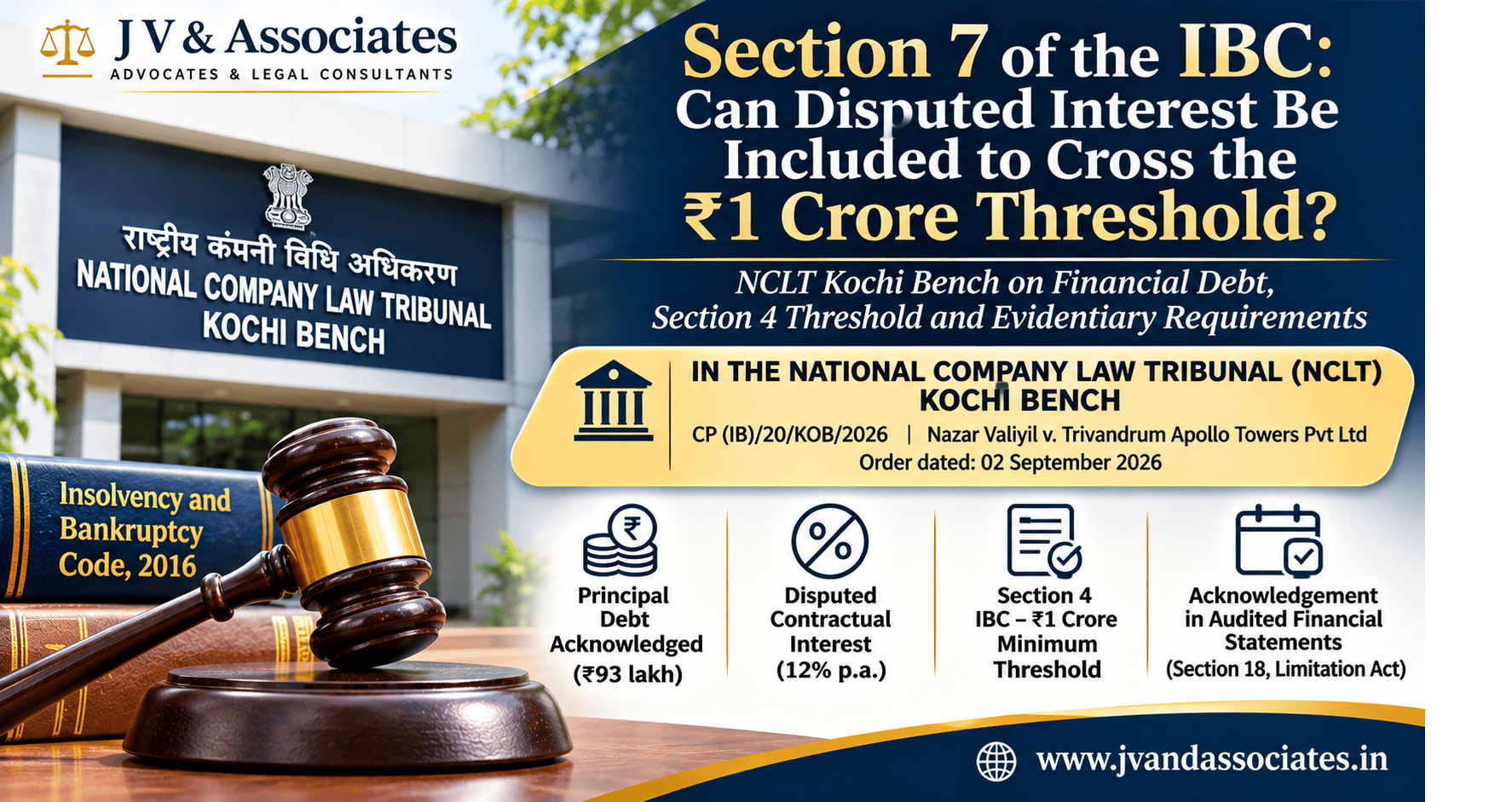
Section 7 of the Insolvency and Bankruptcy Code, 2016 (IBC) enables a financial creditor to initiate Corporate Insolvency Resolution Process (CIRP) against a corporate debtor upon the occurrence of a default in repayment of financial debt.
However, the right to initiate insolvency proceedings is subject to the statutory conditions prescribed under the Code. One of the most important conditions is the minimum amount of default prescribed under Section 4 of the IBC.
A question frequently arising in insolvency proceedings is whether contractual interest can be added to the outstanding principal amount to satisfy the minimum statutory threshold. What happens when the principal amount acknowledged by the corporate debtor is below ₹1 crore, but the financial creditor claims that the outstanding amount, including contractual interest, exceeds ₹1 crore?
Can the Adjudicating Authority rely upon a disputed loan agreement to recognise the contractual interest for the purpose of satisfying the threshold under Section 4?
These questions were considered by the National Company Law Tribunal, Kochi Bench, in a Section 7 application filed by an individual financial creditor against Trivandrum Apollo Towers Private Limited.
The decision is particularly significant because the Tribunal accepted the existence of the underlying financial transaction and subsisting principal liability but declined to recognise the disputed contractual interest of 12% per annum for determining whether the statutory threshold had been satisfied.
Case Details
IN THE NATIONAL COMPANY LAW TRIBUNAL (NCLT) KOCHI BENCH
Company Petition No.: CP (IB)/20/KOB/2026
Under Section 7 of the Insolvency and Bankruptcy Code, 2016
Mr. Nazar Valiyil – Petitioner / Financial Creditor
Versus
M/s. Trivandrum Apollo Towers Private Limited – Respondent / Corporate Debtor
Date of Institution: 23 July 2026
Date of Order: 2 September 2026
Coram:
Hon’ble Shri Vinay Goel – Member (Judicial)
Hon’ble Shri Ravichandran Ramasamy – Member (Technical)
Result: Section 7 application dismissed for failure to satisfy the minimum statutory threshold under Section 4 of the IBC.
3. Facts of the Case
The Financial Creditor, Mr. Nazar Valiyil, had served as an Additional Director of the Corporate Debtor from 11 July 2016 to 24 March 2019.
During this period, he allegedly provided financial assistance to the Corporate Debtor amounting to ₹2.90 crore through banking channels.
The financial assistance was advanced in two instalments:
₹2 crore on 11 July 2016 through Cheque No. 109065 drawn on Canara Bank, Puthiyangadi Branch, Kozhikode.
₹90 lakh on 13 July 2016 through RTGS transfer from the Financial Creditor’s Canara Bank account.
The Corporate Debtor subsequently made repayments aggregating to ₹1.97 crore, as detailed below:
Date | Amount | Mode |
08.02.2018 | ₹50,00,000 | Banking transaction |
15.02.2018 | ₹50,00,000 | Banking transaction |
10.05.2019 | ₹75,00,000 | RTGS |
25.08.2019 | ₹22,00,000 | Cheque |
Total | ₹1,97,00,000 |
After accounting for these repayments, the outstanding principal amount was ₹93 lakh.
– The Unsecured Loan Agreement dated 7 December 2017
The Financial Creditor relied upon an Unsecured Loan Agreement dated 7 December 2017, allegedly executed by the Managing Director and another Director of the Corporate Debtor under the authority of its Board.
According to the agreement:
The loan carried interest at 12% per annum.
Interest was payable monthly with effect from 1 August 2016.
The loan was repayable upon three months’ notice.
On the basis of the alleged contractual interest and the repayments made by the Corporate Debtor, the Financial Creditor prepared a running statement of account and claimed ₹4,01,63,888 as outstanding on 18 February 2026, comprising:
Particulars | Amount |
Principal amount claimed | ₹1,92,01,304 |
Interest claimed | ₹2,09,62,584 |
Total | ₹4,01,63,888 |
– Acknowledgement in the audited financial statements
The Financial Creditor also relied upon the audited financial statements of the Corporate Debtor.
For FY 2021-22, an amount of ₹93 lakh was reflected as payable to the Financial Creditor under the head “Unsecured Loans from Directors”.
The subsequent financial statements up to FY 2024-25 continued to reflect an amount of ₹91.50 lakh under the same head.
The Financial Creditor contended that these entries constituted acknowledgement of the subsisting financial liability and independently supported the existence of the loan transaction.
-Demand notices
The Financial Creditor issued a demand notice dated 9 June 2025, followed by a final demand notice dated 18 February 2026.
Since the Corporate Debtor allegedly failed to discharge the outstanding liability, the Financial Creditor instituted the Section 7 application before the NCLT Kochi Bench on 23 July 2026.
4.Defence of the Corporate Debtor
The Corporate Debtor contested the maintainability of the Section 7 application on several grounds.
Its principal contention was that the actual outstanding principal amount, as reflected in its audited financial statements, was below ₹1 crore.
The Corporate Debtor argued that the Financial Creditor had artificially inflated the claim by relying upon a disputed interest component of 12% per annum under the Unsecured Loan Agreement dated 7 December 2017.
The following objections were raised:
Dispute regarding the genuineness of the loan agreement
The Corporate Debtor disputed the genuineness and execution of the Unsecured Loan Agreement.
It pointed out that:
The agreement was produced only as a photocopy.
The stamp paper had been purchased in the name of the Financial Creditor himself.
The document did not bear the company’s seal.
The signatures appearing on the document were disputed.
The Corporate Debtor contended that the alleged fabrication or genuineness of the document could not appropriately be adjudicated in summary proceedings under Section 7.
2. Principal liability below the statutory threshold
According to the Corporate Debtor, the Financial Creditor had advanced ₹2.90 crore and received repayments of ₹1.97 crore, leaving a principal balance of approximately ₹93 lakh.
Its audited financial statements independently reflected the outstanding unsecured loan at approximately ₹91 lakh.
Therefore, the Corporate Debtor contended that the amount of default did not satisfy the minimum threshold of ₹1 crore prescribed under Section 4.
3.Absence of evidence of interest liability
The Corporate Debtor further contended that no interest had ever been paid, demanded, accrued or subjected to TDS during the relevant period.
It argued that the absence of corresponding entries in its books of account and statutory records was inconsistent with the Financial Creditor’s present claim of an interest-bearing loan.
4.Limitation
The Corporate Debtor contended that the application was barred by limitation, as there was no subsequent acknowledgement of the alleged interest-bearing liability within the meaning of Section 18 of the Limitation Act, 1963.
5.Dispute concerning bank statements
The Corporate Debtor also challenged the evidentiary value of the bank statements produced by the Financial Creditor, contending that the requisite certificate under the Bankers’ Books Evidence Act, 1891, or applicable electronic evidence provisions had not been produced.
6. Financial position of the Corporate Debtor
The Corporate Debtor claimed that it was a solvent and profit-making going concern and was regularly servicing its institutional financial obligations, including its term loan from Kerala Financial Corporation.
It further contended that the IBC could not be used as a mechanism for recovery of a disputed debt or as a means of exerting pressure in disputes between the parties.
5.Issues Considered by the NCLT Kochi Bench
After considering the pleadings, documents and submissions of both parties, the Tribunal formulated three principal issues:
Whether the application filed under Section 7 of the IBC was barred by limitation?
Whether the Unsecured Loan Agreement dated 7 December 2017, along with the other documents and records relied upon by the Financial Creditor, established the existence of financial debt and default?
Whether the financial debt due and payable by the Corporate Debtor satisfied the statutory threshold prescribed under Section 4 of the IBC?
These issues are particularly important because they address three essential aspects of a Section 7 application: limitation, existence of financial debt and the minimum amount of default.
6.Limitation – Acknowledgement in Audited Financial Statements under Section 18 of the Limitation Act, 1963
The first issue examined by the Tribunal concerned limitation.
The Corporate Debtor contended that the alleged loan transaction was of July 2016 and that there was no subsequent acknowledgement of the interest-bearing liability within the prescribed period.
The Financial Creditor, on the other hand, relied upon the audited financial statements of the Corporate Debtor.
The Tribunal examined the following entries:
Financial year | Liability reflected |
FY 2021-22 | ₹93,00,000 |
FY 2024-25 | ₹91,50,000 |
The amounts were reflected under the head “Unsecured Loans from Directors”.
– Section 18 of the Limitation Act, 1963
Section 18 of the Limitation Act, 1963, provides for a fresh period of limitation where an acknowledgement of liability is made in writing and signed by the party against whom the right is claimed, or by a person through whom such party derives title or liability, before the expiration of the prescribed period.
The acknowledgement must relate to a subsisting liability, although it need not necessarily specify the exact amount due.
-Findings of the Tribunal
In paragraph 37 of the order, the Tribunal held that entries in the audited financial statements constituted acknowledgement of the subsisting liability for the purpose of Section 18 of the Limitation Act, subject to the facts and circumstances of the case.
The Tribunal accordingly rejected the Corporate Debtor’s contention that the application was barred by limitation.
It held that the continuing acknowledgement of the liability in the Corporate Debtor’s own audited financial statements prevented the application from being rejected on limitation grounds.
-Practical significance
This finding is important for financial creditors because audited financial statements may constitute valuable evidence of acknowledgement of liability.
However, it is necessary to distinguish between acknowledgement of the principal liability and acknowledgement of a disputed contractual interest component.
The present decision demonstrates that the Tribunal may recognise the principal liability through the company’s audited accounts without necessarily accepting the creditor’s entire interest computation.
7.Existence of Financial Debt – Whether the Loan Agreement Was Essential?
The second issue concerned the existence of financial debt and the evidentiary value of the Unsecured Loan Agreement dated 7 December 2017.
The Corporate Debtor disputed the document and filed IA(IBC)/357/KOB/2026 seeking production of the original agreement for inspection, comparison and forensic examination.
-Direction to produce the original agreement
By order dated 14 August 2026, the Tribunal directed the Financial Creditor to produce the original agreement in a sealed cover.
The direction also permitted the Corporate Debtor to inspect the original document through the Registry.
However, by a subsequent memo dated 17 August 2026, the Financial Creditor informed the Tribunal that the original agreement had unfortunately been misplaced while in the custody of the Advocate to whom it had been handed over for obtaining notarial attestation.
The Financial Creditor produced a notarised copy dated 4 August 2026 and filed an affidavit explaining the circumstances surrounding the non-availability of the original.
-Tribunal’s approach: Examination of the underlying transaction independently
The Tribunal adopted an important approach in examining the existence of financial debt.
In paragraphs 41 to 44, the Tribunal held that the question of genuineness or authenticity of the Unsecured Loan Agreement need not detain it for determining the existence of the underlying financial transaction.
The Tribunal found that the transaction was independently established through:
Banking records evidencing the advance of ₹2.90 crore in July 2016.
Subsequent repayments aggregating to ₹1.97 crore.
The Corporate Debtor’s audited financial statements acknowledging the subsisting liability of ₹93 lakh in FY 2021-22.
The subsequent financial statements reflecting ₹91.50 lakh in FY 2024-25.
The Tribunal observed that even if the disputed Unsecured Loan Agreement was kept aside, the material on record sufficiently established the disbursement of money by the Financial Creditor, substantial repayments by the Corporate Debtor and the continuing balance liability.
Consequently, the objections concerning the stamp paper, corporate seal and disputed signatures did not, by themselves, negate the existence of the underlying financial debt.
-Reliance on Orator Marketing Pvt. Ltd. v. Samtex Desinz Pvt. Ltd.
The Tribunal relied upon the decision of the Hon’ble Supreme Court in:
Orator Marketing Pvt. Ltd. v. Samtex Desinz Pvt. Ltd., [2021] ibclaw.in 68 SC.
The Supreme Court held that the definition of financial debt under Section 5(8) does not exclude an interest-free loan and that financial assistance advanced to finance the business operations of a corporate body can constitute financial debt.
Applying this principle, the NCLT observed that even in the absence of the disputed interest component, the amount advanced by the Financial Creditor to the Corporate Debtor and remaining unpaid could constitute financial debt, provided the requirements of the Code were satisfied.
-Important legal principle
The existence of a financial debt does not necessarily depend upon the production of a particular loan agreement.
The underlying transaction may be established through independent documentary evidence, including banking records, repayments and the Corporate Debtor’s own audited financial statements.
However, the recognition of principal debt does not automatically establish every additional contractual obligation claimed by the creditor.
This distinction became decisive in the present case.
8.Can Contractual Interest Be Included to Satisfy the ₹1 Crore Threshold under Section 4?
This was the most significant issue in the proceedings.
Section 4 of the Insolvency and Bankruptcy Code, 2016, prescribes the minimum amount of default for the applicability of the insolvency resolution provisions.
The Central Government, by Notification No. S.O. 1205(E) dated 24 March 2020, enhanced the minimum threshold from ₹1 lakh to ₹1 crore.
Accordingly, for an application under Section 7, the amount of default must satisfy the statutory minimum of ₹1 crore.
In the present case, the principal amount independently supported by the Corporate Debtor’s financial statements was below ₹1 crore.
The Financial Creditor therefore relied upon the alleged contractual interest of 12% per annum to establish that the total financial debt exceeded the statutory threshold.
The Tribunal examined whether such interest could legally be recognised on the evidence available.
1.Disputed contractual interest of 12% per annum
The Financial Creditor claimed that the Unsecured Loan Agreement dated 7 December 2017 provided for interest at 12% per annum.
However, the Corporate Debtor disputed the genuineness and execution of the agreement.
The Tribunal noticed that the original agreement had not been produced despite a specific direction to produce it in a sealed cover.
The explanation that the original had been misplaced while in the custody of the Advocate was not found satisfactory in the circumstances of the case.
In paragraph 48, the Tribunal observed that the inability to produce the original after representing that it was available materially affected the credibility and evidentiary value of the agreement.
In paragraph 49, the Tribunal further held that the subsequent production of a notarised copy dated 4 August 2026 did not satisfactorily cure the deficiency.
Notarisation of a copy at a subsequent point of time could not, by itself, establish the genuineness or execution of the underlying document when the original was unavailable and the document was specifically disputed.
Consequently, the Tribunal considered it unsafe to rely upon the agreement for establishing the disputed contractual rate of interest of 12% per annum.
2.Failure to produce Income Tax Returns
Another important circumstance was the failure of the Financial Creditor to produce his Income Tax Returns despite repeated directions of the Tribunal.
On 31 July 2026, the Tribunal directed the Financial Creditor to produce his Income Tax Returns for the period during which the alleged loans were advanced and disclose whether the amounts received from the Corporate Debtor had been accounted for as interest income and subjected to applicable taxation.
The matter was subsequently adjourned to enable compliance.
However, despite repeated opportunities, the Financial Creditor did not produce the Income Tax Returns, computation of income, books of account or other contemporaneous financial records demonstrating that interest at 12% per annum had ever been received, recognised or declared as income.
The Tribunal considered this failure significant because the disputed interest component was being relied upon to establish the minimum statutory threshold under Section 4.
3.Absence of interest entries in the Corporate Debtor’s financial statements
The Tribunal also examined the financial statements of the Corporate Debtor.
Although the principal loan liability was consistently reflected under the head “Unsecured Loans from Directors”, there was no separate liability towards interest payable to the Financial Creditor.
The Tribunal noticed that:
No corresponding accounting entry demonstrated accrual of interest at 12% per annum.
There was no material establishing payment of such interest by the Corporate Debtor.
There was no evidence of TDS relating to the alleged interest.
The Corporate Debtor’s books did not recognise the alleged interest liability.
The Tribunal also took note of the fact that the Financial Creditor himself had been an Additional Director of the Corporate Debtor from 11 July 2016 to 24 March 2019, covering the period during which the substantial repayments were made.
Therefore, the absence of contemporaneous accounting treatment assumed particular significance.
4.Chronology of the loan agreement
The Tribunal also examined the chronology of the transaction.
The original amount of ₹2.90 crore was advanced in July 2016, whereas the agreement containing the alleged stipulation for payment of interest at 12% per annum was executed only on 7 December 2017.
Thereafter, substantial repayments were made during 2018 and 2019 and were accounted for against the principal loan liability.
However, no corresponding interest liability appeared in the Corporate Debtor’s books.
The Tribunal clarified that the subsequent execution of the agreement, by itself, did not render the document invalid. Nevertheless, the chronology became significant when considered together with the other circumstances.
5.Whether the agreement was acted upon?
In paragraph 55, the Tribunal observed that even if the Unsecured Loan Agreement was assumed to be genuine, the material on record indicated that its terms, particularly the alleged stipulation regarding payment of interest at 12% per annum, were not acted upon or implemented by either party.
The Financial Creditor was himself a member of the Board during the relevant period and was in a position to ensure that the alleged terms were reflected in the company’s books.
However, no such contemporaneous implementation or accounting treatment was forthcoming.
The Tribunal therefore distinguished between the existence of the principal loan
transaction and the evidentiary basis for recognising the alleged contractual interest.
9.Can the Interest Rate Applicable to Other Unsecured Loans Be Applied to the Financial Creditor’s Loan?
The Financial Creditor raised an alternative argument based on the Corporate Debtor’s own financial statements.
It was submitted that the financial statements disclosed an effective interest rate of approximately 10.47% on other unsecured borrowings of the Corporate Debtor.
According to the Financial Creditor, applying the same rate to the admitted principal amount of ₹93 lakh would result in approximately ₹1,30,88,131 as on 18 February 2026, thereby crossing the statutory threshold of ₹1 crore.
The Tribunal rejected this alternative computation.
In paragraph 56, the Tribunal observed that the accounting rate applicable to other unsecured borrowings could not automatically be imported into the transaction between the Financial Creditor and the Corporate Debtor.
The fact that the Corporate Debtor had agreed to pay interest on other unsecured borrowings did not establish that the Financial Creditor was also entitled to interest at the same rate.
In the absence of a specific contractual stipulation or contemporaneous material establishing the Financial Creditor’s entitlement to such interest, the alternative computation could not be accepted.
–Practical implication
An interest rate reflected in the financial statements of a corporate debtor in respect of one creditor cannot automatically be applied to the loan of another creditor.
The entitlement to interest must be established with reference to the particular transaction and the contractual or other legally sustainable basis of the claim.
10.Interest and the Statutory Threshold – Tribunal’s Finding under Section 4
The Tribunal, in paragraph 57, made an important observation concerning the determination of financial debt and the statutory threshold.
In a proceeding under Section 7, the Adjudicating Authority is required to determine whether a financial debt exists and whether a default has occurred in respect thereof.
Where a Financial Creditor seeks to rely upon a disputed interest component specifically to cross the mandatory threshold prescribed under Section 4, such component must be established through cogent and reliable material.
In the present case, the Tribunal found that the Financial Creditor had failed to establish through sufficient and reliable material that the disputed interest component formed part of the legally enforceable financial debt.
The Tribunal also clarified in paragraph 58 that its findings concerning interest were confined to determining whether the financial debt crossed the statutory threshold under Section 4.
It did not finally adjudicate the rights or liabilities of the parties concerning interest, and its observations were not to prejudice their rights before any other competent forum.
This qualification is important. The rejection of the interest component for the purpose of the Section 7 application should not be misunderstood as a final adjudication extinguishing any independent claim for interest.
11. Final Finding: Principal Debt Below ₹1 Crore – Section 7 Application Dismissed
After examining the entire documentary evidence and submissions, the Tribunal concluded that the principal liability independently established through the banking transactions, repayments and audited financial statements remained below the statutory threshold of ₹1 crore.
The disputed interest component could not be included for satisfying the statutory threshold because its contractual and evidentiary foundation had not been established.
In paragraph 59, the Tribunal held that the mandatory threshold prescribed under Section 4 was not satisfied.
Accordingly, the Section 7 application was rejected.
By its order dated 2 September 2026, the NCLT Kochi Bench dismissed Company Petition No. CP (IB)/20/KOB/2026.
12.Important Legal Principles Emerging from the Judgment
The decision provides several important principles for financial creditors and corporate debtors.
1.Existence of principal debt can be established independently of a disputed loan agreement
A disputed loan agreement need not necessarily defeat a Section 7 application where the underlying transaction is independently established through banking records, repayments and the Corporate Debtor’s audited financial statements.
2.Interest-free loans can constitute financial debt
Following the Supreme Court’s decision in Orator Marketing Pvt. Ltd. v. Samtex Desinz Pvt. Ltd., an interest-free loan is not excluded from the definition of financial debt under Section 5(8), provided the other requirements of the Code are satisfied.
3.Contractual interest must be established through reliable evidence
Where interest is relied upon to satisfy the minimum threshold under Section 4, the creditor must establish the legal basis and enforceability of the interest claim.
A disputed agreement, particularly where the original is not produced despite a specific direction, may not be sufficient.
4.Audited financial statements may constitute acknowledgement under Section 18
Entries in audited financial statements acknowledging a subsisting liability may constitute acknowledgement for the purposes of Section 18 of the Limitation Act, subject to the facts and circumstances of the case.
5.Interest payable to other creditors cannot automatically be applied
An interest rate applicable to other unsecured borrowings of the Corporate Debtor cannot automatically be adopted for a particular creditor’s loan.
6.Principal debt and interest liability must be examined separately
The existence of the principal financial transaction does not automatically establish the contractual interest claimed by the Financial Creditor.
The evidentiary basis for each component must be examined independently.
7.The statutory threshold is mandatory
Even where the existence of a financial transaction and default is established, a Section 7 application cannot be admitted unless the amount of default satisfies the minimum threshold prescribed under Section 4.
13.Practical Guidance for Financial Creditors
The judgment highlights the importance of proper documentation when advancing financial assistance to corporate entities.
Financial creditors should consider the following precautions:
1.Execute the loan agreement contemporaneously
The terms of the loan, including the principal amount, interest rate, repayment period and default consequences, should be documented at the time of the transaction.
2.Preserve the original documents
Original agreements, promissory notes and supporting documents should be carefully preserved. Where the genuineness of an agreement is challenged, the inability to produce the original may materially affect its evidentiary value.
3.Ensure proper accounting treatment
The principal and interest components should be appropriately reflected in the books of account of the creditor and the corporate debtor.
4. Maintain tax records
Where interest is claimed, the creditor should maintain relevant income-tax returns, computation statements, books of account and other contemporaneous records demonstrating the recognition of interest income.
5.Preserve banking evidence
Bank statements and records evidencing disbursement and repayment should be maintained in the appropriate evidentiary form, including the necessary certificates wherever applicable.
6.Examine the statutory threshold before filing
Before instituting a Section 7 application, the creditor should carefully calculate the amount of default and verify whether it satisfies the statutory minimum under Section 4.
A claim should not depend upon a disputed or inadequately documented interest component merely to cross the statutory threshold.
14.Conclusion
The decision of the National Company Law Tribunal, Kochi Bench, in Mr. Nazar Valiyil v. M/s. Trivandrum Apollo Towers Private Limited, CP (IB)/20/KOB/2026, dated 2 September 2026, provides an important illustration of the evidentiary requirements governing applications under Section 7 of the Insolvency and Bankruptcy Code, 2016.
The Tribunal recognised the existence of the underlying financial transaction and the subsisting principal liability on the basis of banking records, substantial repayments and the Corporate Debtor’s own audited financial statements.
However, it declined to recognise the disputed contractual interest of 12% per annum for the purpose of satisfying the minimum statutory threshold under Section 4.
The decision reinforces an important distinction: establishing the existence of a financial debt is not the same as establishing every component of the amount claimed as outstanding.
Where a Financial Creditor relies upon contractual interest to bring an otherwise sub-threshold principal debt within the jurisdiction of the Adjudicating Authority, the entitlement to such interest must be supported by cogent, reliable and contemporaneous evidence.
The judgment is therefore significant for both financial creditors and corporate debtors. It underscores the importance of documentary evidence, proper accounting treatment, preservation of original agreements and careful examination of the statutory threshold before invoking the insolvency jurisdiction of the NCLT.
Ultimately, Section 7 is a statutory remedy for initiating insolvency resolution proceedings and not a substitute for ordinary debt recovery proceedings.
********************************************************************
Case Reference: Mr. Nazar Valiyil v. M/s. Trivandrum Apollo Towers Private Limited, CP (IB)/20/KOB/2026, National Company Law Tribunal, Kochi Bench, order dated 2 September 2026.
Legal Disclaimer: This article is intended for general educational and informational purposes and does not constitute legal advice. The observations discussed are based on the facts and findings of the particular case. The applicability of the legal principles will depend upon the facts and circumstances of each case.