

Table of Contents
Toggle1.Introduction
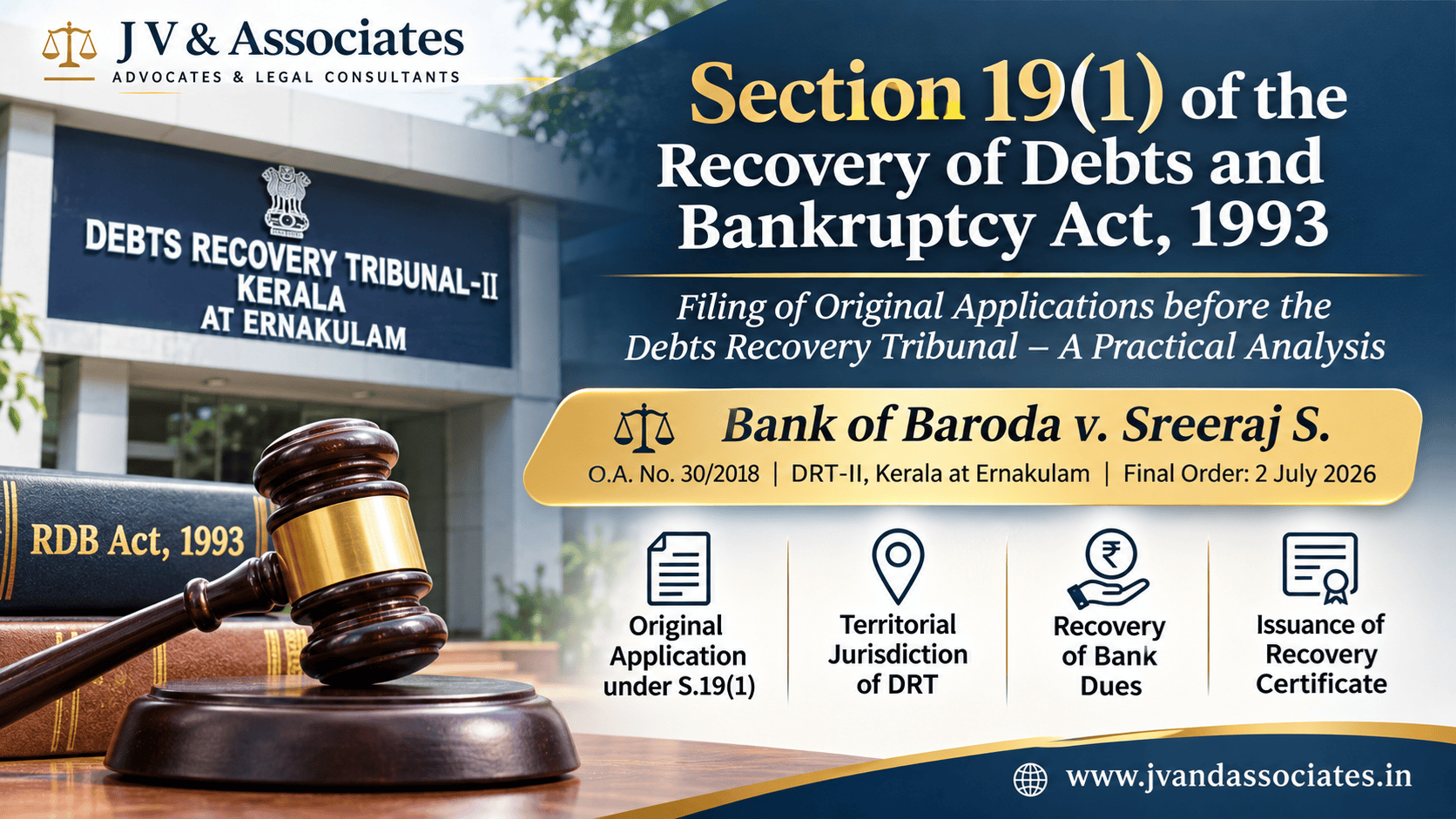
The Recovery of Debts and Bankruptcy Act, 1993 (hereinafter referred to as the “RDB Act”) provides a specialised legal framework for the adjudication and recovery of debts due to banks and financial institutions. One of the most important provisions governing the initiation of recovery proceedings is Section 19(1), which enables banks and financial institutions to approach the Debts Recovery Tribunal (DRT) by filing an Original Application (OA) against a borrower or other person liable for the debt.
An Original Application under Section 19(1) is the principal statutory mechanism through which a bank or financial institution seeks adjudication of its claim and a recovery certificate against the borrower.
The provision is significant not only because it provides the statutory basis for recovery proceedings but also because it determines the territorial jurisdiction of the Tribunal before which such proceedings may be instituted.
A practical illustration of the operation of Section 19(1) can be found in the following decision of the Debts Recovery Tribunal-II, Kerala, at Ernakulam.
2.Case Study: Bank of Baroda v. Sreeraj S.
IN THE DEBTS RECOVERY TRIBUNAL-2, KERALA AT ERNAKULAM
Present: Sri. Sovan Kumar Dash, Presiding Officer
Original Application No. 30/2018
Bank of Baroda – Applicant
Versus
Sreeraj S. – Defendant
Date of Final Order: 2 July 2026
The Original Application was instituted under Section 19(1) of the Recovery of Debts and Bankruptcy Act, 1993, seeking recovery of ₹13,81,150.09 together with interest and costs.
Facts leading to the proceedings
The defendant had approached the Karunagapally Branch of the erstwhile Vijaya Bank during 2014 for a term loan to purchase a new ICML vehicle for business purposes.
The bank sanctioned a term loan of ₹9.44 lakh. The loan was secured by hypothecation of the vehicle purchased using the loan proceeds.
The borrower subsequently defaulted in repayment of the instalments, resulting in the loan account becoming irregular.
The bank issued a lawyer notice dated 8 January 2016 demanding repayment of the outstanding amount. Since the borrower did not discharge the liability, the bank instituted an Original Application before the Debts Recovery Tribunal seeking recovery of the outstanding amount and enforcement of the security.
The applicant bank was subsequently substituted in place of Vijaya Bank pursuant to an order dated 23 May 2022 in I.A. No. 1555/2019.
Defence raised by the borrower
The defendant disputed the bank’s claim and contended, among other things, that:
- Although the loan had been sanctioned for purchasing a particular vehicle, the vehicle actually delivered by the dealer was not the one booked by him.
- The vehicle allegedly lacked the necessary documents required for use on the road.
- No income could be generated from the vehicle, making repayment of the loan difficult.
- A complaint had been filed before the Judicial First Class Magistrate Court, Chavara, against the vehicle dealer and the erstwhile Vijaya Bank.
- The claim was barred by limitation and there was no valid acknowledgement of liability.
Findings of the Tribunal
The Tribunal examined the loan documents, the bank’s proof affidavit and the statement of account.
The bank relied upon the following documents:
- Demand promissory note dated 15 October 2014.
- Loan-cum-hypothecation agreement dated 15 October 2014.
- Letter of repayment.
- Lawyer notice dated 8 January 2016.
- Acknowledgement of liability dated 28 September 2017.
- Certified statement of loan account.
- Certificate relating to the interest and penal interest charged.
The Tribunal observed that the bank’s proof affidavit and documents had not been challenged by the defendant. Despite sufficient opportunities, the defendant did not file a counter proof affidavit and subsequently remained absent from the proceedings.
The Tribunal also found that the defendant had acknowledged liability for ₹13,37,058.09 as on 28 September 2017. Consequently, the Original Application filed on 9 January 2018 was held to be within the statutory period of limitation.
The dispute between the borrower and the vehicle dealer was held not to be a matter that could be entertained in the bank’s recovery proceedings.
Final order
The Tribunal allowed the Original Application and directed recovery of:
- ₹13,81,150.09 from the defendant, including by sale of the scheduled vehicle;
- Pendente lite and post-decree interest at 10% per annum on ₹13,67,590.09 from 10 January 2018 until realisation; and
- Costs and expenses incurred by the bank for recovery of the loan.
The Tribunal further directed that a Recovery Certificate be issued to the Recovery Officer in accordance with the final order.
This decision illustrates how an Original Application under Section 19(1) proceeds from the institution of recovery proceedings to adjudication and issuance of a Recovery Certificate.
3.Section 19(1) of the Recovery of Debts and Bankruptcy Act, 1993 – Statutory Framework
Section 19(1) provides the statutory authority for a bank or financial institution to institute recovery proceedings before the Debts Recovery Tribunal.
The provision reads as follows:
“Where a bank or a financial institution has to recover any debt from any person, it may make an application to the Tribunal within the local limits of whose jurisdiction—
(a) the branch or any other office of the bank or financial institution is maintaining an account in which debt claimed is outstanding, for the time being; or
(aa) the defendant, or each of the defendants where there are more than one, at the time of making the application, actually and voluntarily resides, or carries on business, or personally works for gain; or
(b) any of the defendants, where there are more than one, at the time of making the application, actually and voluntarily resides, or carries on business, or personally works for gain; or
(c) the cause of action, wholly or in part, arises.”
The provision provides alternative territorial jurisdictional grounds for instituting an Original Application before the DRT.
It is important to understand that the provision is not merely concerned with the authority of a bank to recover its dues. It also determines the appropriate Tribunal before which the recovery proceedings may be instituted.
4.Who Can Institute an Original Application under Section 19(1)?
The opening words of Section 19(1) identify the persons entitled to institute recovery proceedings under this provision.
The following are the essential requirements:
1.The applicant must be a bank or financial institution
The provision specifically enables a bank or financial institution to approach the Tribunal for recovery of its debt.
The expression “bank” is defined under Section 2(d) of the Act and includes banking companies, corresponding new banks, the State Bank of India, subsidiary banks, Regional Rural Banks and multi-State co-operative banks.
The expression “financial institution” is defined under Section 2(h) and includes specified public financial institutions, securitisation companies, reconstruction companies and other institutions notified by the Central Government.
Therefore, an ordinary individual creditor or an entity which does not fall within the statutory definition cannot institute an Original Application under Section 19(1) merely because money is due to it.
2. There must be a debt recoverable from a person
The applicant must establish the existence of a debt due from the defendant.
Section 2(g) defines “debt” broadly to include any liability, inclusive of interest, claimed as due from any person by a bank or financial institution in the course of its business activity.
Such liability may be secured or unsecured and may arise under a loan agreement, mortgage, hypothecation or other legally recognised arrangement.
The existence of a security interest is not an essential prerequisite for filing an Original Application. An unsecured debt can also form the basis of recovery proceedings, subject to the other statutory requirements.
3.The claim must fall within the pecuniary jurisdiction of the DRT
Section 1(4) of the Act prescribes the pecuniary threshold for the applicability of the legislation.
By Notification No. S.O. 4312(E) dated 6 September 2018, the Central Government increased the minimum threshold from ₹10 lakh to ₹20 lakh.
Accordingly, the RDB Act ordinarily does not apply to recovery claims below ₹20 lakh, subject to the statutory and notification-based saving provisions for specified applications instituted before the enhanced threshold became applicable.
This aspect is particularly relevant to the present case.
The Original Application in Bank of Baroda v. Sreeraj S. was instituted on 9 January 2018 for ₹13,81,150.09. It was filed before the enhancement of the pecuniary threshold on 6 September 2018.
The subsequent notification dated 11 July 2019 (S.O. 2478(E)) preserved the applicability of the Act to recovery applications filed before 6 September 2018. Thus, the later enhancement of the threshold did not automatically invalidate the pending Original Application.
The distinction between the pecuniary jurisdiction applicable on the date of institution and the subsequently enhanced threshold is important when examining older DRT proceedings.
5.Territorial Jurisdiction under Section 19(1)
One of the most significant aspects of Section 19(1) is the determination of territorial jurisdiction.
The provision provides alternative jurisdictional grounds, enabling the bank to institute proceedings before a Tribunal having jurisdiction under any of the specified clauses.
Let us examine each of these grounds.
i.Jurisdiction where the bank maintains the loan account – Section 19(1)(a)
Under clause (a), an Original Application may be filed before the DRT within whose territorial jurisdiction the branch or any other office of the bank or financial institution maintains the account in which the debt claimed is outstanding for the time being.
This provision is particularly relevant in banking recovery proceedings because the loan account is generally maintained at a particular branch of the lending institution.
For example, if a bank’s branch at Karunagapally maintains the loan account in which the outstanding debt is reflected, the DRT having territorial jurisdiction over that branch may entertain the Original Application, subject to the applicable jurisdictional allocation.
In the present case, the loan was originally sanctioned through the Karunagapally Branch of Vijaya Bank. The applicant bank was subsequently substituted as Bank of Baroda.
The case therefore provides a practical illustration of the relevance of the branch maintaining the outstanding loan account in determining territorial jurisdiction.
The words “for the time being” are also important. They refer to the branch or office where the account is being maintained at the time relevant to the institution of the application.
ii. Jurisdiction based on the defendant’s residence, business or employment – Section 19(1)(aa)
Clause (aa) provides another basis for territorial jurisdiction.
An application may be filed before the Tribunal within whose jurisdiction the defendant, at the time of making the application:
- Actually and voluntarily resides;
- Carries on business; or
- Personally works for gain.
The provision also refers to the situation where there is more than one defendant and each of them resides, carries on business or personally works for gain within the jurisdiction.
The expression “at the time of making the application” is significant. The relevant territorial circumstances are to be examined with reference to the date on which the Original Application is instituted.
For instance, if a borrower actually and voluntarily resides within the territorial jurisdiction of a particular DRT, the bank may rely upon this clause to institute proceedings before that Tribunal.
iii.Jurisdiction where any one of the defendants resides or carries on business – Section 19(1)(b)
Clause (b) specifically addresses cases involving multiple defendants.
Where there are several defendants, an Original Application may be instituted before the Tribunal within whose jurisdiction any one of the defendants, at the time of making the application:
- Actually and voluntarily resides;
- Carries on business; or
- Personally works for gain.
The distinction between clauses (aa) and (b) is relevant.
Clause (aa) refers to the defendant or each of the defendants where there are more than one, whereas clause (b) expressly recognises jurisdiction based on the presence of any one of the defendants within the territorial limits of the Tribunal.
This provision assumes practical importance in recovery proceedings involving borrowers, co-borrowers and guarantors residing or carrying on business in different territorial jurisdictions.
iv.Jurisdiction where the cause of action arises – Section 19(1)(c)
Clause (c) provides that an Original Application may also be instituted before the Tribunal within whose jurisdiction the cause of action arises wholly or in part.
The expression “cause of action” refers to the bundle of material facts which gives the applicant the right to seek judicial or statutory relief against the defendant.
In banking recovery proceedings, relevant facts may include:
- Sanction and disbursement of the loan;
- Execution of loan and security documents;
- Creation of mortgage or hypothecation;
- Failure to repay the instalments;
- Occurrence of default; and
- Other material events forming the basis of the bank’s recovery claim.
Where a material part of the cause of action arises within the territorial jurisdiction of a particular DRT, clause (c) may provide the necessary jurisdictional foundation.
The existence of a jurisdictional connection must, however, be established through relevant facts and not merely by reference to the convenience of the applicant bank.
6.Can the Bank Choose Between Different DRTs?
An important feature of Section 19(1) is that the territorial jurisdictional grounds are expressed in the alternative.
The bank may institute an Original Application before a Tribunal having jurisdiction under any one of the applicable statutory grounds.
For example, the branch maintaining the loan account may be situated in one district, while the borrower resides or carries on business in another district.
Similarly, the cause of action may arise wholly or partly within a different territorial jurisdiction.
In such circumstances, the bank may rely upon the applicable clause of Section 19(1), provided the chosen Tribunal has been assigned jurisdiction over the relevant territorial area.
However, the availability of alternative jurisdictional grounds does not mean that the bank can institute proceedings before any DRT of its choice. The territorial connection must fall within the statutory requirements.
7.Procedure Following Institution of an Original Application
Section 19 does not stop with authorising the institution of recovery proceedings. It also prescribes the procedural framework for adjudication.
Some important stages are discussed below.
i.Filing of the Original Application
Under Section 19(3), the application must be filed in the prescribed form, accompanied by true copies of the documents relied upon and the prescribed application fee.
The application is governed by the Debts Recovery Tribunal (Procedure) Rules, 1993.
The applicant bank is required to place the relevant loan documents, statements of account and other supporting materials before the Tribunal.
ii.Issuance of summons
Under Section 19(4), upon receipt of the application, the Tribunal shall issue summons to the defendant.
The defendant is required to show cause within thirty days of service of summons as to why the relief claimed by the bank should not be granted.
The summons also contains directions concerning disclosure of properties and assets and related interim protections contemplated under the Act.
iii. Filing of written statement
Under Section 19(5), the defendant is required to present a written statement of defence within thirty days from the date of service of summons.
The defendant may raise appropriate legal and factual defences, including disputes concerning:
- The existence and quantum of the debt;
- The correctness of the statement of account;
- The validity of the loan documents;
- Limitation;
- Payments and adjustments;
- The liability of guarantors; and
- The enforceability of the security.
The Act permits an extension of time in exceptional cases and special circumstances, subject to the statutory conditions.
iv.Set-off and counter-claim
Sections 19(6) to 19(9) recognise the defendant’s right to raise a claim of set-off and counter-claim, subject to the requirements prescribed under the Act.
This is an important procedural safeguard because the Tribunal is not confined to examining the bank’s claim in isolation. In appropriate cases, it may also adjudicate the defendant’s legally maintainable claims against the applicant bank.
v.Final adjudication and Recovery Certificate
After considering the pleadings, evidence and submissions of the parties, the Tribunal may pass an interim or final order under Section 19(20).
Under Section 19(22), the Presiding Officer shall issue a Recovery Certificate along with the final order for recovery of the amount specified therein.
The Recovery Certificate is then transmitted to the Recovery Officer for execution in accordance with the provisions of the Act.
8.Practical Lessons from Bank of Baroda v. Sreeraj S.
The decision of the DRT-II, Kerala, offers several practical lessons for borrowers and banking institutions.
Importance of documentary evidence
The Tribunal placed considerable reliance on the loan documents, the certified statement of account and the acknowledgement of liability produced by the bank.
This demonstrates the importance of maintaining proper documentation in banking recovery proceedings.
Importance of filing a proper defence
A borrower cannot effectively contest a recovery claim merely by raising general allegations.
The defendant must specifically dispute the bank’s claim, produce supporting documents and establish the factual and legal basis of the defence.
In the present case, the defendant’s failure to challenge the bank’s proof affidavit and documentary evidence materially affected the adjudication.
Disputes with third parties
The defendant raised allegations concerning the vehicle dealer and the alleged deficiencies in the vehicle supplied.
The Tribunal held that the dispute between the defendant and the vehicle dealer could not be entertained in the bank’s recovery proceedings.
This illustrates the importance of identifying whether a dispute directly concerns the bank’s recovery claim or involves an independent cause of action against a third party.
Acknowledgement of liability and limitation
The Tribunal relied upon the acknowledgement of liability dated 28 September 2017 and held that the Original Application filed on 9 January 2018 was within limitation.
Borrowers should therefore carefully examine the legal effect of acknowledgements, balance confirmations and other documents executed during the subsistence of a loan account.
- Consequences of a Recovery Certificate
The issuance of a Recovery Certificate is not merely a formal conclusion of the adjudication proceedings. It enables the Recovery Officer to initiate recovery measures under the Act.
Consequently, defendants must take the proceedings seriously and raise their objections at the appropriate stage.
9.Conclusion
Section 19(1) of the Recovery of Debts and Bankruptcy Act, 1993, provides the statutory foundation for banks and financial institutions to initiate recovery proceedings before the Debts Recovery Tribunal.
Its importance lies in two principal aspects: first, it recognises the right of eligible banks and financial institutions to institute recovery proceedings; and secondly, it identifies the territorial jurisdictional grounds on which such proceedings may be instituted.
The decision in Bank of Baroda v. Sreeraj S., O.A. No. 30/2018, before the Debts Recovery Tribunal-II, Kerala, at Ernakulam, demonstrates the practical operation of this statutory mechanism, from the institution of an Original Application to the adjudication of the bank’s claim and issuance of a Recovery Certificate.
For borrowers, guarantors and financial institutions, understanding Section 19(1) is essential for identifying the appropriate forum, examining the maintainability of recovery proceedings and protecting their respective legal rights.
Legal Disclaimer: This article is intended for general educational and informational purposes and should not be construed as legal advice. The applicability of statutory provisions depends upon the facts and circumstances of each case and the law in force at the relevant time.
Case Reference: Bank of Baroda v. Sreeraj S., Original Application No. 30/2018, Debts Recovery Tribunal-II, Kerala, at Ernakulam, Final Order dated 2 July 2026.