

Table of Contents
ToggleIntroduction
The jurisdiction of civil courts in matters involving proceedings under the Securitisation and Reconstruction of Financial Assets and Enforcement of Security Interest Act, 2002 (“SARFAESI Act”) has long been the subject of judicial debate. Section 34 of the Act is often invoked by secured creditors to contend that every civil suit touching a secured asset is barred. Conversely, litigants frequently argue that disputes involving partition, title or declaration fall outside the jurisdiction of the Debt Recovery Tribunal (“DRT”) and therefore remain triable by civil courts.
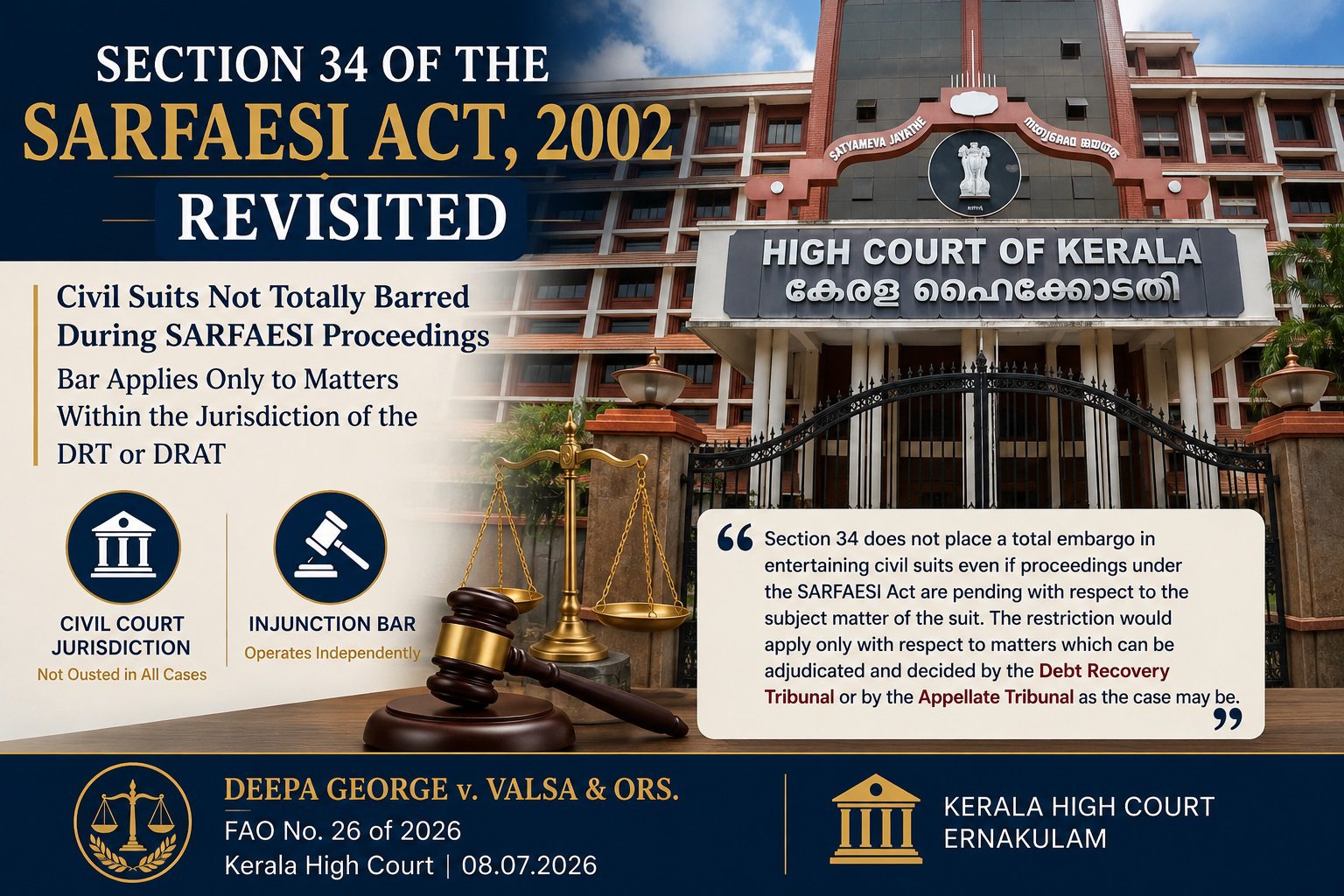
In Deepa George v. Valsa & Others, 2026:KER:50094, the Kerala High Court has undertaken an extensive examination of Section 34 and has delivered an important judgment harmonising the statutory scheme with the recent decision of the Supreme Court in Central Bank of India v. Prabha Jain. The judgment reiterates that Section 34 does not create an absolute prohibition against civil suits merely because SARFAESI proceedings are pending. At the same time, it holds that the prohibition against granting injunctions operates independently and continues to protect SARFAESI proceedings even where the civil suit itself is maintainable.
This decision is likely to become an important precedent in disputes involving partition, declaration of title and mortgage challenges where secured assets are involved.
The Facts in Brief
The appellant instituted a suit seeking partition of family property together with a declaration that the mortgage created in favour of the secured creditor was invalid and not binding on her share. Pending the suit, she sought an interim injunction restraining the secured creditor from taking possession of the property under the SARFAESI Act.
The trial court dismissed the application principally relying upon Jagdish Singh v. Heeralal, holding that Section 34 barred the jurisdiction of the civil court.
The appeal before the Kerala High Court therefore raised two distinct questions:
- Whether a civil suit seeking partition and declaration is barred merely because SARFAESI proceedings are pending; and
- Whether the civil court can nevertheless grant an injunction restraining SARFAESI proceedings.
These two questions form the foundation of the Court’s reasoning.
Section 34: Two Distinct Embargoes
Section 34 reads:
“No civil court shall have jurisdiction to entertain any suit or proceeding in respect of any matter which a Debts Recovery Tribunal or the Appellate Tribunal is empowered… to determine and no injunction shall be granted…”
The Kerala High Court observed that the provision actually contains two separate statutory prohibitions.
First Limb
The first part bars civil court jurisdiction only in respect of matters which the DRT or DRAT is empowered to determine.
Second Limb
The second part prohibits courts from granting injunctions against actions taken or proposed under the SARFAESI Act.
The distinction between these two limbs forms the central theme of the judgment.
Civil Court Jurisdiction is Not Completely Ousted
One of the most important principles reaffirmed by the Court is that Section 34 does not create a blanket exclusion of civil court jurisdiction.
The Court held that the embargo applies only where the subject matter of the suit falls within the adjudicatory powers of the DRT.
Consequently, disputes relating to:
- partition,
- declaration of title,
- succession,
- family rights,
- validity of transfers,
- other civil rights incapable of adjudication by the DRT,
continue to remain within the jurisdiction of the ordinary civil courts.
The DRT is a tribunal of limited jurisdiction. It cannot assume powers which Parliament has never conferred upon it.
Accordingly, where the principal relief is one which the DRT is legally incapable of granting, the civil suit remains maintainable notwithstanding pending SARFAESI proceedings.
The Influence of Central Bank of India v. Prabha Jain
The judgment draws heavily from the Supreme Court’s decision in Central Bank of India v. Prabha Jain (2025).
The Supreme Court had clarified that Jagdish Singh should not be understood as laying down an absolute bar against every civil suit concerning secured assets.
The Kerala High Court notes that Jagdish Singh did not consider the fact that the DRT possesses no jurisdiction to pass partition decrees. Consequently, that decision cannot govern suits involving reliefs which lie exclusively within civil court jurisdiction.
This clarification significantly narrows the broad understanding that many courts had earlier attributed to Jagdish Singh.
The Most Significant Contribution: Interpretation of Section 34
Perhaps the most valuable contribution of this judgment lies in its discussion on interpretation of statutes.
The Court analysed the word “and” occurring in Section 34.
Ordinarily, “and” is read conjunctively.
However, relying upon established principles of statutory interpretation and Supreme Court precedents such as Ishwar Singh Bindra and Municipal Corporation of Delhi v. Tek Chand Bhatia, the Court held that, where necessary to give effect to legislative intent, “and” may be read disjunctively.
If “and” were interpreted strictly conjunctively, the second prohibition against injunctions would become practically redundant.
The Court therefore held that:
- the first limb governs maintainability of suits; while
- the second limb independently governs the grant of injunctions.
This interpretation preserves the effectiveness of both parts of Section 34 and accords with the settled rule that every word used by Parliament must be given meaning.
Why Injunction Was Still Refused
Having held that a partition suit may indeed be maintainable, the Court nevertheless refused interim relief.
The reason was straightforward.
Even if the civil court possesses jurisdiction to decide the dispute, Section 34 expressly prohibits courts from granting injunctions that would obstruct proceedings initiated under the SARFAESI Act.
The Court also relied upon the overriding effect of Section 35 of the Act, observing that Parliament intended SARFAESI proceedings to proceed without interruption from civil courts.
Thus, while adjudication of civil rights remains permissible, interference with recovery proceedings does not.
Practical Significance of the Judgment
The decision offers valuable guidance for practitioners.
For borrowers and co-owners
Genuine partition and title suits remain maintainable notwithstanding pending SARFAESI proceedings.
Such suits cannot be dismissed solely by invoking Section 34.
For secured creditors
SARFAESI proceedings continue without interruption even if civil litigation is pending.
Interim injunctions against recovery measures remain barred except in exceptional circumstances recognised by law.
For civil courts
Maintainability of the suit and grant of interim injunction are two independent enquiries.
The existence of jurisdiction does not automatically confer power to restrain SARFAESI proceedings.
Conclusion
The Kerala High Court has brought much-needed clarity to the scope of Section 34 of the SARFAESI Act. The judgment carefully balances two competing legislative objectives: preserving the jurisdiction of civil courts over disputes beyond the competence of the DRT, while simultaneously ensuring that recovery proceedings under the SARFAESI Act are not frustrated by interlocutory injunctions.
The decision reinforces the principle that the jurisdiction of civil courts is excluded only to the extent expressly provided by statute. At the same time, it recognises Parliament’s intention to protect the efficiency of the SARFAESI mechanism by insulating recovery proceedings from judicial interruption.
From the standpoint of statutory interpretation, the judgment is particularly noteworthy. By treating the two limbs of Section 34 as operating independently, the Court has adopted an interpretation that gives meaningful effect to every part of the provision and harmonises it with the overall scheme of the SARFAESI Act. For lawyers, financial institutions, and litigants alike, this judgment represents an important development in the evolving jurisprudence on the interface between civil court jurisdiction and specialised debt recovery mechanisms.