

Introduction
SARFAESI auction properties often attract buyers because they are perceived to be available at prices lower than prevailing market rates.
Many prospective purchasers assume:
“The property is being sold by a bank, so the title must be completely safe.”
Unfortunately, that assumption is not always correct.
While many SARFAESI auction purchases proceed smoothly, prudent purchasers should understand that buying a property through a bank auction is not entirely free from legal and practical risks.
Before participating in a SARFAESI auction, every bidder should conduct proper due diligence.
Risk No. 1 – Pending Litigation Before DRT
One of the first things an auction purchaser should verify is whether any proceedings are pending before the Debt Recovery Tribunal (DRT).
For example:
* Securitisation Applications under Section 17.
* Challenges to possession proceedings.
* Challenges to auction proceedings.
* Applications concerning the secured asset.
A pending case does not automatically invalidate the auction.
However, it may expose the purchaser to future litigation.
Risk No. 2 – Pending Section 29 Proceedings
Auction notices sometimes disclose that a Section 29 application is pending.
Many purchasers ignore this statement.
That can be a mistake.
Before participating, a purchaser should attempt to ascertain:
* Nature of the application.
* Relief sought.
* Present status.
* Whether any interim orders exist.
The significance of a Section 29 proceeding depends entirely on what is actually being challenged.
Risk No. 3 – Challenge to Possession Proceedings
The borrower may be challenging:
* Section 13(4) measures.
* Section 14 proceedings.
* Physical possession.
If the underlying SARFAESI measures are under challenge, the purchaser should understand the nature of the dispute.
Risk No. 4 – Pending Writ Proceedings
In some cases, borrowers or third parties may approach the High Court.
Before bidding, purchasers should ascertain whether:
* Writ petitions are pending.
* Interim orders have been passed.
* Possession proceedings are under challenge.
Risk No. 5 – Title Issues Predating the Mortgage
A bank auction does not necessarily cure title defects that existed before creation of the mortgage.
For example:
* Defective title deeds.
* Boundary disputes.
* Inheritance disputes.
* Prior ownership claims.
Due diligence should extend beyond the auction notice itself.
Risk No. 6 – Occupied Property
A purchaser should determine:
* Whether physical possession has been taken.
* Whether occupants remain in possession.
* Whether tenants are present.
Obtaining actual possession may sometimes be more difficult than anticipated.
Risk No. 7 – Undisclosed Third-Party Claims
Third parties may claim:
* Ownership rights.
* Easement rights.
* Possessory rights.
* Tenancy rights.
The existence of such claims may affect the purchaser’s future use of the property.
Risk No. 8 – Revenue Record Issues
Purchasers often assume that mutation automatically follows issuance of a Sale Certificate.
In practice, procedural issues may arise regarding:
* Revenue records.
* Property tax records.
* Municipal records.
* Utility transfers.
These matters should be investigated in advance.
Risk No. 9 – Pending Government Dues
Certain statutory liabilities may create practical difficulties for the purchaser.
Verification should be undertaken regarding:
* Property tax.
* Building tax.
* Local authority dues.
* Utility charges.
Risk No. 10 – Incorrect Property Description
The purchaser should verify:
* Survey number.
* Extent.
* Boundaries.
* Building details.
Errors in property description occasionally create complications.
Risk No. 11 – Agricultural Land Issues
The nature of the property should be carefully examined.
Certain categories of property may raise legal issues under the SARFAESI framework.
Risk No. 12 – Auction Conducted During Pending Challenges
A purchaser should ascertain whether:
* Stay applications are pending.
* Interim relief applications are pending.
* Appeals are pending.
Even where no stay order exists, knowledge of ongoing litigation is important.
Risk No. 13 – Sale Certificate Litigation
Many purchasers believe that once a Sale Certificate is issued, all disputes come to an end.
In reality, litigation may continue concerning:
* Validity of the sale.
* Procedural irregularities.
* Fraud allegations.
* Jurisdictional issues.
The mere issuance of a Sale Certificate does not guarantee the absence of future disputes.
Risk No. 14 – Delay in Development or Resale
Properties purchased through auction sometimes encounter delays relating to:
* Mutation.
* Possession.
* Litigation.
* Documentation.
Purchasers intending immediate resale should keep this possibility in mind.
Risk No. 15 – Relying Solely on the Bank’s Assurance
One of the most common mistakes is to rely exclusively upon statements made by bank officials.
For example:
“Do not worry. You will get clear title.”
While such statements may be made in good faith, a prudent purchaser should independently verify:
* Litigation status.
* Property records.
* Possession status.
* Encumbrances.
* Auction documents.
Independent due diligence remains essential.
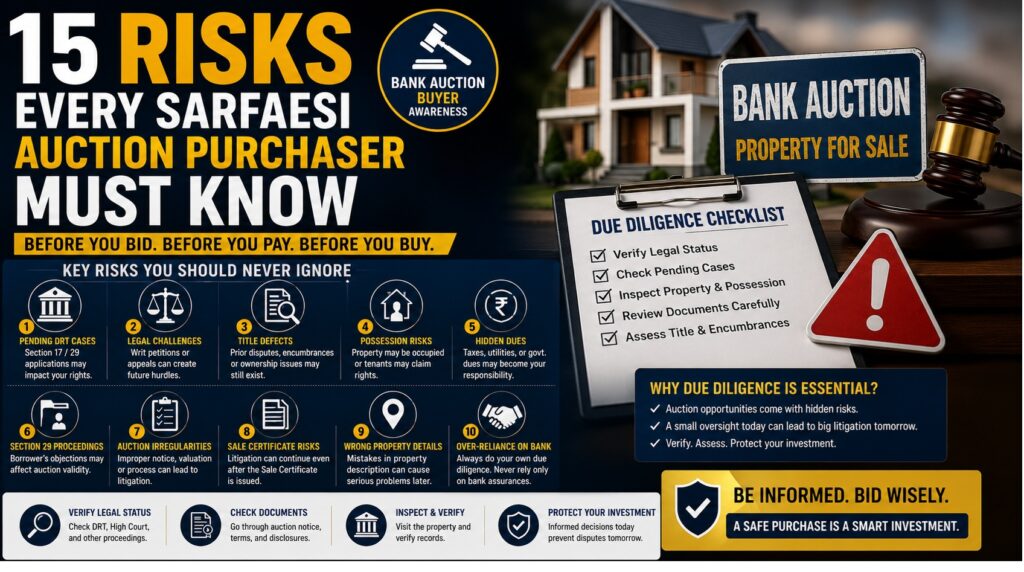
Practical Due Diligence Checklist
Before bidding, consider obtaining:
✓ Auction Notice
✓ Sale Terms and Conditions
✓ Possession Notice
✓ Details of pending DRT proceedings
✓ Details of pending High Court proceedings
✓ Revenue records
✓ Property tax records
✓ Encumbrance records
✓ Valuation details
✓ Status of physical possession
A Frequently Asked Question
Does a SARFAESI Sale Certificate Guarantee Perfect Title?
Not necessarily.
A Sale Certificate is an important document evidencing the statutory sale.
However, prudent purchasers should independently investigate:
* Litigation risks.
* Possession issues.
* Title issues.
* Third-party claims.
The quality of title ultimately depends on the facts relating to the property and the underlying transaction.
Conclusion
SARFAESI auctions present attractive opportunities for property purchasers and investors. However, the prospect of acquiring property at a discounted price should never replace proper legal and factual due diligence.
A prudent purchaser should investigate not only the property itself but also the litigation history, possession status, revenue records, and pending proceedings before committing substantial funds.
In many cases, a few days spent on due diligence can prevent years of avoidable litigation.
Disclaimer: This article is intended for general informational purposes only and does not constitute legal advice. Every property and every auction presents unique factual and legal considerations.