

Introduction
The Bank Has Issued a Sale Certificate. Is the Property Completely Safe to Purchase?
Many purchasers participating in SARFAESI auctions assume:
“The property is being sold by a bank and a Sale Certificate will be issued. Therefore, the title must be completely safe.”
This is one of the most common misconceptions in auction property transactions.
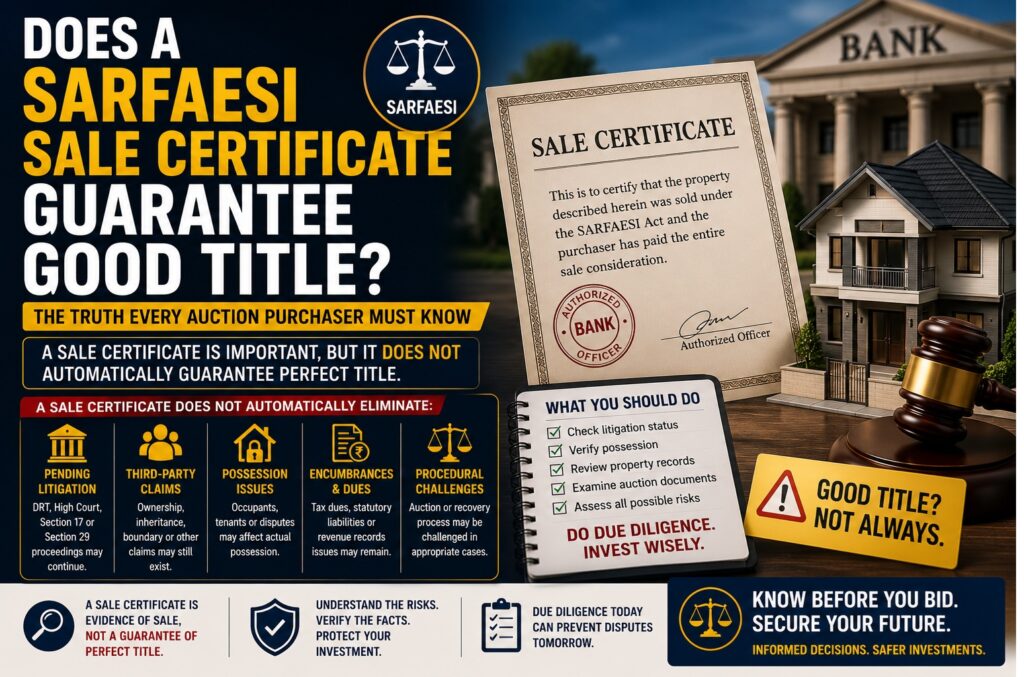
A Sale Certificate is undoubtedly an important document. However, prudent purchasers should understand what a Sale Certificate actually does—and what it does not do.
The answer to the question:
“Does a SARFAESI Sale Certificate guarantee good title?”
is often more nuanced than many purchasers expect.
What Is a SARFAESI Sale Certificate?
After a successful SARFAESI auction and payment of the sale consideration, the Authorized Officer of the bank may issue a Sale Certificate in favour of the auction purchaser.
The Sale Certificate records:
* Details of the property.
* Details of the auction purchaser.
* Sale consideration.
* Completion of the sale process.
It serves as evidence of the statutory sale conducted under the SARFAESI framework.
Why Do Purchasers Place So Much Importance on the Sale Certificate?
Because it is the primary document through which the auction purchaser derives title from the statutory sale.
Many purchasers therefore assume:
“If a Sale Certificate exists, no dispute can arise.”
Unfortunately, that assumption is not always correct.
What Does a Sale Certificate Actually Establish?
Generally speaking, it establishes that:
* The property was sold through the SARFAESI process.
* The purchaser was declared successful in the auction.
* The sale was completed in accordance with the auction process.
However, it does not automatically eliminate every legal issue relating to the property.
Does a Sale Certificate Cure Earlier Title Defects?
Not necessarily.
One of the most important principles for auction purchasers to understand is that a bank auction does not automatically cure every defect that may have existed before the mortgage was created.
For example:
* Ownership disputes.
* Inheritance disputes.
* Boundary disputes.
* Defects in earlier title documents.
Such issues may require independent investigation.
Can litigation Continue Even After Issuance of a Sale Certificate?
Yes.
This often surprises auction purchasers.
Even after issuance of a Sale Certificate, litigation may continue concerning:
* SARFAESI proceedings.
* Auction process.
* Recovery proceedings.
* Alleged procedural irregularities.
* Competing claims.
The significance of such litigation depends upon the facts of the case.
What If a Section 17 Application Is Pending?
Suppose the borrower has filed a Section 17 application before the Debt Recovery Tribunal challenging:
* Possession proceedings.
* Auction proceedings.
* Sale proceedings.
The existence of such proceedings does not automatically invalidate the Sale Certificate.
However, it is a factor that prudent purchasers should examine carefully.
What If a Section 29 Application Is Pending?
Similarly, proceedings relating to attachment, sale or recovery actions may sometimes continue before the Recovery Officer.
Again, the significance depends upon:
* Nature of the application.
* Relief sought.
* Orders passed.
The mere existence of litigation does not automatically destroy the purchaser’s title, but it should not be ignored.
Can the Auction Purchaser Be Made a Party to Future Litigation?
Yes.
This is a practical reality that many purchasers overlook.
Where disputes continue after the sale, the purchaser may be impleaded in proceedings concerning:
* The property.
* The auction process.
* Recovery proceedings.
Being made a party does not automatically mean the purchaser will lose the property.
However, it may involve time, expense and participation in litigation.
Does a Sale Certificate Guarantee Physical Possession?
Not always.
A purchaser should separately ascertain:
* Whether physical possession has been taken.
* Whether occupants remain in possession.
* Whether tenancy disputes exist.
* Whether possession is under challenge.
A Sale Certificate and physical possession are not always obtained simultaneously.
Does a Sale Certificate Guarantee Easy Mutation?
Not necessarily.
Although mutation often follows the issuance of a Sale Certificate, practical issues may arise regarding:
* Revenue records.
* Municipal records.
* Tax records.
* Utility transfers.
The process may vary depending upon the circumstances and local procedures.
Does a Sale Certificate Eliminate All Encumbrance Risks?
Purchasers should conduct independent verification regarding:
* Property records.
* Revenue records.
* Government dues.
* Pending litigation.
A prudent purchaser should never assume that possession of a Sale Certificate alone answers every title-related question.
Common Misconceptions About Sale Certificates
Myth 1
“A Sale Certificate guarantees perfect title.”
Not necessarily.
Myth 2
“No one can challenge the sale after a Sale Certificate is issued.”
The legal position is often more complex.
Myth 3
“No litigation can continue after issuance of the Sale Certificate.”
Litigation may continue depending upon the facts.
Myth 4
“The bank has already verified everything.”
The purchaser should still conduct independent due diligence.
What Due Diligence Should a Purchaser Conduct?
Before bidding—or even after being declared successful—the purchaser should consider verifying:
Litigation Status
* DRT proceedings.
* High Court proceedings.
* Pending challenges.
Possession Status
* Physical possession.
* Occupancy issues.
* Tenancy issues.
Property Records
* Revenue records.
* Tax records.
* Encumbrances.
Auction Records
* Sale notice.
* Possession notice.
* Auction terms.
Practical Questions Every Purchaser Should Ask
Before relying on a Sale Certificate, consider asking:
* Is any Section 17 application pending?
* Is any Section 29 application pending?
* Has possession been obtained?
* Are there occupants in the property?
* Are any High Court proceedings pending?
* Are there third-party claims?
* Have revenue records been updated?
These questions often reveal issues that are not apparent from the Sale Certificate itself.
Why Do Banks Disclose Pending Litigation in Auction Notices?
Many auction notices specifically disclose:
* Pending DRT proceedings.
* Pending applications.
* Ongoing litigation.
This disclosure enables purchasers to assess risk before participating in the auction.
Prudent purchasers should review such disclosures carefully rather than treating them as routine formalities.
Conclusion
A SARFAESI Sale Certificate is an important document evidencing the statutory sale of the property. However, it should not be viewed as a guarantee that every legal, factual, possession-related or title-related issue has been permanently resolved.
The existence of a Sale Certificate does not replace proper due diligence.
A prudent purchaser should examine the litigation history, possession status, property records, and any pending proceedings before making a substantial investment in auction property.
In many cases, the quality of due diligence undertaken before bidding is far more important than the mere existence of a Sale Certificate.
Disclaimer: This article is intended for general informational purposes only and does not constitute legal advice. Every auction property presents unique factual and legal considerations.