

Table of Contents
ToggleIntroduction
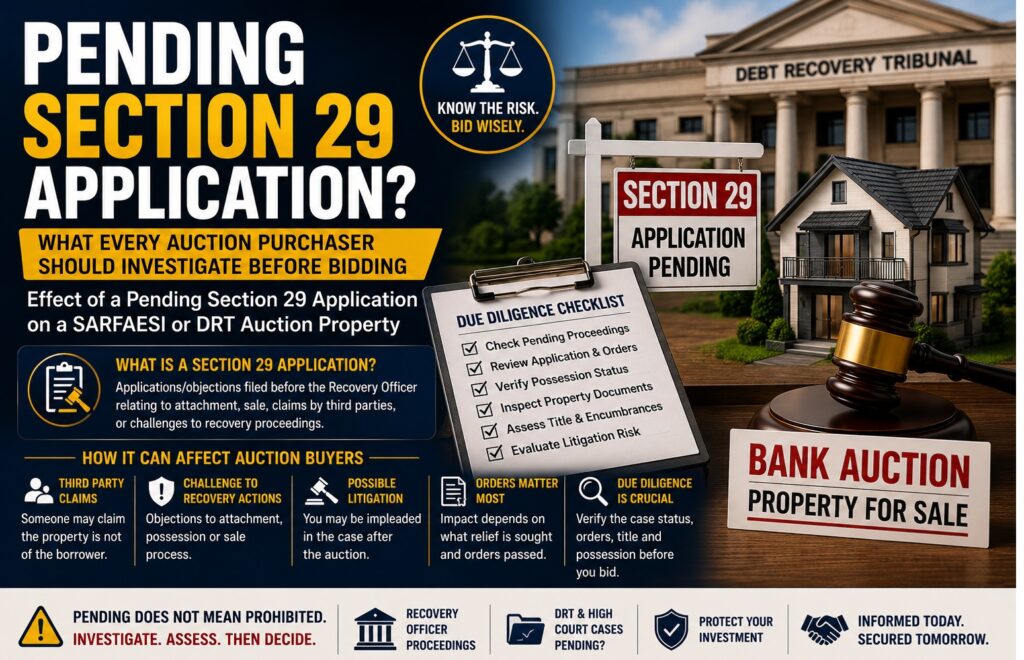
The Auction Notice Mentions a Pending Section 29 Application. Should You Bid?
Many auction purchasers come across a statement in the auction notice stating:
“Section 29 Application Pending.”
The immediate reaction is often:
* Is the property under dispute?
* Can the sale be set aside later?
* Is the title defective?
* Will I become involved in litigation?
* Should I avoid the auction entirely?
The answer depends upon the nature of the pending application.
A Section 29 application is not necessarily a reason to avoid an auction property. However, it is certainly a matter that should be investigated carefully before bidding.
What Is a Section 29 Proceeding?
Section 29 of the Recovery of Debts and Bankruptcy Act incorporates certain recovery mechanisms from the Income Tax recovery framework.
In practical terms, Section 29-related proceedings usually arise after:
- The bank obtains a Recovery Certificate.
- The matter reaches the Recovery Officer.
- Recovery measures are initiated.
Such proceedings commonly concern:
* Attachment of property.
* Recovery actions.
* Sale proceedings.
* Claims by third parties.
* Objections to recovery measures.
Why Is a Section 29 Application Important to an Auction Purchaser?
Because it may directly affect:
* The property being sold.
* The recovery process.
* The validity of attachment.
* The validity of sale proceedings.
The actual risk depends upon what exactly is being challenged.
Common Types of Section 29 Applications
i.Claim Petition by a Third Party
A third party may contend:
“The property does not belong to the debtor.”
This is one of the most significant categories of Section 29 disputes.
A purchaser should carefully examine the basis of the claim.
ii.Objection to Attachment
The debtor may contend:
“The property cannot legally be attached.”
Such objections may concern ownership, jurisdiction, or other legal issues.
Challenge to Recovery Proceedings
Applications may challenge:
* Attachment orders.
* Recovery steps.
* Sale process.
* Other actions of the Recovery Officer.
Applications Relating to Sale Proceedings
Certain applications may directly concern:
* Conduct of auction.
* Confirmation of sale.
* Distribution of sale proceeds.
The impact on the purchaser depends on the relief sought.
Does a Pending Section 29 Application Automatically Stop the Auction?
No.
This is one of the most common misconceptions.
Merely because a Section 29 application is pending does not automatically mean:
* The auction cannot proceed.
* The sale is invalid.
* The purchaser will lose title.
The critical issue is whether any effective order has been passed affecting the auction process.
Why Do Banks Mention Pending Section 29 Applications in Auction Notices?
Banks frequently disclose pending litigation to ensure transparency and avoid allegations that material facts were concealed from purchasers.
Such disclosure allows prospective bidders to make informed decisions.
However, disclosure alone does not explain the seriousness of the dispute.
Further investigation is usually necessary.
Can an Auction Purchaser Rely Solely on the Bank’s Assurance?
A common situation is where a bank officer says:
“Do not worry. You will get clear title.”
While such assurances may be given in good faith, prudent purchasers should not rely exclusively on oral statements.
The purchaser should independently examine:
* Nature of the application.
* Orders passed.
* Stage of proceedings.
* Possession status.
* Property records.
What Due Diligence Should Be Conducted?
Before participating in the auction, consider obtaining:
Copy of the Section 29 Application
The first question should be:
What exactly is the applicant asking for?
Without reading the application, the actual risk cannot be properly assessed.
Latest Orders
Review:
* Orders of the Recovery Officer.
* DRT orders, if any.
* Interim directions.
The actual order often reveals far more than the auction notice.
Status of Possession
Ascertain:
* Whether possession has been taken.
* Whether occupants remain.
* Whether possession is disputed.
Revenue and Property Records
Verify:
* Ownership records.
* Tax records.
* Encumbrances.
* Property descriptions.
Scenario 1 – Minor Procedural Application
Suppose the pending application concerns:
* Adjournment.
* Time extension.
* Procedural clarification.
In such cases, the risk to the purchaser may be relatively limited.
Scenario 2 – Ownership Dispute
Suppose a third party claims:
“The property belongs to me.”
This type of dispute deserves much closer scrutiny.
The implications may be more significant for a prospective purchaser.
Scenario 3 – Challenge to Sale Proceedings
Suppose the application alleges:
* Improper attachment.
* Invalid recovery process.
* Defects in auction proceedings.
In such cases, the purchaser should carefully evaluate the litigation risk before bidding.
Can the Auction Purchaser Become a Party to the Proceedings?
Yes.
After the auction is completed, purchasers are frequently impleaded in proceedings concerning:
* The property.
* The sale process.
* Recovery actions.
This does not necessarily mean the purchaser will lose the property.
However, it may require participation in the litigation.
Does a Sale Certificate Eliminate All Risks?
Not necessarily.
A Sale Certificate is an important document evidencing the sale.
However, litigation may still continue concerning:
* Recovery proceedings.
* Sale process.
* Alleged irregularities.
* Competing claims.
The significance of such litigation depends entirely upon the facts of the case.
Questions Every Auction Purchaser Should Ask
Before bidding, consider asking:
* What is the nature of the Section 29 application?
* Who filed it?
* What relief is sought?
* Has any stay order been granted?
* Is the property itself under challenge?
* Is possession disputed?
* Are there any related DRT or High Court proceedings?
These questions often provide a much clearer picture of the risk involved.
Common Mistakes Made by Auction Purchasers
Ignoring the Disclosure
Many purchasers assume that the mention of a pending Section 29 application is a routine formality.
Sometimes it is.
Sometimes it is not.
The only way to know is to investigate.
Assuming Every Pending Application Is Serious
Not every Section 29 application creates significant risk.
The nature of the dispute is more important than the mere existence of litigation.
Relying Exclusively on Verbal Assurances
Independent due diligence remains essential.
Failing to Review Court Records
The actual pleadings and orders often provide the most reliable picture of the situation.
Conclusion
A pending Section 29 application does not automatically make a SARFAESI or DRT auction property unsafe for purchase. However, it is a matter that should never be ignored.
The real issue is not the existence of the application itself, but the nature of the dispute, the relief sought, and the orders passed by the relevant authority.
Prudent purchasers should therefore conduct careful due diligence before participating in any auction where a pending Section 29 proceeding is disclosed.
In many cases, understanding the litigation before bidding can prevent substantial expense and future complications.
Disclaimer: This article is intended for general informational purposes only and does not constitute legal advice. Every auction property presents unique factual and legal considerations.