

Table of Contents
ToggleIntroduction
One of the most common questions asked by borrowers and guarantors facing recovery proceedings is:
“Can the Debt Recovery Tribunal stop the bank from auctioning my property?”
The short answer is:
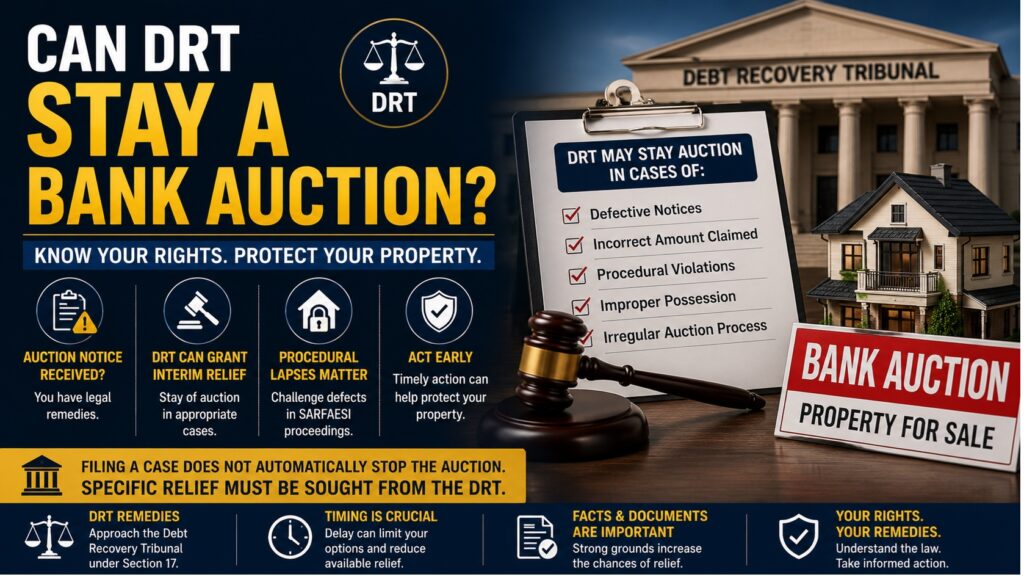
Yes, in appropriate cases, the Debt Recovery Tribunal (DRT) may grant interim protection and stay further recovery measures, including auction proceedings.
However, there is an important qualification:
Filing a case before the DRT does not automatically stop the auction.
The availability of relief depends upon the facts of each case, the stage of the proceedings, and the grounds raised by the applicant.
Why Do Banks Conduct Auctions?
Banks generally conduct auctions under the SARFAESI Act after taking steps such as:
- Issuing a Section 13(2) Demand Notice.
- Taking measures under Section 13(4).
- Obtaining physical possession where required.
- Publishing an auction notice.
The purpose of the auction is to recover the outstanding dues by selling the secured asset.
When Does the DRT Become Involved?
Borrowers, guarantors, and other affected persons frequently approach the Debt Recovery Tribunal after:
* Possession notices are issued.
* Section 14 proceedings are initiated.
* Physical possession is taken.
* Auction notices are published.
In such cases, the applicant may seek appropriate interim relief pending adjudication of the dispute.
Does Filing a Case Automatically Stay the Auction?
No.
This is perhaps the most common misconception in SARFAESI litigation.
Merely filing a Securitisation Application before the DRT does not automatically result in:
* Stay of auction.
* Stay of possession proceedings.
* Stay of further recovery measures.
Specific relief must ordinarily be sought from the Tribunal.
In What Circumstances May the DRT Grant Interim Protection?
Each case depends upon its own facts.
Some issues frequently raised before the Tribunal include:
– Defective SARFAESI Proceedings
The applicant may contend that:
* Mandatory notices were not properly issued.
* Statutory procedures were not followed.
* Possession proceedings are defective.
– Incorrect Outstanding Amount
Disputes sometimes arise regarding:
* Interest calculations.
* Unaccounted payments.
* Accounting discrepancies.
– Wrongful Classification of Account
In some cases, the borrower disputes the classification of the account as a Non-Performing Asset (NPA).
– Serious Procedural Violations
The Tribunal may examine whether the statutory safeguards under the SARFAESI Act and the Security Interest (Enforcement) Rules have been complied with.
– Auction-Related Irregularities
Issues may arise regarding:
* Valuation.
* Reserve price.
* Publication of auction notice.
* Conduct of auction proceedings.
What Happens If the Auction Date Is Very Near?
Many borrowers seek legal advice only a few days before thescheduled auction.
While urgent remedies may still be available depending upon the facts, delay can significantly affect the available options.
The earlier the legal issues are identified and placed before the Tribunal, the greater the opportunity for meaningful consideration.
Can the DRT Stay an Auction After Section 14 Proceedings?
Yes.
A common misconception is that once Section 14 proceedings have been initiated before the District Magistrate, no remedy remains.
In practice, borrowers frequently approach the DRT while:
* Section 14 proceedings are pending.
* Physical possession is being pursued.
* Auction proceedings are underway.
The DRT may consider the grievances raised and grant appropriate relief where justified by the facts.
What If the Auction Has Already Taken Place?
The position becomes more complicated after the auction is conducted.
Important questions include:
* Has the sale been confirmed?
* Has the Sale Certificate been issued?
* Has possession been handed over to the auction purchaser?
The available remedies may vary depending upon the stage reached in the proceedings.
Generally speaking, earlier challenges provide a wider range of options.
What If the Property Has Already Been Sold?
Many borrowers assume that issuance of a Sale Certificate ends all remedies.
That is not always correct.
Depending upon the circumstances, disputes may still arise regarding:
* Serious procedural irregularities.
* Fraud.
* Jurisdictional issues.
* Validity of the sale process.
However, challenges become more complex once third-party rights have crystallised.
Can the Bank Simultaneously Proceed Before DRT and Under SARFAESI?
Yes.
This often causes confusion.
A bank may simultaneously:
Proceed Under SARFAESI
By enforcing the secured asset.
and
Maintain DRT Proceedings
By seeking a Recovery Certificate against borrowers and guarantors.
Therefore, the existence of DRT proceedings does not necessarily stop SARFAESI proceedings unless specific relief is granted.
Common Mistakes Made by Borrowers
Waiting Until the Last Moment
Many borrowers seek legal advice only after publication of the auction notice.
Assuming Filing an Application Automatically Stops the Sale
Specific interim relief is usually required.
Ignoring Possession Proceedings
Auction proceedings are often preceded by earlier SARFAESI measures.
Depending Solely on Informal Discussions
Verbal assurances do not ordinarily suspend statutory recovery proceedings.
Practical Questions to Consider
If you have received an auction notice, important issues include:
* Has a Section 13(2) notice been issued?
* Has a Section 13(4) notice been issued?
* Are Section 14 proceedings pending?
* Has physical possession been taken?
* What is the scheduled auction date?
* Is there a dispute regarding the amount claimed?
* Are there any procedural irregularities?
The answers to these questions often determine the available remedies.
Conclusion
The Debt Recovery Tribunal has the power to consider applications challenging SARFAESI measures and, in appropriate cases, may grant interim protection concerning auction proceedings.
However, there is no automatic stay merely because an application has been filed. The availability of relief depends upon the facts of the case, the stage of the proceedings, and the issues raised before the Tribunal.
Borrowers and guarantors facing an auction notice should understand that timing is often critical. Waiting until the last moment may significantly restrict the available options.
Disclaimer: This article is intended for general informational purposes only and does not constitute legal advice. Every case depends upon its own facts, documents and circumstances.