

Table of Contents
ToggleIntroduction
Many borrowers are shocked when they discover that the Bank has taken possession of their property under the SARFAESI Act.
Their immediate reaction is often:
Can I go straight to the High Court and stop the Bank?
While approaching the High Court may appear to be the quickest option, the legal position is often different.
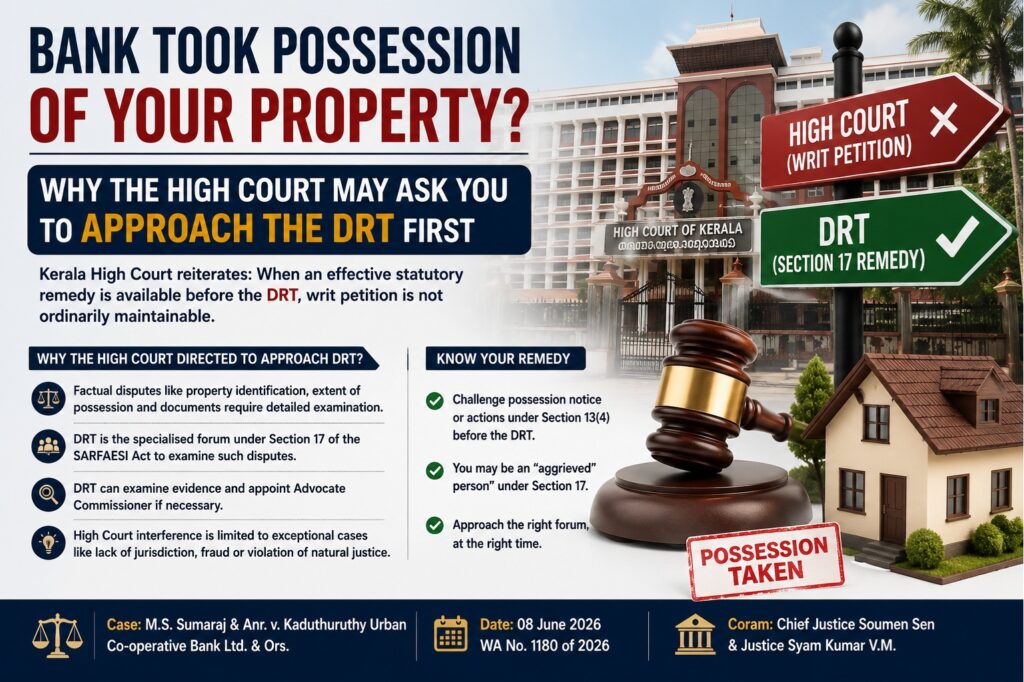
The Kerala High Court recently considered this issue in M.S. Sumaraj & Anr. v. Kaduthuruthy Urban Co-operative Bank Ltd. & Ors., WA No. 1180 of 2026, decided on 08 June 2026 reiterated where an effective remedy is available before the Debts Recovery Tribunal (DRT), parties should ordinarily approach the Tribunal rather than invoke the writ jurisdiction of the High Court.
Understanding this principle can save valuable time and help property owners choose the correct legal remedy.
What Was the Case About?
The dispute arose after a Co-operative Bank took possession of certain properties by invoking Sections 13(4) and 14 of the SARFAESI Act.
The appellants contended that:
* One of them was not a borrower or guarantor.
* Property belonging to a third party had allegedly been taken.
* The Advocate Commissioner had taken possession of land that was not covered by the mortgage.
* There were disputes regarding identification of the mortgaged property.
The property owners approached the High Court seeking relief against the possession proceedings.
Why Didn’t the High Court Decide the Entire Dispute?
The Court noted that the issues raised by the parties involved factual disputes, including:
* Whether the correct property was identified.
* Whether the land taken possession of was actually mortgaged.
* Whether there was encroachment into adjoining property.
* Whether the Advocate Commissioner’s report was correct.
These are issues that require evidence, factual verification and detailed examination.
The High Court observed that the Debts Recovery Tribunal is better equipped to examine such questions and may even appoint an Advocate Commissioner if necessary.
What Is the DRT and Why Is It Important?
The Debts Recovery Tribunal (DRT) is a specialised tribunal created to deal with disputes arising under the SARFAESI Act and recovery laws.
Section 17 of the SARFAESI Act provides a remedy to:
* Borrowers,
* Guarantors,
* Mortgagors,
* Legal heirs, and
* Any person aggrieved by measures taken under Section 13(4).
This provision allows affected persons to challenge possession notices, auction proceedings, sale notices and other actions taken by secured creditors.
The High Court emphasised that both appellants could fall within the expression “any person aggrieved” under Section 17 and therefore had an effective statutory remedy before the DRT.
Does This Mean the High Court Can Never Interfere?
No.
The judgment discusses important Supreme Court precedents explaining that the High Court may still intervene in exceptional circumstances.
Examples include:
- Lack of Jurisdiction
If the Magistrate passes an order under Section 14 without complying with the mandatory requirements of the SARFAESI Act, a writ petition may be maintainable.
For example:
* Failure to examine the affidavit required under Section 14.
* Failure to verify statutory compliance.
* Acting beyond the powers granted by law.
- Fraud or Mala Fides
If the Bank’s action is tainted by fraud, misrepresentation or bad faith, the High Court may exercise jurisdiction.
- Violation of Natural Justice
If mandatory procedural safeguards are ignored, resulting in serious prejudice, the High Court may interfere.
However, these are exceptions rather than the rule.
Why Do Courts Prefer the DRT Route?
There are several practical reasons.
The DRT Specialises in SARFAESI Matters
The Tribunal deals with these disputes daily and is specifically empowered to examine:
* Possession proceedings,
* Sale notices,
* Valuation disputes,
* Auction sales,
* Mortgage documents, and
* Property identification issues.
Evidence Can Be Examined
Many disputes cannot be decided merely by reading documents.
Questions such as:
* Which property was mortgaged?
* Whether possession exceeded the mortgaged extent?
* Whether survey reports are correct?
often require factual enquiry.
The DRT can examine evidence in much greater detail.
Faster and More Effective Relief
The SARFAESI Act itself provides a specialised remedy through the DRT.
Courts therefore generally expect parties to utilise that remedy before invoking constitutional jurisdiction.
An Important Observation for Property Owners
The High Court made an important observation.
The Court clarified that:
* The Bank cannot take possession of property that is not covered by the mortgage.
* Equally, a property owner cannot be deprived of land beyond what is legally mortgaged.
* In case of conflict between area measurements and boundary descriptions, courts generally give greater importance to boundary descriptions.
These observations may prove highly relevant in cases where borrowers allege wrongful possession of adjoining properties.
What Should You Do If the Bank Takes Possession?
Do not assume that nothing can be done.
Equally, do not assume that filing a writ petition is always the best solution.
The first step should be a detailed legal review of:
✔ Loan documents
✔ Mortgage deed
✔ Demand Notice under Section 13(2)
✔ Possession Notice under Section 13(4)
✔ Proceedings under Section 14
✔ Commissioner’s report
✔ Survey records and title documents
A proper review often determines whether the appropriate remedy lies before the DRT, the High Court, or both.
Conclusion
The Kerala High Court’s judgment serves as an important reminder that the Debts Recovery Tribunal is ordinarily the primary forum for challenging SARFAESI measures.
While High Courts retain the power to intervene in exceptional situations involving jurisdictional errors, fraud or serious procedural violations, disputes involving factual questions are generally expected to be examined by the DRT.
For borrowers, guarantors, legal heirs and property owners, choosing the correct forum at the right time can make a substantial difference to the outcome of the case. Before rushing to court, it is always advisable to obtain professional legal advice regarding the remedies available under the SARFAESI Act.