

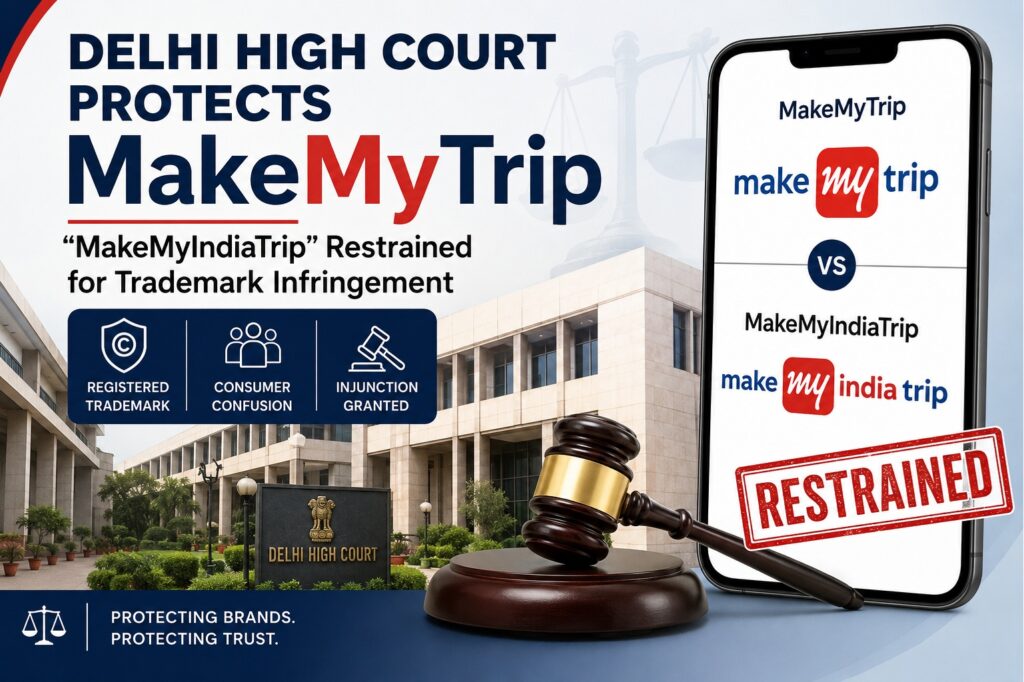
In a significant decision reinforcing trademark protection in the digital economy, the Delhi High Court has restrained a travel business operating under the name “MakeMyIndiaTrip”, holding that the mark is deceptively similar to the well-known trademark “MakeMyTrip”.
The Court observed that merely adding the word “India” to the registered trademark “MakeMyTrip” was insufficient to distinguish the competing marks and was likely to create confusion among consumers.
The order was passed by Justice Jyoti Singh in MakeMyTrip (India) Private Limited v. M/s MakeMyIndiaTrip, CS(COMM) 650/2026, on 29 May 2026.
Background of the Dispute
MakeMyTrip, one of India’s largest online travel platforms, approached the Delhi High Court alleging infringement of its registered trademarks and passing off.
The company pointed out that:
- It has been using the trademark ‘MAKE MY TRIP’ continuously since 2000;
- It owns several trademark registrations in India and abroad;
- The brand enjoys extensive goodwill and recognition among consumers;
- The defendant had adopted the name “MakeMyIndiaTrip”, a similar domain name, and a similar logo for identical travel-related services.
According to the plaintiff, the defendant’s adoption was intended to capitalize on the reputation and goodwill associated with the MakeMyTrip brand.
Plaintiff’s Trademark Portfolio

Why the Court Found Trademark Infringement
The Court noted that:
“MakeMyTrip” is a registered trademark and has acquired substantial goodwill through continuous and extensive use over more than two decades.
The defendant was offering:
* Domestic tour packages;
* International travel services;
* Travel itineraries;
* Travel bookings;
* Car rental services;
which were identical or closely related to the plaintiff’s services.
The Court found that the rival mark  was:
was:
* Visually similar;
* Structurally similar;
* Phonetically similar;
* Conceptually similar.
The addition of the word “India” did not materially alter the overall commercial impression created by the mark.
The Court’s Observations on Consumer Confusion
The Delhi High Court observed that customers encountering the defendant’s mark could reasonably assume an association, affiliation, sponsorship, or connection with MakeMyTrip.
Importantly, the Court referred to multiple forms of confusion:
1.Initial Interest Confusion
A customer may initially believe that the defendant’s website or services are connected with MakeMyTrip.
2.Point-of-Sale Confusion
Consumers may actually purchase travel services under the mistaken belief that they originate from or are endorsed by MakeMyTrip.
3.Post-Sale Confusion
Even after availing the services, third parties may continue to believe that the defendant’s services are associated with MakeMyTrip.
The Court held that such confusion was likely considering the widespread recognition of the MakeMyTrip brand.
Bad Faith Adoption Alleged
The Court was particularly influenced by the fact that:
* The defendant adopted a nearly identical trade name;
* The defendant used a confusingly similar domain name;
* The services offered were identical;
* The defendant maintained an active online presence through websites and social media platforms.
According to the Court, the adoption appeared prima facie intended to ride upon the goodwill and reputation built by MakeMyTrip over many years.
Importance of Domain Name Protection
The case also highlights an important principle in modern trademark law:
Domain Names Can Infringe Trademarks
The defendant was restrained not only from using the impugned trademark but also from using:
* The trade name “MakeMyIndiaTrip”;
* The domain name “[www.makemyindiatrip.com](http://www.makemyindiatrip.com)”;
* Email IDs incorporating the infringing mark.
Businesses often assume that securing a domain name registration automatically grants legal rights. However, Indian courts consistently hold that domain names functioning as business identifiers can amount to trademark infringement when they cause confusion.
Relief Granted by the Court
The Delhi High Court granted an ex parte ad interim injunction and restrained the defendant from:
* Using “MakeMyIndiaTrip”;
* Using any deceptively similar mark;
* Using the infringing logo;
* Using the impugned trade name;
* Using the impugned domain name;
* Using email IDs incorporating the infringing mark.
The injunction will continue until the next date of hearing.
Key Takeaways for Businesses
This decision sends a strong message to businesses operating online:
1.Trademark registration matters
Registered proprietors enjoy strong statutory protection under the Trade Marks Act, 1999.
2.Small modifications may not avoid infringement
Adding generic words such as “India”, “Online”, “Global”, “Express”, or similar descriptive expressions may still amount to infringement if the dominant portion of the mark remains unchanged.
3.Domain names are valuable intellectual property
Businesses should carefully evaluate proposed domain names before launch.
4.Early enforcement is critical
Prompt legal action helps prevent dilution of brand value and protects consumer trust.
Conclusion
The Delhi High Court’s decision reaffirms that trademark law protects not only against exact copying but also against deceptive variations designed to exploit an established brand’s goodwill. The ruling demonstrates the judiciary’s continued willingness to protect well-known brands from imitation in the digital marketplace.
For businesses, startups, and e-commerce ventures, the case serves as a reminder that choosing a brand name, domain name, or logo without conducting proper trademark due diligence can result in costly litigation and immediate injunctive relief.