

Table of Contents
ToggleIntroduction
The legal profession occupies a unique position in a constitutional democracy. Unlike many other professions, advocacy is not merely a means of earning a livelihood; it is a public calling intertwined with the administration of justice. While a lawyer undoubtedly owes a duty of loyalty to the client, that duty is neither absolute nor exclusive. An advocate’s responsibilities extend to the court, the justice delivery system, and society at large.
In a significant order delivered in Sreedhanya Bhaskaran v. Balakrishnan V.S. [OP (FC) No.170 of 2026, decided on 5 June 2026], the Kerala High Court reminded members of the Bar that legal expertise must never be employed to perpetuate illegality, interfere with judicial proceedings, or undermine the administration of justice. The Court further linked these obligations to the solemn declaration taken by every advocate at the time of enrolment, emphasising that professional ethics are not merely aspirational ideals but binding commitments.
The Incident That Prompted the Court’s Observations
The proceedings arose from a highly sensitive child custody dispute involving a six-year-old child. The Division Bench had directed that the father need not personally appear before the Court on a particular day because the Judges intended to interact with the child independently and assess his emotional well-being.
However, while the child and his mother were waiting inside the court hall, an unidentified lawyer allegedly approached the child and informed him that his father was waiting outside the court premises. According to the Court, the child, who had until then appeared cheerful and comfortable, became visibly disturbed, frightened and emotionally distressed after the incident.
Upon examining the video conferencing recordings and CCTV footage, the Court found sufficient material to conclude that an unidentified lawyer had approached the child and conveyed the message before quickly leaving the court hall.
The Court viewed the incident seriously, not merely because it affected the child, but because it had the potential to interfere with the Court’s efforts to independently assess the child’s welfare.
The Court’s Strong Message to the Legal Profession
Expressing its concern, the High Court made a profound observation on the ethical obligations of advocates:
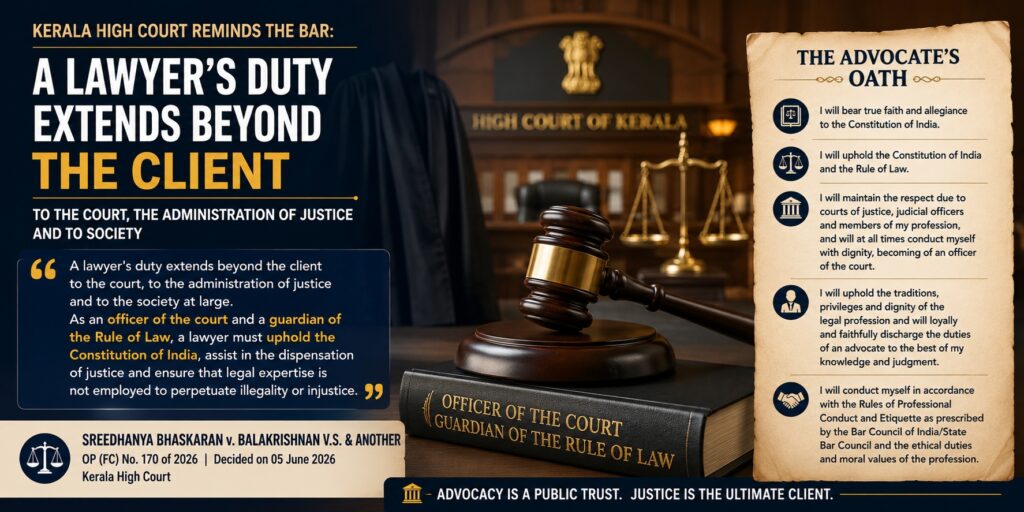
“A lawyer’s duty extends beyond the client to the court, to the administration of justice and to the society at large. As an officer of the court and a guardian of the Rule of Law, a lawyer must uphold the Constitution of India, assist in the dispensation of justice and ensure that legal expertise is not employed to perpetuate illegality or injustice.”
These observations transcend the facts of the case. They reaffirm a foundational principle of legal ethics—that advocacy is not a licence to pursue a client’s objectives by any means whatsoever.
The Court emphasised that lawyers occupy a special position in society because they are participants in the justice delivery system itself. Their professional obligations therefore extend beyond private interests and encompass a duty to protect the integrity of judicial proceedings.
The Advocate’s Oath: A Binding Commitment
What makes the judgment particularly noteworthy is the Court’s express reference to the oath taken by advocates at the time of enrollment.
The Court observed that the order was being reported as a reminder to members of the Bar about the solemn commitments undertaken when entering the profession.
Under the Declaration prescribed by the Bar Council of Kerala, every advocate solemnly undertakes:
* To bear true faith and allegiance to the Constitution of India;
* To uphold the Constitution of India and the Rule of Law;
* To uphold the traditions, privileges and dignity of the legal profession;
* To faithfully discharge the duties of an advocate to the best of his or her knowledge and judgment;
* To maintain the respect due to courts of justice, judicial officers and fellow members of the profession;
* To conduct oneself with the dignity becoming of an officer of the court; and
* To adhere to the Rules of Professional Conduct and Etiquette prescribed by the Bar Council and the ethical duties and moral values of the profession.
The Court’s observations demonstrate that these declarations are not ceremonial formalities. They embody the standards expected from every advocate and serve as the ethical foundation of legal practice.
An Advocate Is More Than a Client’s Representative
The judgment reinforces the distinction between a lawyer and an ordinary agent.
A client may pursue personal interests, but an advocate must pursue those interests within the framework of law, ethics and justice. The duty to the client cannot override duties owed to the court and the legal system.
This principle is reflected in the Rules framed by the Bar Council of India, which recognise the advocate as an officer of the court and impose obligations of fairness, candour and integrity.
An advocate must therefore refrain from any conduct that:
* Interferes with the administration of justice;
* Undermines judicial proceedings;
* Misleads the court;
* Exploits vulnerable individuals;
* Encourages disobedience of court orders; or
* Uses professional skills for improper purposes.
The Court’s observations are a reminder that professional competence must always be accompanied by professional responsibility.
Lawyers as Guardians of the Rule of Law
Perhaps the most significant aspect of the judgment is its characterisation of advocates as “guardians of the Rule of Law.”
The Rule of Law is not preserved by judges alone. Lawyers play an equally important role in ensuring that disputes are resolved fairly, constitutional values are respected, and public confidence in the justice system is maintained.
The legal profession functions as an essential pillar of democracy because advocates stand at the intersection of citizens and the justice system. Every act of advocacy therefore carries a public dimension.
When lawyers adhere to ethical standards, they strengthen the legitimacy of the justice system. Conversely, when professional responsibilities are ignored, public confidence in the legal process suffers.
A Reminder for the Entire Bar
Although the Court’s remarks arose from a specific incident involving a custody dispute, the message is universal.
The judgment serves as a reminder that:
* Advocacy is a public trust.
* Professional ethics are integral to the administration of justice.
* Lawyers owe duties not only to clients but also to courts and society.
* The advocate’s oath is a continuing obligation throughout professional life.
* Legal expertise must always be employed in furtherance of justice and never in aid of illegality or unfairness.
The Court’s observations reinforce the idea that the nobility of the profession lies not merely in winning cases but in preserving the integrity of the justice system itself.
Conclusion
The Kerala High Court’s decision in *Sreedhanya Bhaskaran v. Balakrishnan V.S.* is a powerful reaffirmation of the ethical foundations of the legal profession. By reminding advocates of the oath taken at enrollment and emphasizing that a lawyer’s duty extends beyond the client to the court, the administration of justice and society, the Court has reiterated a timeless truth.
An advocate is not merely a spokesperson for a litigant. An advocate is an officer of the court, a participant in the administration of justice and a guardian of the Rule of Law. The privileges enjoyed by the profession are inseparable from these responsibilities. Ultimately, the true measure of advocacy lies not in securing victory at any cost, but in ensuring that justice is pursued with integrity, fairness and unwavering fidelity to constitutional values.