

Table of Contents
ToggleIntroduction
The Securitisation and Reconstruction of Financial Assets and Enforcement of Security Interest Act, 2002 (“SARFAESI Act”) was enacted to enable banks and financial institutions to enforce their security interests swiftly and efficiently without the intervention of courts. One of the key provisions facilitating this objective is Section 14, which empowers the Chief Metropolitan Magistrate or District Magistrate (and in Kerala, the CJM/ACJM exercising such jurisdiction) to assist secured creditors in taking physical possession of secured assets.
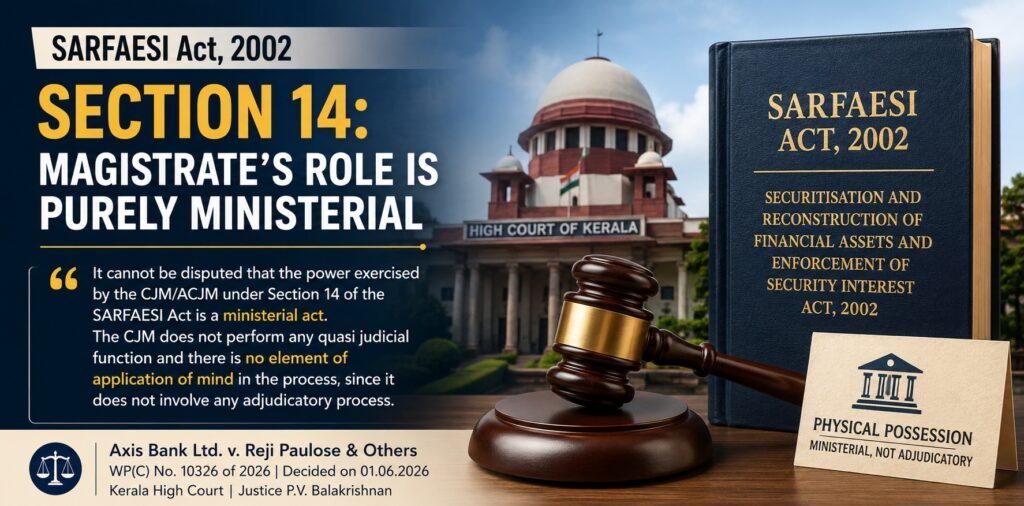
In a significant ruling, the Kerala High Court in *Axis Bank Ltd. v. Reji Paulose & Others* (WP(C) No. 10326 of 2026, decided on 01.06.2026) has once again clarified that the power exercised by the Magistrate under Section 14 is purely ministerial and not adjudicatory in nature. Consequently, the Magistrate cannot divert such proceedings to mediation or undertake any exercise that delays the statutory process contemplated by the Act.
Facts of the Case
The petitioner, Axis Bank Ltd., being a secured creditor, filed an application under Section 14 of the SARFAESI Act before the Special Additional Chief Judicial Magistrate, Ernakulam, seeking assistance for taking physical possession of the secured asset after the borrowers committed default.
The ACJM initially verified the statutory affidavit and was satisfied that the requirements under Section 14 had been complied with. Accordingly, an order was passed appointing an Advocate Commissioner for taking possession of the secured asset.
However, at a subsequent stage, the ACJM referred the matter for mediation. Aggrieved by this order, the secured creditor approached the Kerala High Court challenging the referral to mediation.
Issue Before the Court
The principal question before the Court was:
Whether a Magistrate exercising powers under Section 14 of the SARFAESI Act can refer the matter to mediation or otherwise exercise discretion beyond the limited statutory function contemplated under the provision?
Court’s Findings
The High Court answered the question in the negative and held that the Magistrate has no such power.
The Court relied upon the decisions of the Supreme Court in R.D. Jain & Co. (M/s) v. Capital First Ltd. and Others [(2023) 1 SCC 675] and the earlier Kerala High Court decision in C.R. Sindhu v. State of Kerala and Others [2007 (4) KHC 944].
The Court observed that:
“It cannot be disputed that the power exercised by the CJM/ACJM under Section 14 of the SARFAESI Act is a ministerial act. The CJM does not perform any quasi judicial function and there is no element of application of mind in the process, since it does not involve any adjudicatory process.”
The Court further noted that once the statutory requirements are satisfied, the Magistrate’s duty is confined to facilitating possession of the secured asset and handing over the same to the secured creditor.
Why the Magistrate’s Function is Ministerial
The judgment reiterates several important principles governing Section 14 proceedings:
1.No Adjudicatory Function
The Magistrate does not adjudicate disputes between the borrower and the secured creditor. Questions relating to the validity of measures taken under the SARFAESI Act fall within the jurisdiction of the Debts Recovery Tribunal under Section 17.
2.Verification of Statutory Compliance Alone
The Magistrate’s role is limited to examining whether the affidavit filed by the secured creditor satisfies the requirements prescribed under Section 14 and whether the statutory conditions have been fulfilled.
3.No Discretion to Conduct Parallel Proceedings
Since the function is ministerial, the Magistrate cannot entertain objections on merits, adjudicate rival claims, negotiate settlements, or refer parties to mediation.
4.Time-Bound Nature of Proceedings
The Court emphasized that Section 14 itself prescribes a strict timeline. The Magistrate is expected to pass appropriate orders within 30 days from the date of application, extendable up to a maximum of 60 days. Any unnecessary diversion of proceedings would defeat the legislative intent of expeditious enforcement.
Referral to Mediation Held Unsustainable
The Kerala High Court found that the order referring the parties to mediation was contrary to the statutory scheme of Section 14.
The Court observed that the Magistrate has no discretion in the matter except to facilitate possession in accordance with law. Since mediation necessarily involves a consensual dispute-resolution process, introducing mediation into a Section 14 proceeding effectively transforms a ministerial process into an adjudicatory one, which the statute does not contemplate.
Accordingly, the High Court set aside the mediation order and directed the Magistrate to proceed with the Section 14 application and pass appropriate orders in accordance with law.
Significance of the Judgment
This decision is important for banks, financial institutions, asset reconstruction companies, and practitioners dealing with SARFAESI proceedings because it:
* Reinforces the limited scope of Section 14 proceedings.
* Prevents delays caused by extraneous procedures such as mediation.
* Upholds the objective of speedy recovery under the SARFAESI Act.
* Clarifies that borrowers cannot seek adjudication of disputes before the Magistrate in Section 14 proceedings.
* Reaffirms that the appropriate remedy against SARFAESI measures remains before the Debts Recovery Tribunal under Section 17.
Conclusion
The Kerala High Court’s ruling serves as a timely reminder that proceedings under Section 14 of the SARFAESI Act are intended to be administrative and facilitative rather than adjudicatory. By holding that the CJM/ACJM performs only a ministerial function and cannot refer parties to mediation, the Court has strengthened the statutory framework designed to ensure swift enforcement of security interests.
The judgment aligns with the Supreme Court’s jurisprudence that a Magistrate acting under Section 14 is not expected to adjudicate disputes or exercise discretion beyond verifying statutory compliance and facilitating possession. For secured creditors, the decision reinforces the efficiency of the SARFAESI mechanism and discourages procedural detours that could frustrate recovery proceedings.