

Are you need IT Support Engineer? Free Consultant

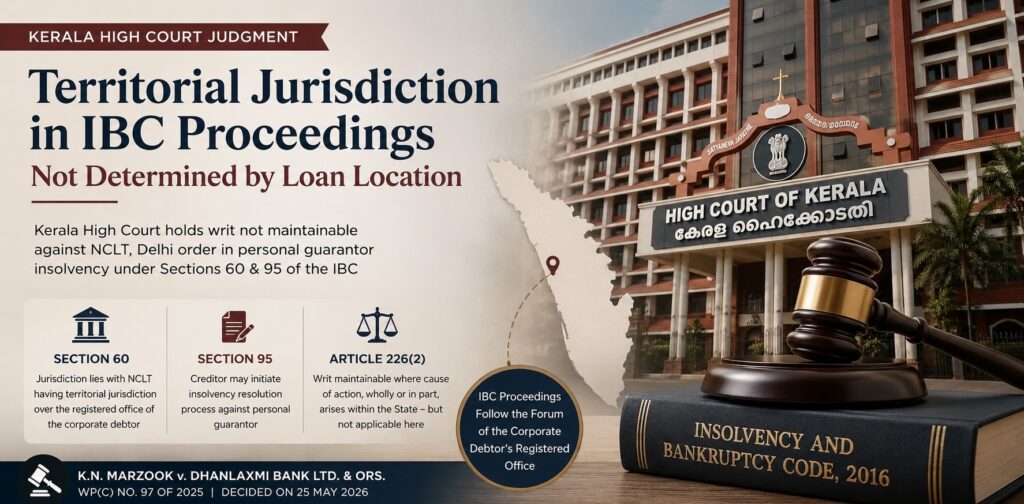
Kerala High Court Clarifies Territorial Jurisdiction in Personal Guarantor Insolvency Proceedings under the IBC

  • June 9, 2026
  • 9 Views
Introduction The Kerala High Court, in K.N. Marzook v. Dhanlaxmi Bank Ltd., has provided significant clarity on the interplay between the territorial jurisdiction provisions of the Insolvency and Bankruptcy Code, 2016 and Article 226(2) of the Constitution of India. The judgment reiterates that proceedings relating to insolvency resolution of personal guarantors are intrinsically linked to the jurisdiction prescribed under Section 60 of the IBC and that the mere existence of an underlying commercial transaction within a State does not confer territorial jurisdiction upon the High Court of that State. Background of the Case The petitioner, Mr. K.N. Marzook, had allegedly stood as a personal guarantor for credit facilities availed by a corporate debtor from Dhanlaxmi Bank. The Bank initiated insolvency proceedings against the personal guarantor under Section 95 of the IBC before the National Company Law Tribunal (NCLT), New Delhi. Initially, the application erroneously mentioned another individual as the personal guarantor. Subsequently, the NCLT permitted correction of the error and the petitioner's name was substituted. Thereafter, the NCLT passed an order permitting initiation of insolvency proceedings against the petitioner. Aggrieved by the said order, the petitioner approached the Kerala High Court under Article 226 of the Constitution seeking to challenge the NCLT's decision. The principal objection raised by the Bank was that the Kerala High Court lacked territorial jurisdiction since the impugned order had been passed by the NCLT, New Delhi, in proceedings governed by the IBC. Section 95 of the Insolvency and Bankruptcy Code: Initiation of Insolvency Resolution Process Against Personal Guarantors Section 95 forms part of Chapter III of Part III of the IBC dealing with insolvency resolution and bankruptcy for individuals and partnership firms. The provision empowers a creditor to initiate an insolvency resolution process against a personal guarantor to a corporate debtor by filing an application before the Adjudicating Authority. The purpose of Section 95 is to provide creditors with a statutory mechanism for enforcing obligations undertaken by personal guarantors. Once an application under Section 95 is filed, the Adjudicating Authority appoints a Resolution Professional who examines the application and submits a report recommending either admission or rejection of the insolvency application. The Kerala High Court noted that the proceedings initiated against the petitioner were specifically under Section 95 of the IBC and therefore had to be examined within the statutory framework prescribed by the Code rather than by reference to the location where the original loan transaction took place. Section 60 of the Insolvency and Bankruptcy Code: Adjudicating Authority for Corporate Persons and Personal Guarantors Section 60 is the cornerstone provision governing jurisdiction under the IBC in relation to corporate debtors and their personal guarantors. Sub-section (1) provides: The National Company Law Tribunal having territorial jurisdiction over the place where the registered office of the corporate person is located shall be the Adjudicating Authority in relation to insolvency resolution and liquidation proceedings concerning corporate persons and their personal guarantors. The legislative intent behind Section 60 is to ensure that proceedings against a corporate debtor and its personal guarantors are dealt with by a single forum. This avoids conflicting decisions and promotes coordinated insolvency resolution. The Kerala High Court emphasized that Section 60 specifically mandates that insolvency proceedings against personal guarantors must be filed before the NCLT having jurisdiction over the registered office of the corporate debtor. In the present case, the registered office of the corporate debtor was situated in New Delhi and not in Kerala. Consequently, the NCLT, New Delhi, was the statutorily designated Adjudicating Authority. The Court therefore concluded that the proceedings were correctly instituted before the NCLT, New Delhi. Article 226(2) of the Constitution of India: Territorial Jurisdiction of High Courts Article 226(2) expands the territorial jurisdiction of High Courts by providing that a High Court may exercise jurisdiction if the cause of action, wholly or in part, arises within its territorial limits, notwithstanding that the authority against whom relief is sought is located outside the State. The petitioner relied upon this provision by arguing that:  The credit facilities had been availed from Kerala;  The transactions giving rise to the guarantee occurred in Kerala; and  Therefore, at least a part of the cause of action arose within Kerala. The Court accepted that the underlying credit transaction had indeed originated in Kerala. However, it distinguished the loan transaction from the insolvency proceedings subsequently initiated under the IBC. According to the Court, the challenge before it was not directed against the grant of the credit facility or the loan transaction. Rather, it was directed against an order passed by the NCLT in insolvency proceedings governed by the IBC. The cause of action relevant for determining territorial jurisdiction therefore arose from the insolvency proceedings and not from the underlying commercial transaction. The Court held that: Merely because the credit facility had been availed in Kerala does not mean that a part of the cause of action relating to insolvency proceedings under the IBC arose within Kerala. Accordingly, the Kerala High Court concluded that it lacked territorial jurisdiction to entertain the writ petition. Findings of the Court The Kerala High Court held:  Proceedings against personal guarantors under Section 95 of the IBC are governed by the jurisdictional scheme contained in Section 60 of the Code.  The relevant cause of action for determining territorial jurisdiction must be examined with reference to the insolvency proceedings and not the original loan transaction.  Since the registered office of the corporate debtor was situated in New Delhi, the NCLT, New Delhi, was the proper Adjudicating Authority under Section 60 of the IBC.  No part of the cause of action concerning the insolvency proceedings arose within the territorial jurisdiction of the Kerala High Court. Therefore, the writ petition was not maintainable under Article 226(2). The writ petition was accordingly dismissed. Significance of the Decision This judgment reinforces the centralised jurisdictional framework established under the Insolvency and Bankruptcy Code. It prevents forum shopping by litigants seeking to challenge insolvency proceedings before High Courts merely because a connected commercial transaction took place within their territorial limits. The decision also serves as a reminder that while Article 226(2) confers broad powers upon High Courts, the determination of territorial jurisdiction must be based on the cause of action directly connected with the impugned proceedings. Where insolvency proceedings against a personal guarantor are initiated under Section 95 of the IBC, the jurisdictional mandate of Section 60 assumes decisive significance. For banks, financial institutions, insolvency professionals and personal guarantors, the judgment provides valuable guidance on the proper forum for challenging insolvency proceedings and underscores the importance of the corporate debtor's registered office in determining jurisdiction under the IBC. Citation: K.N. Marzook v. Dhanlaxmi Bank Ltd. & Ors., WP(C) No. 97 of 2025, decided on 25 May 2026, Kerala High Court.
Introduction

The Kerala High Court, in K.N. Marzook v. Dhanlaxmi Bank Ltd., has provided significant clarity on the interplay between the territorial jurisdiction provisions of the Insolvency and Bankruptcy Code, 2016 and Article 226(2) of the Constitution of India. The judgment reiterates that proceedings relating to insolvency resolution of personal guarantors are intrinsically linked to the jurisdiction prescribed under Section 60 of the IBC and that the mere existence of an underlying commercial transaction within a State does not confer territorial jurisdiction upon the High Court of that State.

Background of the Case

The petitioner, Mr. K.N. Marzook, had allegedly stood as a personal guarantor for credit facilities availed by a corporate debtor from Dhanlaxmi Bank. The Bank initiated insolvency proceedings against the personal guarantor under Section 95 of the IBC before the National Company Law Tribunal (NCLT), New Delhi. Initially, the application erroneously mentioned another individual as the personal guarantor. Subsequently, the NCLT permitted correction of the error and the petitioner’s name was substituted. Thereafter, the NCLT passed an order permitting initiation of insolvency proceedings against the petitioner. Aggrieved by the said order, the petitioner approached the Kerala High Court under Article 226 of the Constitution seeking to challenge the NCLT’s decision.

The principal objection raised by the Bank was that the Kerala High Court lacked territorial jurisdiction since the impugned order had been passed by the NCLT, New Delhi, in proceedings governed by the IBC.

Section 95 of the Insolvency and Bankruptcy Code: Initiation of Insolvency Resolution Process Against Personal Guarantors

Section 95 forms part of Chapter III of Part III of the IBC dealing with insolvency resolution and bankruptcy for individuals and partnership firms.

The provision empowers a creditor to initiate an insolvency resolution process against a personal guarantor to a corporate debtor by filing an application before the Adjudicating Authority.

The purpose of Section 95 is to provide creditors with a statutory mechanism for enforcing obligations undertaken by personal guarantors. Once an application under Section 95 is filed, the Adjudicating Authority appoints a Resolution Professional who examines the application and submits a report recommending either admission or rejection of the insolvency application.

The Kerala High Court noted that the proceedings initiated against the petitioner were specifically under Section 95 of the IBC and therefore had to be examined within the statutory framework prescribed by the Code rather than by reference to the location where the original loan transaction took place.

Section 60 of the Insolvency and Bankruptcy Code: Adjudicating Authority for Corporate Persons and Personal Guarantors

Section 60 is the cornerstone provision governing jurisdiction under the IBC in relation to corporate debtors and their personal guarantors.

Sub-section (1) provides:

The National Company Law Tribunal having territorial jurisdiction over the place where the registered office of the corporate person is located shall be the Adjudicating Authority in relation to insolvency resolution and liquidation proceedings concerning corporate persons and their personal guarantors.

The legislative intent behind Section 60 is to ensure that proceedings against a corporate debtor and its personal guarantors are dealt with by a single forum. This avoids conflicting decisions and promotes coordinated insolvency resolution.

The Kerala High Court emphasized that Section 60 specifically mandates that insolvency proceedings against personal guarantors must be filed before the NCLT having jurisdiction over the registered office of the corporate debtor. In the present case, the registered office of the corporate debtor was situated in New Delhi and not in Kerala. Consequently, the NCLT, New Delhi, was the statutorily designated Adjudicating Authority.

The Court therefore concluded that the proceedings were correctly instituted before the NCLT, New Delhi.

Article 226(2) of the Constitution of India: Territorial Jurisdiction of High Courts

Article 226(2) expands the territorial jurisdiction of High Courts by providing that a High Court may exercise jurisdiction if the cause of action, wholly or in part, arises within its territorial limits, notwithstanding that the authority against whom relief is sought is located outside the State.

The petitioner relied upon this provision by arguing that:


  • The credit facilities had been availed from Kerala;
  • The transactions giving rise to the guarantee occurred in Kerala; and
  • Therefore, at least a part of the cause of action arose within Kerala.

The Court accepted that the underlying credit transaction had indeed originated in Kerala. However, it distinguished the loan transaction from the insolvency proceedings subsequently initiated under the IBC.

According to the Court, the challenge before it was not directed against the grant of the credit facility or the loan transaction. Rather, it was directed against an order passed by the NCLT in insolvency proceedings governed by the IBC. The cause of action relevant for determining territorial jurisdiction therefore arose from the insolvency proceedings and not from the underlying commercial transaction.

The Court held that:

Merely because the credit facility had been availed in Kerala does not mean that a part of the cause of action relating to insolvency proceedings under the IBC arose within Kerala.

Accordingly, the Kerala High Court concluded that it lacked territorial jurisdiction to entertain the writ petition.

Findings of the Court

The Kerala High Court held:

  • Proceedings against personal guarantors under Section 95 of the IBC are governed by the jurisdictional scheme contained in Section 60 of the Code.
  • The relevant cause of action for determining territorial jurisdiction must be examined with reference to the insolvency proceedings and not the original loan transaction.
  • Since the registered office of the corporate debtor was situated in New Delhi, the NCLT, New Delhi, was the proper Adjudicating Authority under Section 60 of the IBC.
  • No part of the cause of action concerning the insolvency proceedings arose within the territorial jurisdiction of the Kerala High Court. Therefore, the writ petition was not maintainable under Article 226(2).

The writ petition was accordingly dismissed.

Significance of the Decision

This judgment reinforces the centralised jurisdictional framework established under the Insolvency and Bankruptcy Code. It prevents forum shopping by litigants seeking to challenge insolvency proceedings before High Courts merely because a connected commercial transaction took place within their territorial limits.

The decision also serves as a reminder that while Article 226(2) confers broad powers upon High Courts, the determination of territorial jurisdiction must be based on the cause of action directly connected with the impugned proceedings. Where insolvency proceedings against a personal guarantor are initiated under Section 95 of the IBC, the jurisdictional mandate of Section 60 assumes decisive significance.

For banks, financial institutions, insolvency professionals and personal guarantors, the judgment provides valuable guidance on the proper forum for challenging insolvency proceedings and underscores the importance of the corporate debtor’s registered office in determining jurisdiction under the IBC.

Citation: K.N. Marzook v. Dhanlaxmi Bank Ltd. & Ors., WP(C) No. 97 of 2025, decided on 25 May 2026, Kerala High Court.