

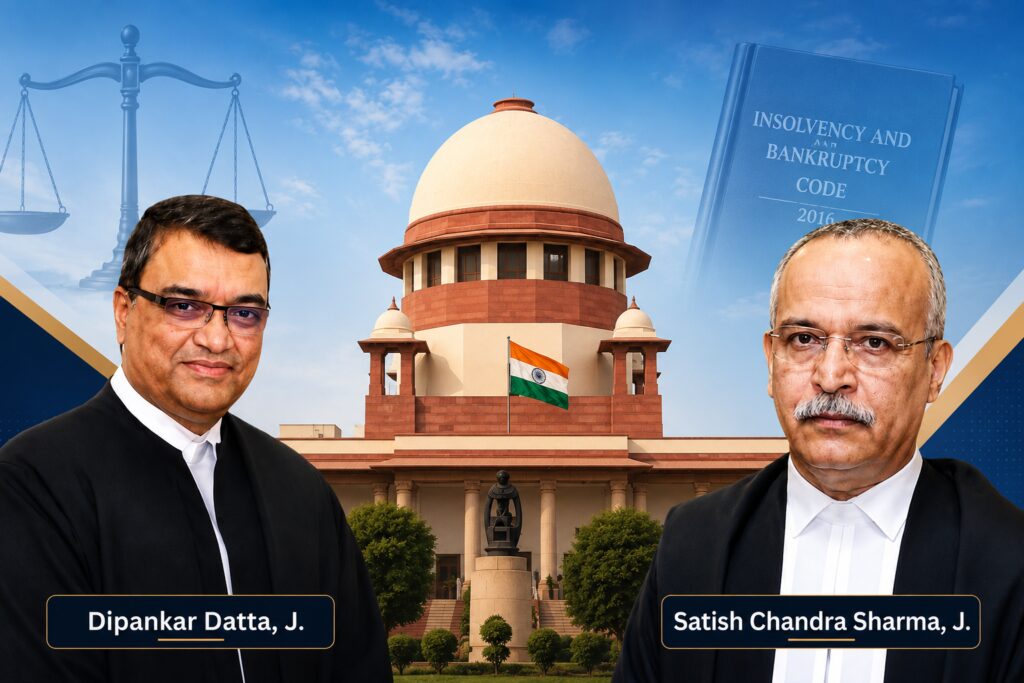
The Supreme Court of India, in CA Ramchandra Dallaram Choudhary v. Adani Infrastructure and Developers Private Limited (Judgment dated 01 June 2026), has reiterated the strict and time-bound nature of the Insolvency and Bankruptcy Code, 2016 (“IBC”). The Court examined whether delay in re-filing an appeal under Section 62 of the IBC, after curing defects pointed out by the Registry, can be condoned beyond the period prescribed under the Supreme Court Rules, 2013.
The judgment underscores that the IBC is a complete code in itself and that the timelines prescribed therein are mandatory. The Court held that a defective appeal cannot be used as a device to circumvent statutory limitation and that once the prescribed periods for filing and curing defects expire, the right of appeal stands extinguished. The decision is significant for insolvency practitioners, liquidators, resolution professionals, creditors, and litigants, as it reinforces the legislative objective of ensuring expeditious resolution and finality in insolvency proceedings.
The full text of the judgment is reproduced below for the benefit of readers:
2026 INSC 629 REPORTABLE
IN THE SUPREME COURT OF INDIA CIVIL APPELLATE JURISDICTION
CIVIL APPEAL No /2026
@ D.No.5988/2026
CA RAMCHANDRA DALLARAM CHOUDHARY …APPELLANT
VERSUS
ADANI INFRASTRUCTURE AND DEVELOPERS PRIVATE LIMITED
…RESPONDENT
J U D G M E N T
DIPANKAR DATTA,
- This is an appeal under Section 62 of the Insolvency and Bankruptcy Code, 20161, at the instance of the liquidator of a corporate debtor under liquidation. Under challenge is the judgment and order dated 08th December, 20252 passed by the National Company Law Appellate Tribunal, Principal Bench at New Delhi3 in Comp. App. (AT) (Ins) No.2316 of 2024.
————-
1 IBC
2 impugned order
3 NCLAT
- Having regard to the point on which we propose to decide the appeal, we see no reason to comment on the correctness or otherwise of the impugned order.
- The appeal was presented on 29th January 2026, beyond the period of limitation prescribed in sub-section (1) of Section 62, IBC but within the grace period stipulated in sub-section (2) thereof. Office reported a delay of 7 (seven) days in filing the appeal. An application seeking condonation of the said delay has been filed. Office had also marked the appeal defective. Upon curing the defects, the appeal came to be re-filed after a further delay of 82 (eighty-two) days for which a separate application seeking condonation of delay in re-filing has also been filed.
- At the outset, it must be borne in mind that the scheme of limitation under the IBC is a strict and time-bound one. The concept of condonation of delay itself is alien to the statutory framework beyond the period expressly contemplated under the statute. Section 62 of the IBC permits an appeal to be filed before this Court within 45 (forty-five) days, with a further grace period of only 15 (fifteen) days, and that too, only upon sufficient cause being shown. Thus, the outer limit statutorily permissible is 60 (sixty) days, beyond which the appeal itself becomes barred and the Court’s jurisdiction to condone the delay ceases.
- The importance of strict adherence to timelines under the IBC has been enunciated by this Court succinctly in its decision in Mobilox Innovations (P) Ltd. v. Kirusa Software (P) Ltd.4 as follows:
“36. … Even in appeals to the Supreme Court from the Appellate Tribunal under Section 62, 45 days’ time is given from the date of receipt of the order of the Appellate Tribunal in which an appeal to the Supreme Court is to be made, with a further grace period not exceeding 15 days. The strict adherence of these timelines is of essence to both the triggering process and the insolvency resolution process. … .”
—————–
4 (2018) 1 SCC 353
- Time bound resolution is the essence of the IBC was reiterated in respect of an appeal under Section 61 thereof in Kalparaj Dharamshi v. Kotak Investment Advisors Limited5 in the following words:
- This Court has held, that it is not open to the adjudicating authority or appellate authority to reckon any other factor other than specified in Sections 30(2) or 61(3) of the I&B Code. It has further been held, that the commercial wisdom of CoC has been given paramount status without any judicial intervention for ensuring completion of the stated processes within the timelines prescribed by the I&B Code. … .
(emphasis ours)
- Reference can also be made to the decisions in National Spot Exchange Ltd. v. Dunar Foods Ltd. (Resolution Professional)6, V. Nagarajan v. SKS Ispat & Power Ltd7 and Tata Steel Limited v. Raj Kumar Banerjee and Others8 which, though arising in the context of appeals under Section 61 of the IBC, reaffirm that condonation of delay beyond the period expressly prescribed by the statute itself would be impermissible.
- Furthermore, this Court in PEC Ltd. v. M/s Phulchand Exports Private Ltd.9 held pithily as follows:
“1.There is a delay of 21 days in filing the appeal under Section 62 of the Insolvency and Bankruptcy Code 2016. The delay is beyond the maximum period which is condonable in terms of the statute.
2.Hence, the civil appeal is dismissed on the ground of limitation.
3.Pending applications, if any, stand disposed of.”
———-
5 (2021) 10 SCC 401
6 (2022) 11 SCC 761
7 (2022) 2 SCC 244
8 (2025) 9 SCC 483
9 Civil Appeal (Diary) No. 37293 of 2022
- In Saturn Ventures and Advisors Pvt. Limited v. S. Gopalakrishnan10, delay of two days in presentation of an appeal under Section 62 of the IBC was not condoned reasoning that the Court has no power to condone the delay.
- Let us now ascertain what the position is under the Supreme Court Rules, 201311. Sub-rules (3) and (4), of Rule 6 of Order VIII, SCR, lay down the regime governing re-filing of, inter alia, petitions and appeals after curing defects. A period of 28 (twenty-eight) days is earmarked for curing of defects. A litigant not curing the defects within 28 (twenty-eight) days may re-file the petition or the appeal, as the case may be, together with an application seeking condonation of re-filing delay. Needless to observe, condonation of re-filing delay for petitions and appeals is discretionary.
- Is it open to this Court [where an appeal under Section 62, IBC is filed within time, i.e., 45 (forty-five) days or beyond the said period but before expiry of 60 (sixty) days as contemplated in the sub-sections thereof and are marked defective, for whatever reason] to condone the delay in re-filing of the appeal when the defects pointed out are not cured within 28 (twenty-eight) days? This was the question we posed to Mr. Fernandes, learned senior counsel for the appellant to answer.
- Fernandes contends that the appellant is a neutral officer acting under the aegis of this Court for the benefit of all stakeholders as well as the corporate debtor under liquidation and having regard to the nature of duties imposed on him, the insignificant delay in filing the appeal as well as re-filing thereof ought to be considered liberally rather than strictly. He also contends, notwithstanding that the defects were not cured within 28 (twenty-eight) days of such defects being notified, this Court’s power to condone re-filing delay of any number of days beyond 28 (twenty-eight) days is not fettered and if sufficient cause be shown to exist, which did preclude a party from acting within the timelines provided in the IBC, re-filing delay of any length of time is invariably condoned. According to him, under the SCR, delay in re-filing after curing of the defects is treated differently from delay in initial filing. If initially the appeal is filed within 45 (forty-five) days, or even within the grace period of 15 (fifteen) days and sufficient cause for condonation of filing delay is shown, the Court would generally condone the delay – in filing and re-filing – if the same is satisfactorily explained.
- Fernandes has, in this connection, invited our attention to a coordinate Bench decision between the same parties in CA Ramchandra Dallaram Choudhary v. Adani Infrastructure & Developers (P) Ltd.12 where re-filing delay in filing an appeal before the NCLAT under Section 61 of the IBC was condoned. Particular reliance was placed on the following passages:
“9.Be that as it may, it is well-recognised principle of law that the courts view applications relating to lawyer’s lapses more leniently than applications relating to litigant’s lapses. The classic example is the difference in approach of courts to applications for condonation of delay in filing an appeal and applications for the condonation of delay in refilling the appeal after rectification of defects. Useful reference may be made to the decision of the co-ordinate Bench of this Court in Perumon Bhagvathy Devaswom v. Bhargavi Amma [(2008) 8 SCC 321; 2008 SCC OnLine SC 1049.]
10.Having regard to the fact that the appellant despite limitations had done all that was necessary for filing of the appeal within 30 days, and then 15 days, i.e., within the prescribed and extended period of limitation, respectively, as well as dependency of the appellant on its lawyers who, in turn, were dependent on their clerk to refile the appeal, and there were some missteps contributing to the present situation, coupled with the fact that the issue sought to be raised by the appellant in the appeal filed before the National Company Law Appellate Tribunal, if answered in its favour, would enure to the benefit of the debtors, and also that better justice is always achieved when a lis is decided on a contested hearing rather than on default, we need to take an overall view of the matter. We are of the considered opinion that the words “sufficient cause” in this case ought to have been construed liberally and that interest of justice would be best served if, upon condonation of delay in refilling of the appeal, the National Company Law Appellate Tribunal proceeds with the hearing of the appeal on merits. Ordered accordingly.”
—-
12 2025 SCC OnLine SC 1406
- We propose to advert to the decision in CA Ramchandra Dallaram Choudhary (supra) a little later.
- Having regard to the statutory scheme of the IBC, since validated by this Court in numerous decisions by holding that the strict timelines are meant to prevent misuse by dilatory tactics, it is difficult to accept Mr. Fernandes’ contention. It is axiomatic that an appeal under Section 62 of the IBC to be regarded as having been instituted within the prescribed period of 45 (forty-five) days must be a defect-free appeal, which is capable of being acted upon by the Registry for being immediately placed before the appropriate Bench for consideration. Any appeal which is not filed within the stipulated period in a form shorn of defects, for all practical and legal purposes, remains a defective appeal.
- Can or should a litigant be permitted to circumvent the rigours of limitation by filing a defective appeal as a device to save limitation and, thereafter, to opt to cure the notified defects at leisure? Can or should this Court countenance such a practice? The answers to both questions have to be a resounding ‘NO’. To hold otherwise would defeat the object of the IBC and render nugatory the discipline of timelines engrafted both in Section 62 as well as the SCR. Any such practice of filing a defective appeal, if encouraged, could result in a litigant dragging the process of re-filing for months and still being heard on his application for condoning re-filing delay premised on the ground that the IBC says nothing about re-filing delay and that the SCR being a procedural law must be read in a manner to aid the rendering of substantive justice to a party who is shown to be above board.
- Consequently, no litigant can be permitted to subvert the statutory scheme by seeking condonation of re-filing delay beyond the period of 28 (twenty-eight) days after having initially lodged a defective appeal. Once the window of 60 (sixty) days prescribed by the IBC, followed by the window of 28 (twenty-eight) days in re-filing the appeal upon curing of defects permitted by the SCR is shut, the right to appeal stands extinguished.
- The argument that the SCR does not impose a cap beyond which re-filing delays cannot be condoned and, hence, it is the acceptability of the cause shown amounting to ‘sufficient cause’ which is and should be decisive, irrespective of the length of time taken to cure the defects, is equally unimpressive. The SCR is the subordinate legislation in the field and whenever the IBC and the SCR clash, the latter cannot override the express provisions of the former. The IBC must prevail being the statutory edict. Though indisputable that the standards for examining a prayer for condoning a re-filing delay is certainly less rigorous than a filing delay but such standard would stand true and be applicable for the general laws, like proceedings arising from the Codes of Civil and Criminal Procedure, as well as from remedies provided by the Constitution of India. Section 62, IBC is, however, a complete code in itself for filing of appeals and is different from other laws. An appeal under Section 62, IBC does not remain alive after the 28 (twenty-eight) day period allowable under the SCR for curing defects and the lis would stand frozen once the defects are not cured within such period. An extended window cannot be granted de hors the legislative intent behind stipulation of the strict timelines in the IBC.
- We may also observe that the fact of the appellant being a neutral officer acting under the aegis of this Court for the benefit of all stakeholders and the corporate debtor under liquidation is not sufficient for us to invoke our extraordinary jurisdiction under Article 142 of the Constitution to dilute or override the express statutory timeframes engrafted under the IBC. Pertinently, the IBC does not mark a different threshold for officers like the appellant and hence, reading words into the statute which are not used by the legislature would not be a permissible interpretational exercise.
- Moving on to the decision in CA Ramchandra Dallaram Choudhary (supra), which has been pressed into service by Mr. Fernandes, the peculiar factual matrix of the said appeal assumes significance and warrants a recapitulation of the events.
a.Appellant had earlier challenged the order dated 21st June, 2024 passed by the National Company Law Tribunal13 before the NCLAT in an appeal under Section 61, IBC. However, the appeal before the NCLAT itself was not filed within the prescribed period and was beset by delay in re-filing.
b.Vide its order dated 6th February, 2025, the NCLAT declined to condone the delay. Aggrieved thereby, the appellant approached this Court by filing an appeal14 under Section 62, IBC. This Court, by its order dated 5th May, 2025, set aside the order of the NCLAT and remanded the matter for consideration on merits, whereupon the NCLAT proceeded to decide the appeal and delivered the impugned order.
——
13 NCLT
14 Civil Appeal No. 5106 of 2025
- It would, therefore, appear that notwithstanding the indulgence shown by this Court to the self-same appellant at an earlier stage, the appeal presently under consideration has been re-filed after substantial delay. The explanation for the re-filing delay reads as follows:
- That it is most humbly submitted that essentially the delay in refiling arose due to an internal oversight within the Office of the Liquidator. While the defects were duly communicated by the Registry, a concerned officer within the Liquidator’s office either mistakenly believed that the requisite details had already been conveyed or did not promptly relay them to the Advocate-on Record. It is also pertinent to mention that this officer has since left the position, leading to a gap in communication. The delay, thus, was neither intentional nor negligent but arose from a bona fide administrative lapse within the office.
(emphasis ours)
- The circumstance that this Court had earlier interdicted refusal of the NCLAT to condone the delay in re-filing the appeal under Section 61 of the IBC does not advance the appellant’s case, rather even on a cursory comparison of the two situations, it only accentuates the reason as to why the earlier exercise of discretion cannot be extended to the present proceedings. While setting aside the order of the NCLAT, this Court had emphasized the differing degrees of liberality, which ought to be extended in the cases of lapses attributable to the advocate-on-record and to the litigant, as far as re-filing delay is concerned. It was in this factual milieu, the controversy warranted examination on merits, thereby necessitating the condonation of delay in re-filing of the appeal before the NCLAT and restoration of the appeal before it.
- The decision in CA Ramchandra Dallaram Choudhary (supra) reiterates the principle which must guide the exercise of judicial discretion in matters of condonation of delay. The present case stands on an entirely different pedestal, wherein the appellant seeks condonation not merely of delay in re-filing but also of delay in invoking the appellate jurisdiction of this Court under Section 62, IBC. Importantly so, the appellant approaches this Court after having availed the benefit of a liberal construction of “sufficient cause” at the previous stage of the same litigation. A litigant who has once secured indulgence in relation to delay cannot legitimately proceed on the assumption that further defaults engendered at the next appellate stage would automatically attract a similar exercise of discretion. To hold otherwise would render the law of limitation under the IBC progressively elastic at every successive stage of challenge, defeating the legislative objective of expedition and finality.
- Restating what has already been enunciated, the appellant can derive no advantage from the earlier order condoning the delay in re-filing the appeal under Section 61, IBC before the NCLAT. That exercise of discretion was confined to the peculiar facts of that case and cannot be construed as a warrant for repeated indulgence. The discipline of limitation, particularly in the context of the IBC, does not countenance serial condonations of delay across successive appellate stages. Having once availed the benefit of a liberal approach, the appellant cannot legitimately seek a further relaxation when the present appeal under Section 62 is itself beset by delay both in filing and in re-filing.
- To sum up our discussion, 45 (forty-five) days is available under sub-section (1) of Section 62, IBC from date of receipt of the order of the NCLT to file an appeal involving a substantial question of law before this Court. As per sub-section (2), subject to sufficient cause being shown, the Supreme Court may allow an appeal to be filed within 15 (fifteen) days after the expiry of the said 45 (forty-five) days but not beyond. Curing of defects arising out of a defectively filed appeal under Section 62, IBC is permissible within 28 (twenty-eight) days of notification thereof by the Registry. If the defects are cured within 28 (twenty-eight) days, the appeal would deserve registration upon removal of the “D No.”. However, there being no scope for curing defects after lapse of the period of 28 (twenty-eight) days in respect of an appeal under Section 62, IBC, filing of an application for re-filing delay does not arise. Consequently, no question of condonation of delay [even for a day beyond 60 (sixty) days (in case of an appeal which, apart from the little delay in filing beyond 45 (forty-five days), is otherwise defect-free) and 28 (twenty-eight) days (in case of a defective appeal)] arises for consideration.
- Thus, the legal position being settled beyond cavil, it is unnecessary for us to venture into the merits of the explanations furnished in support of the applications for condonation of delay in filing and re-filing herein. Where the statute itself erects an insurmountable jurisdictional bar, noenquiry into the adequacy of the cause shown would alter the legal consequence that inexorably follows.
- Apart from what has been held above, upon a perusal of the applications seeking condonation of delay in filing and in re-filing, we find sufficient cause not having been shown to satisfactorily explain the delay(s). Absent any cogent or convincing justification, the delay(s) in both the filing of the defective appeal and re-filing of the appeal are not liable to be condoned.
- Be that as it may, the defective appeal stands dismissed as time-barred having been filed beyond the maximum period condonable in terms of the IBC.
- Connected applications too stand dismissed.
… J.
(DIPANKAR DATTA)
… J.
(SATISH CHANDRA SHARMA)
NEW DELHI; JUNE 01, 2026.