

Table of Contents
ToggleIntroduction
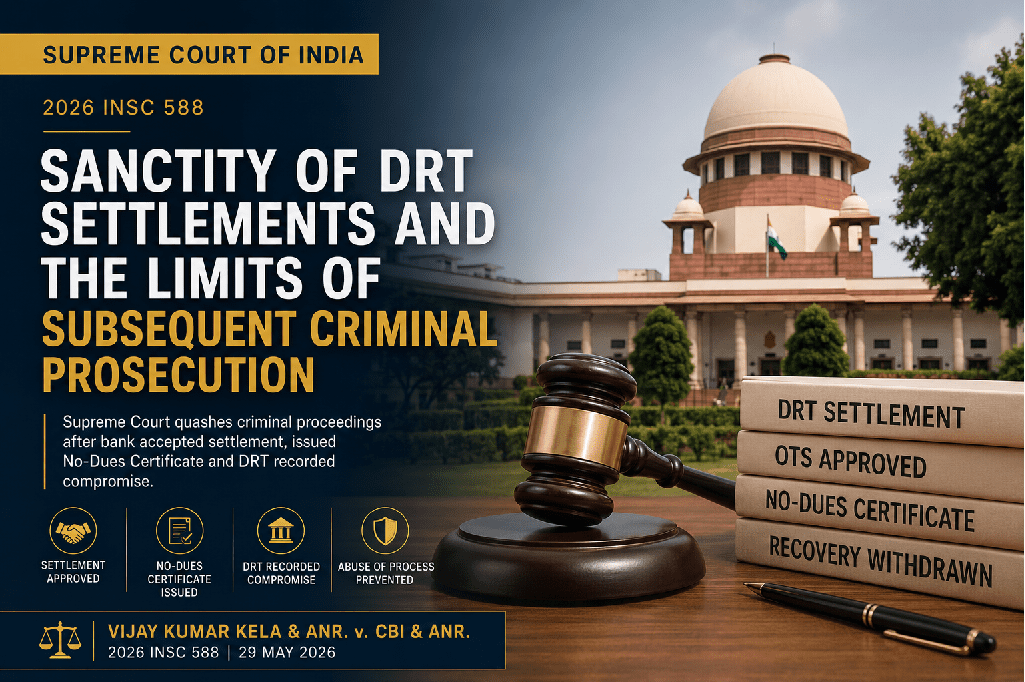
In a significant decision strengthening the finality of banking settlements and commercial dispute resolution, the Supreme Court in Vijay Kumar Kela & Anr. v. Central Bureau of Investigation & Anr. (2026 INSC 588) has held that criminal proceedings initiated by a bank after a full and final compromise settlement before the Debts Recovery Tribunal (DRT) may amount to an abuse of process and deserve to be quashed.
The judgment addresses an important question frequently encountered in banking litigation:
Can a borrower be subjected to criminal prosecution for cheating and use of forged documents after the bank has voluntarily settled the loan account, accepted the settlement amount, issued a No-Dues Certificate, and withdrawn recovery proceedings before the DRT?
Answering the question in the negative on the facts of the case, the Supreme Court emphasized the need to preserve the sanctity of negotiated settlements in commercial and banking disputes.
Background of the Case
The appellants had availed various credit facilities from UCO Bank between 2006 and 2009. The credit limits were enhanced from time to time and secured by mortgage of immovable properties.
Subsequently, the loan account became irregular and was classified as a Non-Performing Asset (NPA). Recovery proceedings were initiated by the bank before the DRT and under the SARFAESI Act.
During the pendency of the DRT proceedings, the parties negotiated a compromise settlement. The competent authority of the bank approved a One-Time Settlement (OTS) under which:
- Outstanding dues were approximately ₹6.49 crore.
- Settlement amount was fixed at ₹4.25 crore.
- The borrower paid the entire settlement amount.
- The bank issued a No-Dues Certificate.
- The DRT recorded the compromise and permitted withdrawal of the recovery proceedings.
However, more than two years later, the bank lodged a complaint with the CBI alleging that:
The borrower had obtained enhancement of credit facilities through forged audit reports.
Valuable mortgaged properties had been substituted with encroached properties.
The bank had suffered financial loss.
The CBI registered an FIR and ultimately filed a chargesheet under Sections 420 and 471 IPC.
The Core Issue
The Supreme Court framed the central issue as follows:
Whether criminal prosecution under Sections 420 and 471 IPC can be initiated and continued after the loan account has been settled through a compromise approved by the competent authority of the bank and endorsed by the DRT.
Findings of the Supreme Court
1.The dispute had predominantly civil and commercial characteristics
The Court observed that the transaction originated from a banking relationship involving grant of credit facilities and subsequent recovery proceedings.
The dispute arose out of a commercial transaction and therefore possessed an overwhelmingly civil flavour.
The Court reiterated the principles laid down in:
- Nikhil Merchant v. CBI
- Gian Singh v. State of Punjab
- Narinder Singh v. State of Punjab
- Parbatbhai Aahir v. State of Gujarat
- Bharthi Devi v. State of Telangana
which recognize that criminal proceedings arising out of commercial transactions may be quashed where the parties have settled the dispute completely.
2.The Bank itself approved and acted upon the settlement
An important factor noted by the Court was that:
The compromise was approved by the bank’s competent authority.
A joint application was filed before the DRT.
The settlement amount was accepted.
A No-Dues Certificate was issued.
Recovery proceedings were withdrawn.
Thus, the settlement was not merely a private arrangement but had become part of judicial proceedings before the DRT.
3. Delay in initiating criminal proceedings undermined the Bank’s stand
The Court found it significant that the bank claimed to have suspected fraud as early as 2013.
Despite this alleged suspicion:
The bank negotiated the settlement.
Accepted the compromise amount.
Obtained closure of DRT proceedings.
Issued a No-Dues Certificate.
Only thereafter was a criminal complaint lodged before the CBI.
The Court held that such conduct lacked good faith and was inconsistent with the bank’s own actions during the settlement process.
4.Continuation of prosecution would amount to abuse of process
The Court observed that once the dispute had been completely settled and judicially recognized by the DRT, permitting criminal proceedings to continue would be oppressive and prejudicial to the borrower.
The possibility of conviction was considered remote and bleak in the peculiar facts of the case.
Accordingly, continuation of criminal prosecution would amount to an abuse of the process of law.
Importance of the DRT’s Approval
Perhaps the most significant aspect of the judgment is the Court’s emphasis on the judicial character of a settlement recorded by the DRT.
The Court observed that once a compromise has:
Been approved by the competent authority of the bank;
Been acted upon by both parties; and
Received the imprimatur of a judicial forum such as the DRT,
the sanctity of such settlement deserves protection.
The Court warned that permitting subsequent criminal prosecution in such circumstances may discourage borrowers and banks from entering into negotiated settlements.
Impact on Banking and Recovery Litigation
The judgment has far-reaching implications.
For Borrowers
Borrowers may rely upon this decision where:
- A loan account has been settled under an approved OTS;
- Recovery proceedings have been withdrawn;
- No-Dues Certificates have been issued; and
- Criminal proceedings are initiated later based substantially on the same transaction.
For Banks
Banks must exercise greater caution before:
- Approving compromise settlements;
- Certifying closure of accounts; and
- Subsequently alleging fraud based on facts known to them before settlement.
The judgment underscores that a bank cannot ordinarily approbate and reprobate.
For DRT Practitioners
- The decision strengthens the legal significance of settlements recorded before DRTs and reinforces confidence in negotiated dispute resolution mechanisms.
Important Caveat
The judgment should not be understood as granting blanket immunity in all fraud cases.
The Supreme Court reaffirmed the distinction between:
Commercial disputes possessing predominantly civil flavour; and
Serious economic offences affecting public interest or involving corruption and public servants.
Each case will continue to depend on its own facts.
Conclusion
The Supreme Court’s decision in Vijay Kumar Kela v. CBI is a strong reaffirmation of the principle that commercial settlements must carry finality.
Where a bank consciously enters into a compromise, receives the agreed amount, issues a No-Dues Certificate, and secures closure of DRT proceedings, a subsequent criminal prosecution founded upon the same transaction may not be permitted to continue.
The judgment serves as an important reminder that the legal system must encourage and protect genuine commercial settlements rather than allow them to be undermined through belated criminal proceedings.
In doing so, the Court has reinforced both the credibility of DRT-mediated settlements and the broader policy objective of facilitating resolution of commercial disputes.