

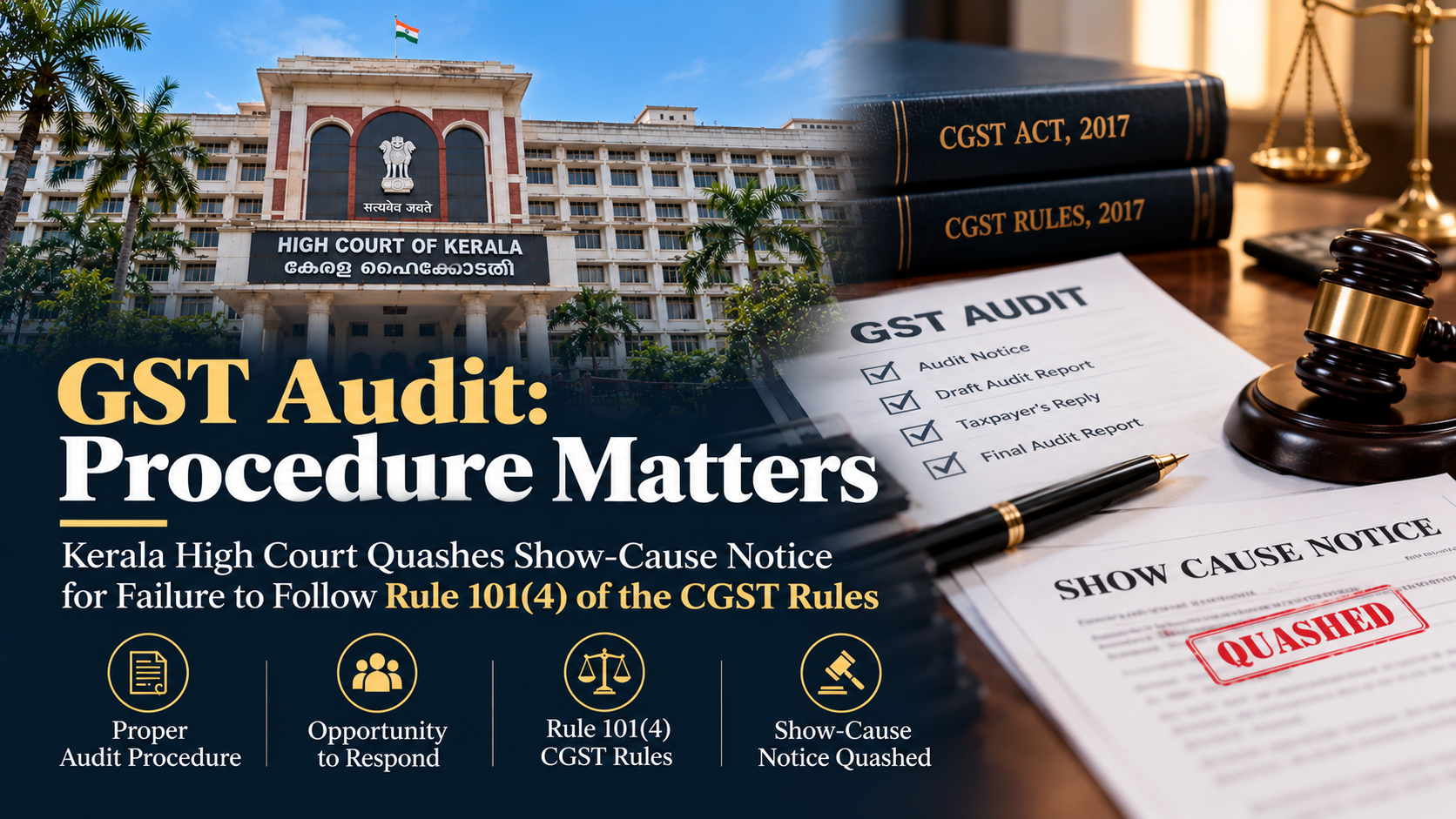
The Kerala High Court has ruled that a GST show-cause notice issued on the basis of audit observations that had not attained finality was legally unsustainable. The Court also held that the tax authorities must provide the registered taxpayer an opportunity to respond to audit discrepancies and consider the reply before finalising the audit under Rule 101(4) of the CGST Rules, 2017.
Table of Contents
ToggleIntroduction
GST audits are an important mechanism for verifying the correctness of tax declarations, returns and other records maintained by registered taxpayers. However, the exercise of audit powers must comply with the procedure prescribed under the Central Goods and Services Tax Act, 2017 (CGST Act) and the rules framed thereunder.
A significant question arises when the tax authorities issue a show-cause notice based on preliminary audit observations before completing the statutory audit process. Can such a notice be sustained when the taxpayer has not been given a proper opportunity to respond to the discrepancies identified during the audit?
The Kerala High Court examined this issue in The Alleppey Company Ltd. v. Assistant Commissioner, Central Tax and Central Excise & Another, W.P.(C) No. 30354 of 2024, reported as 2026:KER:75858.
In its judgment dated 30 September 2026, delivered by Justice Ziyad Rahman A.A., the Court held that the show-cause notice was legally unsustainable because it was issued on the basis of audit observations that had not attained finality. The Court also found that the statutory procedure requiring an opportunity to submit objections had not been followed while finalising the audit.
The judgment is important for businesses facing GST audits and for understanding the procedural safeguards available to taxpayers during audit proceedings.
Background of the Case
The petitioner, The Alleppey Company Ltd., is a company registered under the Companies Act, 1956 and a registered taxpayer under the CGST Act and the Kerala State Goods and Services Tax Act, 2017.
The company challenged a GST show-cause notice and a subsequent corrigendum on the ground that the audit proceedings forming the basis of the notice had not been completed in accordance with Section 65 of the CGST Act read with Rule 101 of the CGST Rules.
The relevant sequence of events was as follows:
- 17 January 2024: The company received an audit notice in Form GST ADT-01.
- 24 January 2024: The company submitted its reply and produced the relevant documents.
- 4 July 2024: Draft audit observations were communicated to the company.
- 11 July 2024 and 15 July 2024: The company requested additional time to submit its reply to the audit observations.
- 16 July 2024: The authorities issued an audit note identifying discrepancies.
- 31 July 2024: A show-cause notice was issued based on the discrepancies referred to in the audit note.
- 1 August 2024: A corrigendum to the show-cause notice was issued.
- 3 September 2024: A further report, described as the final audit report, was issued.
The company contended that the authorities had issued the show-cause notice without first completing the audit in the manner required by law. It also argued that the requests for additional time to respond to the draft audit observations had not been properly considered.
The company therefore approached the Kerala High Court seeking judicial intervention.
Issues Considered by the High Court
The Court considered two principal issues.
1. Whether the GST audit had been completed within the prescribed time limit
The company contended that the audit had not been finalised within the period prescribed under Section 65(4) of the CGST Act.
According to the company, the necessary documents had been submitted on 24 January 2024. On that basis, it argued that the audit should have been completed by 23 April 2024, whereas the final audit report was issued only on 3 September 2024.
2. Whether the prescribed audit procedure had been followed
The company also contended that the authorities had failed to follow the procedure prescribed under Rule 101(4) of the CGST Rules.
In particular, the company argued that it had not been given a proper opportunity to respond to the discrepancies identified during the audit before the audit findings were finalised and the show-cause notice was issued.
The High Court examined these issues separately and reached different conclusions on the limitation objection and the procedural objection.
Statutory Framework: Section 65 of the CGST Act
Section 65 of the CGST Act governs the audit of registered persons by the tax authorities.
Time limit for completing the audit
Section 65(4) provides that an audit under Section 65(1) must be completed within three months from the date of commencement of the audit.
The Explanation to Section 65(4) defines the commencement of the audit by reference to two events:
- The date on which the records and other documents called for by the tax authorities are made available by the registered person; or
- The actual institution of the audit at the place of business of the registered person.
The later of these two dates determines the commencement of the audit for the purpose of calculating the statutory period.
Communication of audit findings
Section 65(6) requires the proper officer, upon conclusion of the audit, to inform the registered person within 30 days about the audit findings, the registered person’s rights and obligations, and the reasons for those findings.
The audit process must therefore be completed in accordance with the statutory framework. The identification of discrepancies during an audit and the finalisation of audit findings are not necessarily the same procedural stage.
Why the High Court Rejected the Limitation Objection
The company argued that the audit should be treated as having commenced when it submitted the documents requested by the authorities on 24 January 2024.
The High Court, however, examined the specific definition of the commencement of an audit under Section 65(4).
The Court noted that the audit was actually conducted at the company’s premises on various dates between 24 May and 4 June 2024. The actual institution of the audit at the business premises therefore occurred on 24 May 2024.
Since the statutory definition requires the later of the two relevant dates to be taken into account, the Court held that the audit commenced on 24 May 2024.
On that basis, the Court concluded that the final audit report dated 3 September 2024 could not be treated as time-barred under Section 65(4).
The Court therefore decided the limitation issue against the company.
This aspect of the judgment is particularly relevant when determining the commencement date of a GST audit. The date on which a taxpayer submits documents is not necessarily decisive if the actual institution of the audit at the place of business occurs later.
The statutory definition must be applied to the facts of the particular case.
Rule 101(4): The Right to Respond to Audit Discrepancies
Although the company failed on the limitation issue, the High Court accepted its contention that the prescribed audit procedure had not been followed.
Rule 101(4) of the CGST Rules provides the procedural framework for communicating discrepancies identified during an audit and obtaining the registered person’s response.
Under this provision:
- The proper officer may inform the registered person of discrepancies noticed during the audit.
- The registered person may submit a reply to those discrepancies.
- The proper officer must finalise the audit findings after duly considering the reply furnished.
The provision contemplates an opportunity for the taxpayer to respond before the audit findings are finalised.
This opportunity is not merely a formality. It enables the registered person to explain the transactions, produce supporting records, clarify apparent discrepancies and contest conclusions that may have been drawn from incomplete information.
The audit must be finalised after due consideration of the taxpayer’s response, in accordance with the prescribed procedure.
Why the Show-Cause Notice Was Held Unsustainable
The High Court examined the sequence in which the draft audit observations, audit note, show-cause notice and final audit report had been issued.
The draft audit observations were communicated to the company on 4 July 2024. The company subsequently requested additional time to submit its reply through communications dated 11 July 2024 and 15 July 2024.
However, the authorities issued the audit note dated 16 July 2024 without providing the company an opportunity to submit the requested response.
The show-cause notice followed on 31 July 2024, relying on the discrepancies identified in that audit note.
The Court observed that the audit note dated 16 July 2024 was more in the nature of an intimation of the discrepancies noticed during the audit, intended to enable the company to furnish its reply under Rule 101(4).
It was not the final audit observation.
The Court further noted that the final audit report was issued only on 3 September 2024. The respondents themselves relied on that report as the final audit observation.
Consequently, the show-cause notice dated 31 July 2024 had been issued before the audit observations relied upon by the authorities had attained finality.
The Court held that the show-cause notice could not be sustained when it was based on an audit note that was not the final audit observation.
The judgment thus distinguishes between a preliminary communication identifying discrepancies and the finalisation of audit findings in accordance with the statutory procedure.
The Final Audit Report Also Failed to Comply with the Prescribed Procedure
The Court did not stop with examining the show-cause notice.
It also considered whether the final audit report dated 3 September 2024 could be sustained.
The company had sought additional time to respond to the draft audit observations. However, the authorities issued the subsequent audit note without referring to the requests or passing an order accepting or rejecting them.
The High Court found that the company had not been provided the opportunity to submit its objections as contemplated under Rule 101(4).
The fact that draft audit observations had initially been issued did not cure the defect. The statutory procedure required the authorities to permit a response to the discrepancies and consider that response before finalising the audit findings.
Since this procedure had not been followed, the Court concluded that the final audit report also lacked legal sanctity.
Accordingly, both the show-cause notice and the final audit report were held to be legally unsustainable.
Final Decision of the Kerala High Court
The Kerala High Court disposed of the writ petition by quashing the show-cause notice dated 31 July 2024 and the final audit report dated 3 September 2024.
The Court issued the following directions:
- The competent authority was directed to permit the company to submit its objections to the audit observations dated 16 July 2024.
- The company was directed to submit its reply within one month from the date of receipt of a copy of the judgment.
- The authorities were directed to finalise the audit proceedings after considering the reply submitted by the company.
- The audit proceedings were to be completed as expeditiously as possible.
The judgment did not finally determine the underlying tax discrepancies or hold that the company was not liable for any tax, interest or penalty. Instead, the Court required the authorities to reconsider the matter by following the prescribed procedure.
This distinction is important: quashing a show-cause notice or audit report for procedural non-compliance does not automatically extinguish the underlying tax issue. The matter may be reconsidered in accordance with the Court’s directions and the applicable law.
Practical Implications for Businesses Facing GST Audits
The judgment provides useful guidance for registered taxpayers and businesses undergoing GST audits.
1. Verify the commencement date of the audit
Taxpayers should carefully examine the date on which the requested records were made available and the date on which the audit was actually instituted at their business premises.
Under Section 65(4), the later of the two relevant dates determines the commencement of the audit.
A limitation objection should therefore be based on the statutory definition and the supporting records, rather than merely the date of submission of documents.
2. Respond promptly to draft audit observations
When draft audit observations are received, taxpayers should examine the discrepancies and prepare a detailed response supported by relevant documents.
If additional time is required because of the volume or complexity of the observations, the taxpayer should submit a written request explaining the reasons for seeking an extension.
Copies of the requests, acknowledgements and subsequent communications should be preserved.
3. Examine whether objections were considered before finalisation
The judgment emphasises that the audit findings must be finalised after due consideration of the taxpayer’s reply.
Where the taxpayer has submitted objections, the subsequent audit report should be examined to determine whether the prescribed procedure has been followed.
Where a request for additional time has been made but not addressed, the surrounding facts and procedural history may be relevant in assessing whether the taxpayer received a proper opportunity to respond.
4. Distinguish preliminary observations from final audit findings
A communication identifying discrepancies during an audit should not automatically be treated as the final audit report.
Taxpayers should examine the substance of the communication, its stated purpose and the subsequent steps taken by the authorities.
In the present case, the High Court found that the audit note dated 16 July 2024 was an intimation of discrepancies intended to enable a reply, while the report dated 3 September 2024 was treated by the authorities as the final audit observation.
5. Examine the legal basis of a show-cause notice
Where a show-cause notice is based on an audit report, the taxpayer should examine whether the report had been finalised in accordance with the applicable statutory procedure.
The relevant questions may include whether the prescribed opportunity to respond was provided, whether the reply was considered and whether the notice relies on findings that had attained the required procedural status.
6. Preserve the distinction between procedural and substantive defences
A taxpayer may have grounds to dispute the procedure followed by the authorities as well as the substantive tax allegations.
These are separate issues and should be examined independently.
Even where a procedural defect is established, the underlying tax dispute may require further consideration in accordance with the law and the directions issued by the Court.
Conclusion
The Kerala High Court’s decision in The Alleppey Company Ltd. v. Assistant Commissioner, Central Tax and Central Excise & Another reinforces the importance of complying with the statutory procedure governing GST audits.
While the Court rejected the company’s limitation objection after determining the commencement date under Section 65(4), it accepted the contention that the audit procedure prescribed under Rule 101(4) had not been followed.
The show-cause notice was issued on the basis of audit observations that had not attained finality, and the final audit report was issued without providing the company the required opportunity to submit its objections.
The Court therefore quashed the show-cause notice and the final audit report and directed the authorities to reconsider the matter after permitting the company to respond to the audit observations.
For businesses, the judgment highlights the importance of monitoring audit timelines, responding to audit observations and ensuring that the statutory procedure is followed before audit findings are finalised.
For tax professionals, it serves as a reminder that procedural compliance is an essential component of lawful GST audit proceedings.
Case Reference: The Alleppey Company Ltd. v. Assistant Commissioner, Central Tax and Central Excise & Another, W.P.(C) No. 30354 of 2024, 2026:KER:75858, Kerala High Court, judgment dated 30 September 2026, per Justice Ziyad Rahman A.A.
**************************
Disclaimer: This article is intended for general legal information and educational purposes. It is based on the judgment identified above and should not be treated as legal or tax advice in any particular matter. The appropriate course of action depends on the facts of the case, the applicable statutory provisions and subsequent legal developments.