

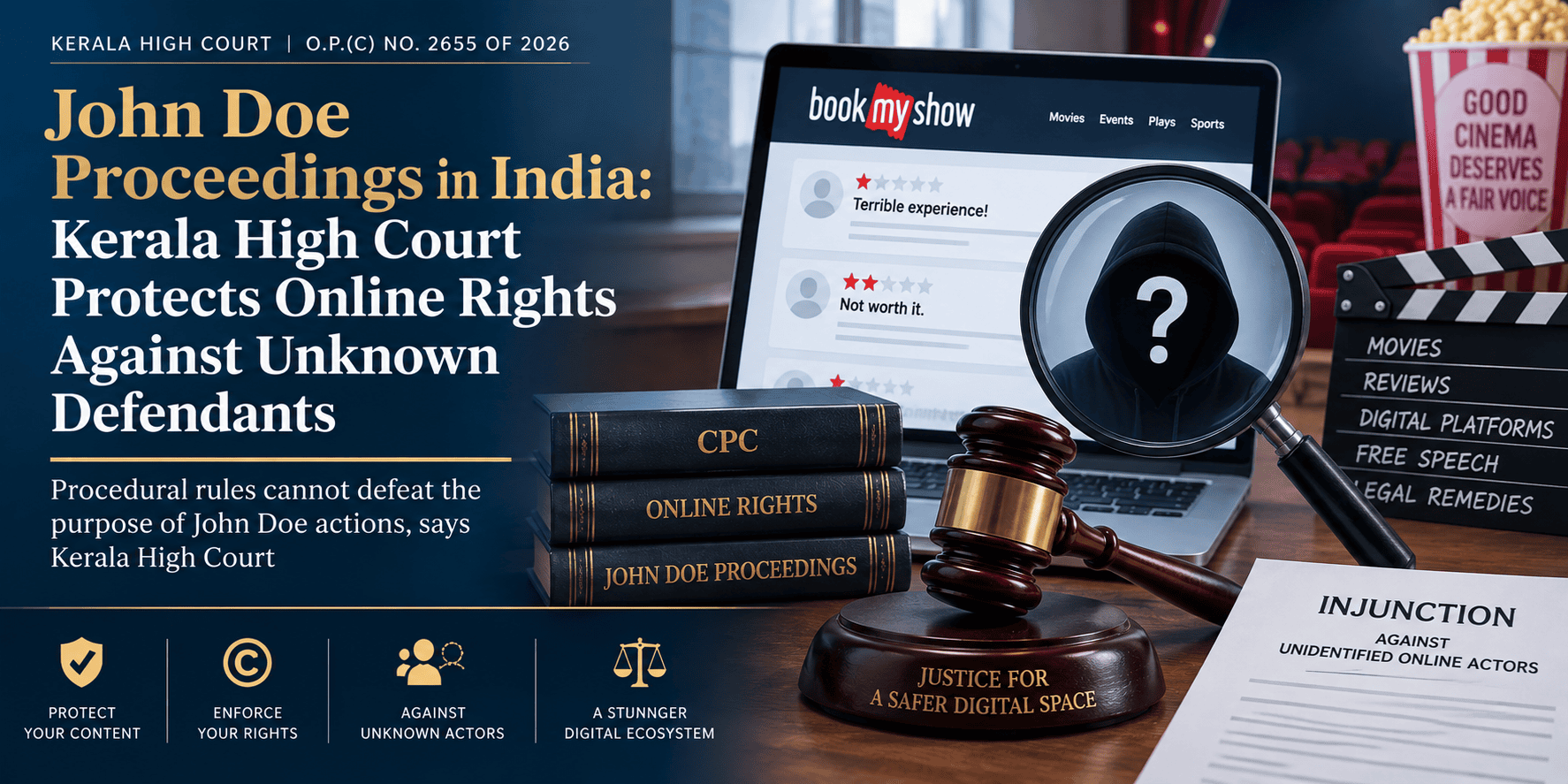
The rapid growth of digital platforms has created a recurring problem for intellectual property owners, businesses and content creators: what can be done when the identity of the person committing the alleged infringement is not known?
A plaintiff may know that unlawful content has been uploaded or circulated through an online platform, but may not know the name, address or other identifying details of the person responsible.
In such circumstances, John Doe proceedings, also known in India as Ashok Kumar proceedings, can provide a procedural mechanism for seeking relief against unidentified persons.
A recent judgment of the High Court of Kerala in O.P.(C) No. 2655 of 2026, decided on 14 September 2026, has considered an important procedural issue arising in such proceedings.
The Court held that where the very purpose of impleading a defendant as a John Doe/Ashok Kumar defendant is that the person’s identity is unknown, insisting upon particulars which the plaintiff cannot possibly provide can defeat the purpose of the proceedings.
Table of Contents
Toggle1.What are John Doe proceedings?
A John Doe proceeding is a type of litigation in which the plaintiff seeks relief against persons whose identities are not yet known.
In Indian practice, such unidentified defendants are also frequently described as “Ashok Kumar” defendants.
The mechanism becomes particularly relevant where a plaintiff knows that an infringement or unlawful act is being committed but does not yet know the identity of the person responsible.
For example, in a digital environment:
- an anonymous person may upload infringing content;
- a person may post allegedly unlawful material through an online platform;
- the identity of the account holder may be hidden;
- multiple unknown persons may be involved; or
- the plaintiff may need information from the platform to identify the persons concerned.
The purpose of the proceeding is therefore not to avoid identifying the defendant permanently. Rather, it enables the plaintiff to approach the court before the identity of the wrongdoer is discovered.
The Kerala High Court recognised that the concept of John Doe litigation is expanding rapidly.
2. Background of the Kerala High Court case
The case was filed by M/s Cubes Entertainments, represented by its designated partner.
The petitioner had instituted a suit seeking injunction against alleged online activity concerning reviews posted on the BookMyShow platform.
The grievance related to reviews of the film “Kattalan” posted on the platform of the first defendant.
According to the judgment, the plaintiff sought removal of the review in order to protect its rights and sought other reliefs as well.
The difficulty was that the plaintiff did not know the exact identity of the persons who had posted the reviews.
Consequently, the second defendant was described as: “John Doe” / “Ashok Kumar”.
3.Why did the Munsiff Court refuse to number the suit?
The plaintiff initially approached the Principal Munsiff Court, Ernakulam.
The trial court refused to number the suit.
The apparent reason was non-compliance with the requirements of Order VI Rule 14A of the Code of Civil Procedure, 1908, concerning the address of the party for service of notice.
The plaintiff therefore filed an application seeking exemption from compliance with:
- Order VI Rule 14A CPC, and
- Order VII Rule 1(c) CPC.
That application was rejected by the trial court.
The plaintiff then approached the Kerala High Court under Article 227 of the Constitution of India.
4.What does Order VI Rule 14A CPC require?
Order VI Rule 14A CPC deals with the address for service of notice.
The rule requires every pleading filed by a party to be accompanied by a statement, in the prescribed form, containing the address of the party for service.
The requirement is understandable in ordinary litigation.
A defendant has to be served with the pleadings and court process, and therefore the court needs sufficient particulars for service.
But the situation becomes fundamentally different when the defendant is deliberately described as John Doe/Ashok Kumar because the defendant’s identity is not known.
That was the procedural difficulty before the High Court.
5.The Kerala High Court identifies a “procedural paradox”
The High Court found that insisting upon the physical address of the unidentified John Doe defendant under Order VI Rule 14A created a procedural paradox.
The Court’s reasoning was straightforward.
- If the plaintiff already knew:
- the name of the defendant; and
- the defendant’s address,
- there would ordinarily be no reason to describe that person as a John Doe defendant.
But where the person is genuinely unidentified, it may be impossible for the plaintiff to provide the very particulars demanded by the procedural rule.
The Court therefore observed that insisting upon such particulars could defeat the very purpose of John Doe jurisprudence.
6.Why John Doe proceedings are important in digital disputes
The issue becomes especially significant in online litigation.
Digital platforms can contain enormous quantities of user-generated material.
A rights holder may discover allegedly infringing or unlawful content but may initially know only:
the platform on which it appears;
- the username or account;
- the URL or digital location;
- the content itself; or
- other limited identifying information.
The actual person’s identity may remain unknown.
The Kerala High Court recognised that, in such cases, compliance with conventional procedural requirements may not always be possible at the initial stage.
The judgment records that in John Doe/Ashok Kumar proceedings it can be virtually impossible to comply with Order VI Rule 14A where the persons responsible for the material are unidentified.
7.The development of John Doe jurisprudence in India
The Kerala High Court traced the development of John Doe proceedings in India to decisions of the Delhi High Court.
The judgment refers to Taj Television v. Rajan Mandal (2003), where the Delhi High Court restrained unlicensed cable operators from unlawfully broadcasting the 2002 FIFA World Cup content.
The concept was subsequently developed in other cases, including:
- S.P.N Software India Pvt. Ltd. v. Tudu Enterprises & Ors.
- UTV Software Communications Ltd. & Ors. v. 1337X.To & Ors.
The High Court referred to these cases to demonstrate the development of the jurisprudence concerning unidentified defendants and John Doe orders.
8.John Doe litigation is expanding
The Kerala High Court observed that the concept of John Doe litigation is expanding rapidly.
This development is particularly relevant in disputes involving:
- copyright infringement;
- trademark infringement;
- unauthorised publication;
- online piracy;
- digital content;
- anonymous online activity; and
- other forms of internet-based infringement.
The Court stated that courts should adopt a progressive approach when entertaining suits in which John Doe orders are sought and should not allow procedural requirements to defeat the purpose of such proceedings.
9. Procedural rules are intended to facilitate justice
One of the most important observations in the judgment concerns the role of procedural law.
The High Court emphasised that the procedural rules under the CPC are “handmaidens of justice” and should not become technical obstructions to substantive justice.
In the Court’s view, the trial court could also have considered obtaining an undertaking from the plaintiff that the actual person who posted the review would be impleaded once his identity was discovered.
This provides a useful practical approach.
Instead of insisting that the plaintiff provide information that is genuinely unavailable, the court can allow the proceeding to move forward while requiring the plaintiff to identify and implead the actual defendant once sufficient information becomes available.
10.Article 227 jurisdiction and procedural correction
The plaintiff invoked the supervisory jurisdiction of the High Court under Article 227 of the Constitution of India.
The High Court found that intervention was necessary to correct the procedural approach adopted by the Principal Munsiff Court.
The Court held that Article 227 jurisdiction could be invoked to render substantive justice and correct the procedural infirmity.
This does not mean that Article 227 becomes an ordinary appellate remedy.
Rather, in the circumstances considered by the Court, the supervisory jurisdiction was exercised to address the procedural difficulty which prevented the suit from proceeding.
11.What did the Kerala High Court finally order?
The High Court allowed the Original Petition.
It:
- set aside the impugned order of the Principal Munsiff Court;
- directed the Principal Munsiff Court, Ernakulam, to number the suit upon production of the certified copy of the judgment; and
- directed the trial court to proceed to consider the interlocutory application forthwith.
Thus, the plaintiff was not prevented from proceeding merely because the identities of the alleged online actors were not initially known.
12.Practical significance for copyright and trademark owners
The judgment is particularly relevant to intellectual property litigation.
Suppose a copyright owner discovers that unknown persons are uploading copyrighted material online.
Or suppose a trademark owner discovers anonymous online activity which allegedly infringes its trademark rights.
At the initial stage, the owner may not know:
- the real name of the person;
- residential or business address;
- identity of the account holder; or
- other information necessary for conventional service.
The judgment illustrates why John Doe/Ashok Kumar proceedings can be an important procedural tool in such situations.
The exact relief available will, of course, depend upon the facts of each case, the applicable statute and the evidence placed before the court.
13.What should a plaintiff establish in a John Doe case?
Although the present judgment primarily concerned the procedural issue relating to numbering of the suit, a plaintiff seeking John Doe relief should carefully prepare the underlying case.
Depending upon the nature of the dispute, relevant material may include: Identification of the unlawful activity
The plaintiff should clearly identify the alleged infringement or wrongful activity.
Digital evidence
Where the dispute concerns online content, evidence may include:
- screenshots;
- URLs;
- timestamps;
- account details;
- platform information;
- copies of the allegedly infringing material; and
- other available digital records.
The plaintiff’s legal rights
The plaintiff should establish the legal right which it seeks to protect.
For example, this may involve:
- copyright;
- trademark rights;
- contractual rights; or
- other legally protected interests.
Information available concerning the unknown defendant
Even if the identity is unknown, whatever information is available should be placed before the court.
The purpose is to enable the court to understand the nature of the alleged wrongdoing and the steps required to identify the person concerned.
14.John Doe does not mean that the defendant remains unidentified forever
An important conceptual point is that John Doe proceedings are not intended to permanently dispense with identification of the defendant.
The unidentified person is initially described in that manner because the plaintiff does not yet possess sufficient information.
Once the identity becomes known, the actual defendant can be identified and impleaded in the proceedings.
The Kerala High Court specifically noted that the trial court could have obtained an undertaking to implead the actual person once his identity was revealed.
15. Key legal takeaways
Issue | Kerala High Court’s observation
|
Unknown online defendant | May be proceeded against as John Doe/Ashok Kumar where identity is not known |
Order VI Rule 14A CPC | Its address requirement can be impossible to satisfy against a genuinely unidentified defendant |
Procedural requirements | Should not defeat the purpose of John Doe proceedings |
John Doe jurisprudence | Recognised as an expanding area of Indian litigation |
Digital disputes | Particularly relevant where online actors are unidentified |
Actual defendant | Can be identified and impleaded when identity becomes known |
Article 227 | High Court can exercise supervisory jurisdiction to correct procedural infirmity in appropriate circumstances |
Result in this case | Munsiff Court was directed to number the suit and consider the interlocutory application forthwith |
These points arise from the reasoning and operative directions in the judgment.
16.Why this judgment matters for online litigation in Kerala
The judgment is significant because online disputes often move faster than conventional civil litigation.
A rights holder may discover allegedly unlawful online content and need urgent judicial protection while the identity of the person responsible is still unknown.
If conventional procedural requirements are applied without considering the special circumstances of unidentified defendants, the plaintiff may be unable to even get the proceeding numbered.
The Kerala High Court’s judgment indicates that procedural law must be applied in a manner that recognises the realities of John Doe litigation.
The Court’s approach also demonstrates the importance of balancing procedural requirements with the need to protect substantive rights.
Conclusion
The judgment of the Kerala High Court in O.P.(C) No. 2655 of 2026 provides useful guidance on John Doe/Ashok Kumar proceedings, particularly in the context of online content and unidentified persons.
The Court recognised the practical difficulty of requiring a plaintiff to furnish the physical address and other particulars of a person whose identity is genuinely unknown.
The judgment emphasises that procedural rules should facilitate the administration of justice and should not become technical barriers that make a legitimate proceeding ineffective.
For businesses, copyright owners, trademark proprietors and other rights holders facing unidentified online actors, John Doe proceedings can therefore provide an important procedural route for seeking judicial protection while steps are taken to identify the actual wrongdoer.
The judgment also highlights the role of Article 227 of the Constitution in correcting procedural infirmities where appropriate.
Case Details
Case: M/s Cubes Entertainments v. Big Tree Entertainment Private Limited & Others
Court: High Court of Kerala at Ernakulam
Case Number: O.P.(C) No. 2655 of 2026
CNR: KLHC010679142026
Citation: 2026:KER:69867
Date of Judgment: 14 September 2026
Judge: Hon’ble Mr. Justice Easwaran S.