

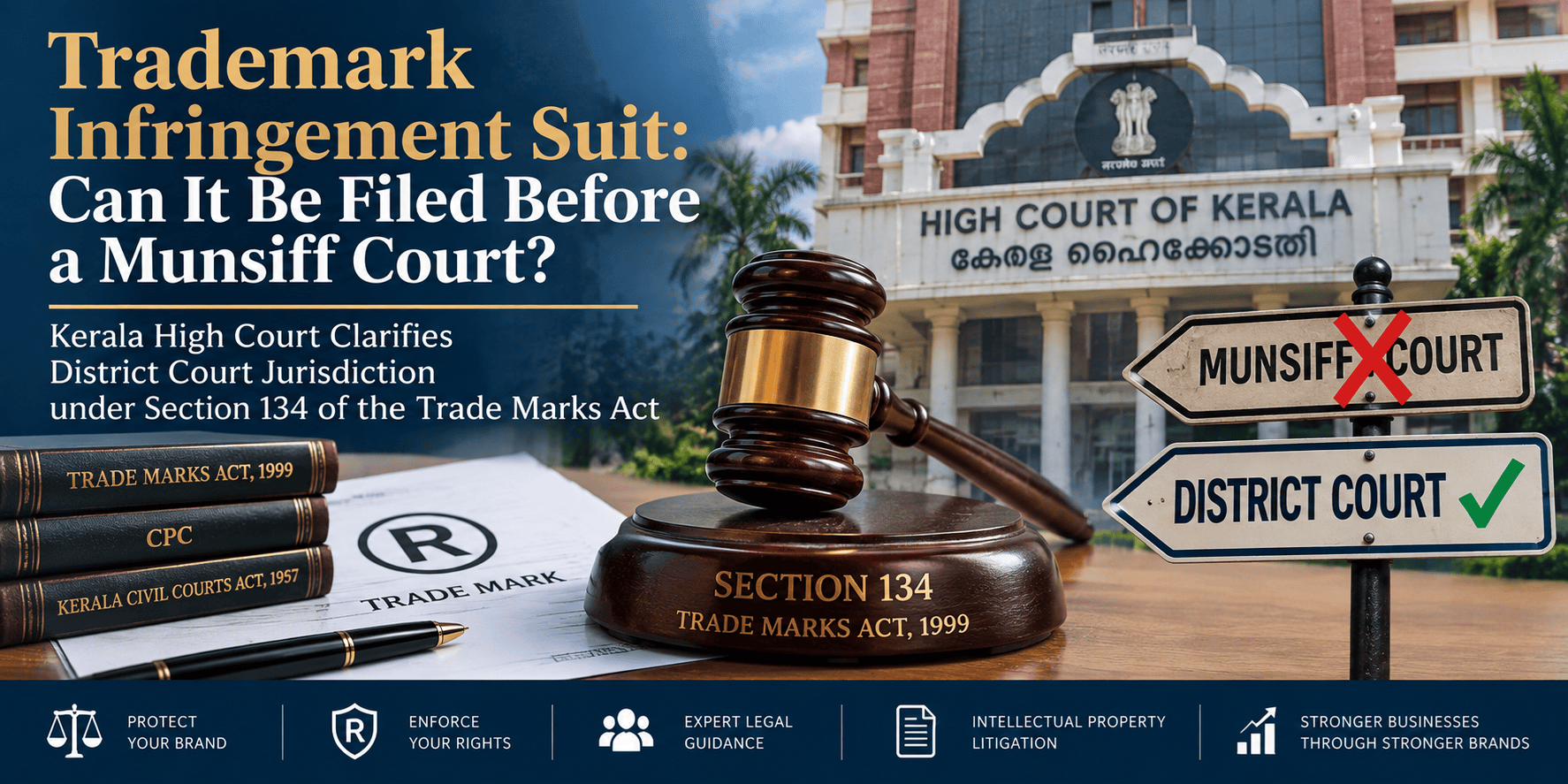
The question of which court has jurisdiction to entertain and try a trademark infringement suit can become particularly important where the monetary value of the claim is relatively low.
A recent judgment of the High Court of Kerala in C.R.P. No. 284 of 2025, decided on 8 September 2026, has examined this issue in detail.
The Court considered whether a trademark infringement suit having a total valuation of only ₹5.10 lakh could be instituted before a District Court but subsequently tried by a court of a lower grade on the ground of ordinary pecuniary jurisdiction.
The Kerala High Court rejected that approach and held that Section 134 of the Trade Marks Act, 1999 operates as a special jurisdictional provision requiring the suit to be instituted and tried by the District Court having jurisdiction.
1.Background of the case
The case arose from a trademark infringement suit filed before the Additional District Court, Kozhikode.
The plaintiff alleged that the defendants were infringing its registered trademark and sought:
a prohibitory injunction; and damages.
The relief of prohibitory injunction was valued at ₹1,000/-, while the damages claimed were ₹5,00,000/-.
Accordingly, the total jurisdictional value stated in the plaint was ₹5,01,000/-.
The defendants challenged the maintainability of the suit before the District Court.
Their argument was essentially that although Section 134 of the Trade Marks Act required institution before a District Court, the relatively low valuation meant that the suit could not actually be tried by the District Court and ought to be tried by a Munsiff Court under the ordinary pecuniary jurisdiction rules.
This raised an important distinction between:
-the court before which a suit is instituted and
-the court which has jurisdiction to try the suit.
2.The legal issue before the Kerala High Court
The principal question was whether a trademark infringement suit: can be instituted before a District Court under Section 134 of the Trade Marks Act but thereafter be tried by a court below the District Court because the monetary value of the suit falls within the latter court’s pecuniary jurisdiction.
The revision petitioners relied upon Section 9 of the Code of Civil Procedure, 1908 and Section 11(2) of the Kerala Civil Courts Act, 1957 in support of their contention.
The High Court rejected this interpretation.
3.What does Section 134 of the Trade Marks Act provide?
Section 134 of the Trade Marks Act, 1999 contains a special provision relating to suits concerning infringement of registered trademarks and certain related claims.
The provision states that such a suit shall not be instituted in a court inferior to a District Court having jurisdiction to try the suit.
The significance of this provision was central to the High Court’s reasoning.
The Court held that the expression used in Section 134 is not merely concerned with the formal place where the plaint is presented. It also identifies the level of court competent to try the trademark suit.
4.Section 9 CPC does not create a gap between institution and trial
An important observation of the Kerala High Court concerns Section 9 of the Code of Civil Procedure.
The Court held that Section 9 CPC does not itself create a distinction between:
-the court in which a suit is instituted; and
-the court which has jurisdiction to try the suit.
According to the Court, there is no “jurisdictional vacuum” between the court of institution and the court of trial.
The court competent to entertain the suit under the CPC is, subject to lawful transfer under the CPC or another special enactment, the court competent to adjudicate the matter.
This distinction becomes particularly important where a special statute prescribes the level of court before which a particular category of suit must be instituted.
5.Section 134 is a special jurisdictional provision
The High Court treated Section 134 of the Trade Marks Act as a special jurisdictional provision.
The Court reasoned that if a trademark infringement suit were first instituted before the District Court merely to comply with Section 134 and were then transferred to a Munsiff Court for trial solely because of pecuniary valuation, the statutory requirement contained in Section 134 would effectively be undermined.
The Court observed that the District Court must be regarded, for the purposes of Section 134, as the lowest grade of competent court to try a trademark suit.
This is the central proposition emerging from the judgment.
6.Pecuniary value does not permit a trademark suit to be tried by a lower court
One of the most important observations in the judgment is that the expression “having jurisdiction” in Section 134 does not necessarily mean only pecuniary jurisdiction.
The High Court held that Section 134 has to be understood as a special jurisdictional provision which overrides the ordinary CPC position to the extent specified by the statute.
Therefore, a plaintiff cannot be required to institute a trademark infringement suit before a District Court and then have the suit tried by a court below the District Court merely because the monetary valuation falls within the ordinary pecuniary jurisdiction of that lower court.
7.Why the distinction matters
Consider a hypothetical trademark infringement claim involving:
-injunction against infringement; and
-damages of ₹5 lakh.
Ordinarily, the monetary value may suggest that a lower civil court has pecuniary jurisdiction.
However, a trademark infringement action is governed by the specific jurisdictional requirement under Section 134 of the Trade Marks Act.
The High Court’s reasoning means that the plaintiff cannot simply rely upon the low valuation to institute or have the suit tried before a court below the District Court.
This is because Section 134 imposes a statutory requirement concerning the level of court competent to deal with the trademark suit.
8.What about the Commercial Courts Act?
The judgment also considers the position under the Commercial Courts Act, 2015.
The Kerala High Court noted that the Government of Kerala, in consultation with the High Court, had designated District Courts and Additional District Courts in the State as Commercial Courts at the District Judge level for specified commercial disputes, including disputes arising under the Trade Marks Act, 1999, among other intellectual property statutes.
The Court further noted that the specified-value requirement of ₹10 lakh mentioned in the relevant context related to commercial suits.
This aspect is important because it is easy to confuse two separate questions:
Question 1 : Which court is designated to deal with a trademark dispute under the Trade Marks Act?
Question 2 : Does the particular dispute satisfy the specified-value requirements applicable to a commercial suit under the Commercial Courts Act?
These are related but distinct jurisdictional considerations.
9.Section 134 of the Trade Marks Act versus ordinary pecuniary jurisdiction
The judgment demonstrates the importance of distinguishing between ordinary pecuniary jurisdiction and special statutory jurisdiction.
A lower civil court may ordinarily have jurisdiction over a suit because of its monetary valuation.
However, where Parliament has specifically prescribed the minimum level of court before which a particular type of action must be instituted, that special statutory provision has to be given effect.
In the present case, the High Court found that Section 134 of the Trade Marks Act prevents a trademark infringement suit from being instituted before a court inferior to the District Court having jurisdiction to try the suit.
10 The High Court rejects the “formal institution and subsequent transfer” argument
The revision petitioners essentially sought an interpretation under which:
- the plaintiff could comply with Section 134 by instituting the suit before the District Court;
- the suit could then be transferred to a lower court; and
- the lower court could try the suit because of its ordinary pecuniary jurisdiction.
The High Court rejected this approach.
The Court specifically held that Section 134 does not contemplate a trademark suit being instituted in the District Court merely as a matter of form and thereafter being transferred to a court inferior to the District Court for trial on the ground of pecuniary jurisdiction.
11. What did the Kerala High Court finally decide?
The Court concluded that there was no merit in the objection raised by the revision petitioners.
It held that the only court where the plaintiff could have instituted the suit was the District Court.
The revision petition was consequently dismissed.
12. Practical implications for trademark litigation
This judgment is particularly relevant when deciding the forum for a trademark infringement action.
Before filing a trademark suit, practitioners should examine at least the following:
i. Is the action actually a trademark infringement suit?
The statutory forum requirement under Section 134 must first be considered.
ii. Is the trademark registered?
The nature of the statutory claim will depend upon the rights asserted and the relief sought.
iii. Where does the cause of action arise?
Territorial jurisdiction remains an important issue in addition to the level of the court.
iv. What reliefs are being claimed?
Injunction, damages and other reliefs may have different valuation and procedural consequences.
v. Does the Commercial Courts Act apply?
The specified-value requirements and the designation of Commercial Courts must also be examined where applicable.
vi. What is the effect of Section 134?
The plaintiff cannot simply rely upon ordinary pecuniary jurisdiction to select a court below the District Court for a suit covered by Section 134.
13. A useful takeaway for trademark owners
For trademark owners, the judgment provides an important procedural point.
A trademark infringement case is not necessarily governed solely by the amount of damages claimed.
Even where the damages claimed are relatively modest, the statutory framework governing trademark litigation can determine the appropriate level of court.
Therefore, when preparing a trademark infringement action, forum selection should be considered separately from valuation of the monetary claim.
14. Key legal principles from the judgment
The principal propositions emerging from the Kerala High Court judgment may be summarised as follows:
Issue | Position stated by the High Court |
Section 9 CPC | Does not itself create a distinction between the court of institution and the court of trial |
Section 134 Trade Marks Act | Operates as a special jurisdictional provision |
Lower court based on pecuniary value | A trademark suit cannot be tried by a court inferior to the District Court merely on this basis |
“Having jurisdiction” under Section 134 | Does not necessarily mean only pecuniary jurisdiction |
District Court | Treated as the lowest grade competent court for a trademark suit under Section 134 |
Transfer to lower court | Section 134 does not contemplate institution in District Court merely as a formality followed by transfer to a lower court |
Commercial Courts Act | District/Additional District Courts have been designated as Commercial Courts at District Judge level for specified commercial disputes, including trademark disputes |
Final result | Civil Revision Petition dismissed |
These propositions are drawn directly from the reasoning and conclusion of the judgment.
Conclusion
The Kerala High Court’s judgment in C.R.P. No. 284 of 2025 provides useful clarification on the jurisdiction of courts in trademark infringement litigation.
The important point is that Section 134 of the Trade Marks Act, 1999 is a special jurisdictional provision. A trademark infringement suit cannot be instituted before a court inferior to the District Court having jurisdiction to try the suit merely because the monetary value of the claim would ordinarily fall within the pecuniary jurisdiction of a lower civil court.
The Court also rejected the argument that a suit could be instituted before the District Court merely to satisfy Section 134 and then transferred to a lower court for trial on the basis of pecuniary jurisdiction.
For trademark owners and businesses involved in trademark disputes, the judgment highlights the importance of considering statutory jurisdiction, territorial jurisdiction, pecuniary valuation and the applicability of the Commercial Courts Act together before instituting proceedings.
Case Details
Case: M/s. Cutis International Cosmetics Clinic Ltd. & Others v. M/s. Cutis Institute of Medicine and Surgery Private Limited
Court: High Court of Kerala at Ernakulam
Case Number: C.R.P. No. 284 of 2025
CNR: KLHC010699542025
Judgment Date: 8 September 2026
Citation: 2026:KER:68191
Judge: Hon’ble Mr. Justice Mohammed Nias C.P.