

Table of Contents
ToggleIntroduction
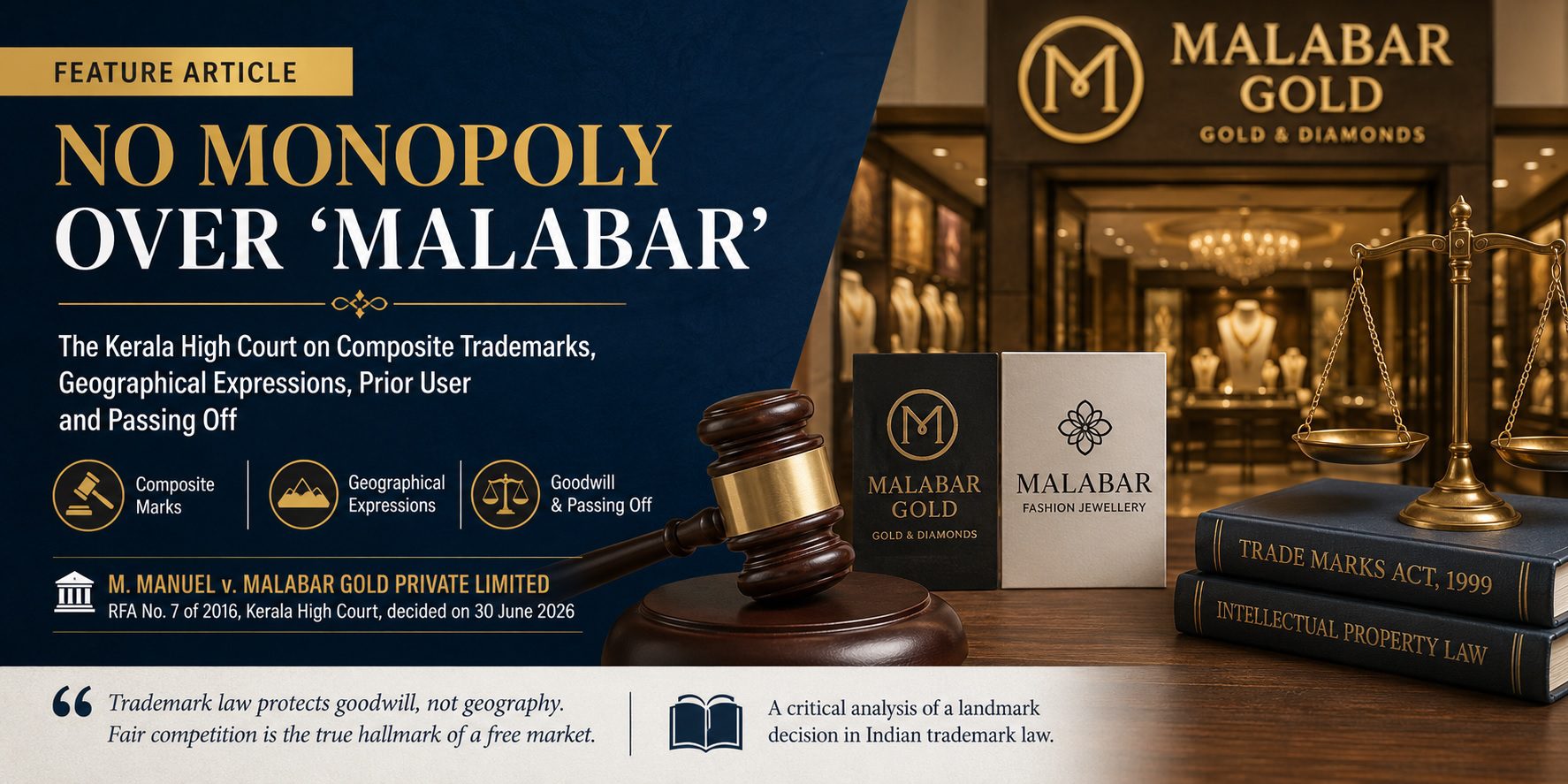
The Kerala High Court, in RFA No.7 of 2016 (M. Manuel v. Malabar Gold Pvt. Ltd.), has delivered an important judgment that carefully balances two competing principles of trademark law:
- protection of established and reputed trademarks; and
- prevention of monopolisation of geographical expressions.
The Court examined the relationship between:
- Sections 28 and 29 of the Trade Marks Act, 1999,
- Section 34 relating to prior user,
- Section 124 regarding rectification proceedings,
- protection of composite trademarks,
- geographical names,
- passing off, and
- deceptive similarity.
The judgment is significant because it explains that while a registered proprietor is entitled to protection against deceptive imitation, registration does not automatically confer exclusive ownership over every component of a composite mark.
Facts of the Case
Malabar Gold Private Limited instituted a suit alleging:
- infringement of its registered trademark “MALABAR GOLD”;
- passing off;
- copyright infringement; and
- deceptive use of the mark “Malabar Fashion Jewellery” by the defendant.
According to the plaintiff,
- it had been using the mark since 1993;
- its mark had acquired enormous goodwill;
- the defendant intentionally adopted a deceptively similar mark to ride upon its reputation.
The Trial Court decreed the suit by granting:
- permanent injunction;
- mandatory injunction directing destruction of infringing materials; and
- protection under Section 135 of the Trade Marks Act.
The defendant challenged the decree before the High Court.
Principal Issues Before the High Court
The appeal raised several important questions:
- Can a trader claim exclusive rights over the geographical expression “Malabar”?
- Does registration of a composite trademark confer monopoly over every individual word contained in the mark?
- Whether the civil court could entertain the suit when questions relating to trademark registration were raised?
- Whether the plaintiff proved prior user and goodwill?
- Whether deceptive similarity existed between the competing marks?
- Whether the decree of the Trial Court required modification?
Defendant’s Principal Contentions
The defendant argued that:
- “Malabar” is only a geographical expression.
- Numerous traders legitimately use the word.
- The plaintiff cannot monopolise the geographical name.
- Both parties possessed registered trademarks.
- The dispute ought to have been dealt with under Sections 124 and 125 of the Trade Marks Act.
- The plaintiff’s registration was subject to limitations.
- The plaintiff was actually engaged in retail services rather than manufacture under Class 14.
- Delay and acquiescence barred relief.
The defendant also relied upon the principles laid down in Patel Field Marshal Agencies and other precedents relating to concurrent registrations and rectification proceedings.
Plaintiff’s Case
The plaintiff contended that:
- it had continuously used the mark since 1993;
- enormous goodwill had been built over decades;
- consumers associated the mark exclusively with the plaintiff;
- the defendant had deliberately copied its overall commercial presentation;
- the defendant intended to deceive customers.
The plaintiff also argued that although “Malabar” is geographical, the composite mark “Malabar Gold” had acquired distinctiveness and secondary meaning through long and extensive use.
Important Findings of the High Court
1. Geographical Names Cannot Normally Be Monopolised
The Court reiterated a fundamental principle of trademark law:
A geographical expression ordinarily remains available for use by all traders.
The word “Malabar”, by itself, is a geographical description.
Therefore, no trader can claim an absolute proprietary right over the geographical word standing alone.
This is one of the most significant observations in the judgment.
2. Composite Trademarks Receive Protection
The Court simultaneously held that:
although the word “Malabar” cannot be monopolised, the composite trademark “Malabar Gold”, together with its logo, artistic presentation, colour combination and commercial identity, had acquired protectable distinctiveness.
Protection therefore extends to the trademark as a whole, not merely to one geographical component.
This distinction is crucial.
3.Deceptive Similarity Must Be Judged Holistically
The Court reaffirmed that: courts do not compare trademarks by splitting them into isolated words.
Instead, comparison must consider:
- visual impression;
- phonetic similarity;
- overall commercial identity;
- colour scheme;
- trade dress;
- get-up;
- manner of presentation;
- likelihood of consumer confusion.
Applying these principles, the Court found substantial deceptive similarity.
4.Passing Off Continues Independent of Registration
The Court recognised that registration alone is not the end of the enquiry.
Even where registration exists, long use and goodwill remain highly relevant in a passing off action.
The plaintiff successfully established substantial goodwill and reputation deserving legal protection.
5.Section 124 Was Not Attracted
One of the important legal discussions concerns Section 124 of the Trade Marks Act.
The defendant argued that the civil court ought to have stayed the proceedings because issues concerning validity of registration existed.
The High Court rejected this contention.
It held that:
- no proper challenge to validity had been raised;
- no issue regarding invalidity had been framed;
- the statutory requirements of Section 124 were not satisfied.
Consequently, the civil court retained jurisdiction to decide the infringement suit.
6. Prior User Still Matters
The Court reaffirmed the importance of prior user.
Long, continuous and established use remains one of the strongest foundations of trademark protection.
Registration strengthens the proprietor’s rights, but goodwill and reputation remain central considerations in both infringement and passing off actions.
Modification of the Trial Court’s Decree
Although the High Court substantially agreed with the Trial Court, it found one aspect required correction.
The Trial Court’s decree appeared capable of being interpreted as granting an exclusive right over the word “Malabar” itself.
The High Court modified the decree.
The injunction now restrains the defendant only from using:
- marks,
- logos,
- labels,
- artistic works,
- trade dress,
- colour combinations,
- commercial presentation,
that are deceptively similar to the plaintiff’s established trademark and business identity.
The Court clarified that:
the plaintiff cannot claim an exclusive monopoly over the geographical word “Malabar” standing alone.
Practical Significance of the Judgment
The decision offers valuable guidance for businesses and trademark practitioners.
Businesses should note:
- registration does not automatically create monopoly over geographical expressions;
- composite marks receive stronger protection than individual descriptive words;
- long use and goodwill remain vital in passing off actions;
- deceptive similarity is assessed from the viewpoint of the average consumer;
- overall commercial impression is more important than isolated comparison of words.
- Trademark practitioners should note:
- pleadings relating to prior user and goodwill remain critical;
- Section 124 cannot be casually invoked;
- protection extends beyond the registered word mark to trade dress and commercial presentation where appropriate;
- geographical words require proof of acquired distinctiveness before broader protection can be claimed.
Conclusion
The Kerala High Court has struck a careful balance between protecting commercial goodwill and preserving fair competition.
The judgment reinforces that trademark law protects business identity, not geographical monopoly.
A trader may legitimately obtain strong protection over a composite trademark that has acquired distinctiveness, but cannot prevent others from honestly using a geographical expression unless exclusive rights over that expression have independently been established through acquired distinctiveness.
The decision therefore serves as an important precedent on the law relating to geographical trademarks, composite marks, deceptive similarity and passing off, and is likely to be frequently cited in future trademark litigation.