

Table of Contents
ToggleIntroduction
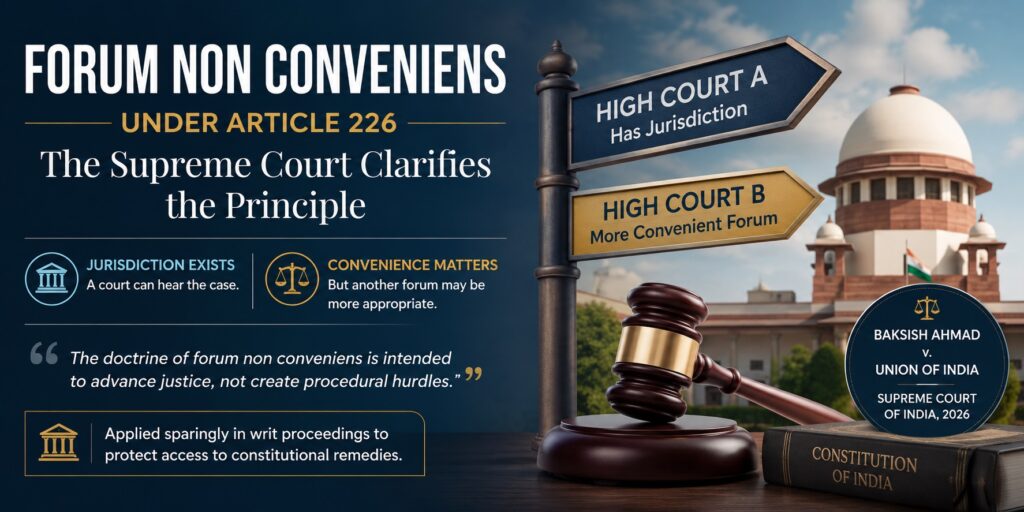
The doctrine of ‘forum non conveniens’ is a principle that allows a court, even when it has jurisdiction to hear a matter, to decline exercising that jurisdiction if another court is clearly more appropriate or convenient for deciding the dispute.
The Supreme Court, in Baksish Ahmad v. Union of India (2026), has provided important guidance on the scope and limits of this doctrine, particularly in relation to writ petitions filed under Article 226 of the Constitution of India.
The judgment is significant because it draws a distinction between:
- A court having jurisdiction; and
- A court choosing not to exercise that jurisdiction on the ground that another forum is more convenient.
The Court also emphasised that the doctrine should be applied sparingly in constitutional proceedings.
What Does “Forum Non Conveniens” Mean?
The expression is derived from Latin and literally means “an inconvenient forum.”
The doctrine recognises that more than one court may legally possess jurisdiction over a dispute. In such situations, a court may ask:
* Is there another court that can grant the same relief?
* Is that other court better connected with the dispute?
* Would the interests of justice be better served if the matter is heard there?
If the answer is yes, the court may refuse to entertain the case and leave the litigant to approach the more suitable forum.
Thus, the doctrine is not concerned with the existence of jurisdiction but with the exercise of jurisdiction.
Jurisdiction versus Convenience
A fundamental point highlighted by the Supreme Court is that a court may have jurisdiction and yet consider whether it should exercise that jurisdiction.
The doctrine operates only after jurisdiction is established.
In other words:
- Lack of jurisdictionmeans the court cannot hear the case.
- Forum non conveniens means the court can hear the case but may choose not to.
This distinction is crucial because the doctrine does not take away jurisdiction; it merely regulates its exercise.
The Supreme Court’s Explanation of the Doctrine
The Court explained that the doctrine becomes relevant only when multiple forums are available to a litigant for obtaining the same relief.
Where several courts are competent to entertain a matter, the court approached by the litigant may examine whether another court would be more appropriate, convenient, or better suited to decide the dispute.
However, the doctrine is discretionary. It does not automatically require a court to decline jurisdiction merely because another forum exists.
Forum Non Conveniens in Writ Jurisdiction
The most important contribution of the judgment lies in its discussion of Article 226.
Article 226 permits a High Court to exercise jurisdiction in two broad situations:
- Jurisdiction based on the location of the authority
Under Article 226(1), a writ may be issued against a person or authority located within the territorial jurisdiction of the High Court.
- Jurisdiction based on cause of action
Under Article 226(2), jurisdiction may also arise where the cause of action, wholly or partly, occurs within the territorial limits of the High Court.
As a result, more than one High Court may often possess jurisdiction over the same dispute.
The question then arises: can one of those High Courts decline to hear the matter on the ground of forum non conveniens?
The Supreme Court answered this question with caution.
Why the Doctrine Must Be Applied Sparingly in Writ Proceedings
The Court observed that constitutional remedies occupy a special position in Indian law.
A citizen approaching a High Court under Article 226 is seeking enforcement of constitutional and legal rights. Therefore, doctrines that restrict access to such remedies must be applied carefully.
The Court emphasised that where jurisdiction is available under Article 226(1) because the concerned authority is situated within the territorial limits of a High Court, the doctrine of forum non conveniens may only rarely justify refusal to entertain the petition.
The reason is practical as well as constitutional.
When a writ of certiorari is sought, the records of the case are ordinarily available with the respondent authorities. Such records can easily be produced before the court having jurisdiction. Therefore, inconvenience is often minimal.
The Court noted that if a litigant chooses a forum that is already convenient for the respondent authority, insisting that the litigant approach another court may actually obstruct access to justice rather than promote it.
The Core Principle Emerging from the Judgment
The Supreme Court distilled the essence of the doctrine into a simple proposition:
A court that possesses jurisdiction may, in appropriate circumstances, direct a litigant to approach another equally competent court that is more convenient for the parties and better suited to adjudicate the dispute.
However, in writ proceedings under Article 226, especially where jurisdiction is invoked on the basis of the location of the respondent authority, courts should be slow to refuse relief solely on the ground of forum non conveniens.
The doctrine should facilitate justice, not create procedural hurdles.
Practical Implications
The judgment has important consequences for service matters involving Central Government departments, Central Armed Police Forces, statutory authorities, and other bodies having headquarters in Delhi or elsewhere.
The decision recognises that:
* More than one High Court may legitimately have jurisdiction.
* Jurisdiction cannot be denied merely because another court is also available.
* The doctrine of forum non conveniens should not be used mechanically.
* Access to constitutional remedies should remain broad and effective.
* Convenience must be evaluated in a manner that advances, rather than restricts, justice.
Conclusion
The Supreme Court’s decision reaffirms an important constitutional principle: the existence of a more convenient forum does not automatically justify refusal of jurisdiction.
The doctrine of forum non conveniens is intended to promote fairness, convenience, and judicial efficiency. Yet, when constitutional remedies under Article 226 are involved, the doctrine must be applied with restraint.
The judgment reminds courts that the ultimate objective is not merely procedural convenience but meaningful access to justice. A litigant who approaches a court that legally possesses jurisdiction should not ordinarily be turned away unless compelling reasons demonstrate that another forum is clearly more appropriate.
In essence, the doctrine is a tool of judicial discretion, not a weapon for denying constitutional remedies.