

Table of Contents
ToggleIntroduction
The right to approach a Court is not available to every person who may be interested in the outcome of a dispute. Courts adjudicate legal rights and legal injuries, not speculative interests or indirect expectations. Reaffirming this fundamental principle, the Kerala High Court recently held that a person cannot maintain an appeal merely because he was arrayed as a party in a writ petition.
The principles discussed in this article emerge from the decision of the Kerala High Court in Dr. Anoop R. & Anr. v. Dr. Surabhi S.L. & Ors., 2026:KER:37626, where the Court elaborately considered the concepts of “aggrieved person”, locus standi, and the maintainability of appeals under Section 5 of the Kerala High Court Act, 1958.
The Foundation of Judicial Remedies: A Legal Right and a Legal Wrong
The Court emphasized that the right to invoke judicial remedies is founded upon the existence of a legally protected right that has been infringed.
According to the Court, to have standing to sue, a litigant must establish that:
* His legal rights have been invaded;
* Such invasion has resulted in a legal wrong; and
* The grievance relates to an injury to a legally protected right.
The justiciability of a claim is therefore tested on the touchstone of legal injury. Unless a person demonstrates that he has suffered a legal wrong affecting a legally recognised right, he cannot seek judicial intervention merely because he has an interest in the subject matter.
The Court reiterated that a nominal, remote, or highly speculative impact on a person’s interests is insufficient to confer standing before a Court. Mere expectation of a possible benefit arising from litigation cannot substitute the requirement of legal injury.
Who is an “Aggrieved Person”?
The concept of an “aggrieved person” is central to both original and appellate proceedings.
A person is aggrieved when an order adversely affects his legal rights or imposes civil consequences upon him. Such a person has suffered a legal wrong and is therefore entitled to seek judicial redress.
On the other hand, a person whose interest is merely contingent, speculative, or indirect cannot claim the status of an aggrieved person. The possibility that a favourable outcome in litigation may someday benefit him does not create a legally enforceable grievance.
The Court found that the appellants’ claim of prejudice was based only on a speculative possibility that they might secure an appointment if another candidate were ultimately disqualified. Such a possibility was held insufficient to confer the status of “persons aggrieved”.
Necessary Parties, Proper Parties and Interested Parties
An important aspect of the judgment is its distinction between parties whose presence is legally required and persons who merely have an interest in the outcome.
The Court reiterated the settled principles that:
A ‘necessary party’ is one without whom no effective order can be passed.
A ‘proper party’ is one whose presence may assist in the complete adjudication of the dispute, although an effective order can still be passed in his absence.
The Court held that where the dispute concerns the personal rights of a litigant, persons claiming only an indirect or speculative interest cannot elevate themselves to the status of necessary or proper parties merely because they may benefit from a particular outcome.
The existence of a personal interest in the result of litigation is not equivalent to possessing a legal right that requires judicial protection.
The Right of Appeal Under Section 5 of the Kerala High Court Act
Section 5 of the Kerala High Court Act, 1958 provides for an intra-court appeal from a judgment or order of a Single Judge exercising original jurisdiction.
The judgment clarifies an important aspect of this statutory provision. While Section 5 creates a right of appeal, it does not confer that right upon every person who happened to be impleaded in the proceedings before the Single Judge.
The statutory right of appeal remains subject to the rule of standing.
Therefore, before an appeal can be maintained under Section 5, the appellant must demonstrate that:
* He is a person aggrieved by the judgment; and
* The impugned decision adversely affects his legal rights or legally protected interests.
The Court categorically held that the right of appeal under Section 5 can be exercised only by a person who satisfies the rule of locus standi.
Mere Inclusion in the Party Array Does Not Create a Right to Appeal
The most significant principle emerging from the decision is that impleadment in a writ petition does not automatically translate into a right of appeal.
The Court observed that merely because a person figures in the party array of a writ petition, he does not acquire an unrestricted right to challenge the judgment rendered therein.
The test is not whether the person was a party to the proceedings. The real test is whether the judgment has adversely affected any legal right vested in that person.
If the answer is in the negative, the appeal is not maintainable.
In a clear and emphatic pronouncement, the Court held that merely by reason of being included in the party array of a writ petition, an appeal under Section 5 of the Kerala High Court Act cannot be maintained.
Standing Cannot Be Founded on Speculation
A noteworthy feature of the judgment is its rejection of speculative claims as a basis for standing.
The Court observed that judicial remedies are not available to persons whose interests are uncertain, contingent, or dependent upon future events. The law requires an existing legal injury, not a hypothetical possibility of future advantage.
This principle serves an important institutional purpose. It prevents courts from becoming forums for persons seeking to advance private expectations or competitive interests that have not matured into legally enforceable rights.
The doctrine of locus standi thus functions as a jurisdictional filter, ensuring that courts adjudicate genuine legal disputes involving actual legal injuries.
Conclusion
The judgment is a valuable reaffirmation of a basic yet often overlooked principle of public law: litigation must be founded upon legal injury and not merely upon personal interest.
The Kerala High Court has clarified that:
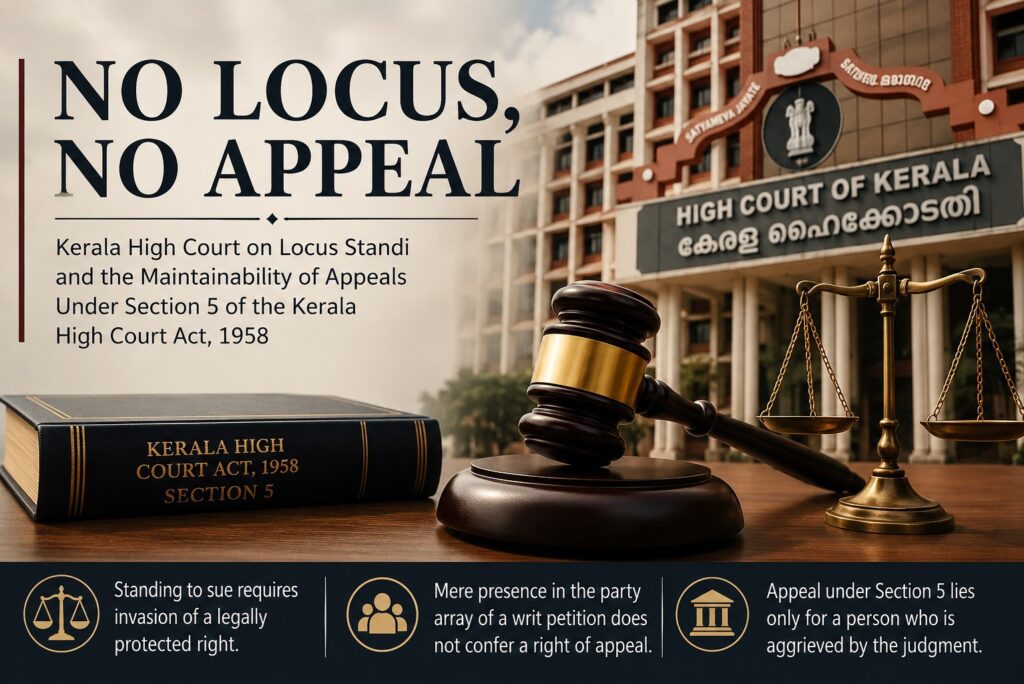
* Standing to sue requires invasion of a legally protected right.
* An aggrieved person is one who has suffered a legal wrong.
* Speculative or contingent interests do not confer locus standi.
* The right of appeal under Section 5 of the Kerala High Court Act is available only to persons who satisfy the rule of standing.
* Mere presence in the party array of a writ petition does not create a right to maintain an intra-court appeal.
The decision therefore reinforces the principle that courts exist to vindicate legal rights and redress legal wrongs, not to adjudicate disputes at the instance of persons whose interest in the outcome remains merely speculative.