

Table of Contents
ToggleReceived a Section 13(2) Notice From the Bank? Do Not Ignore It.
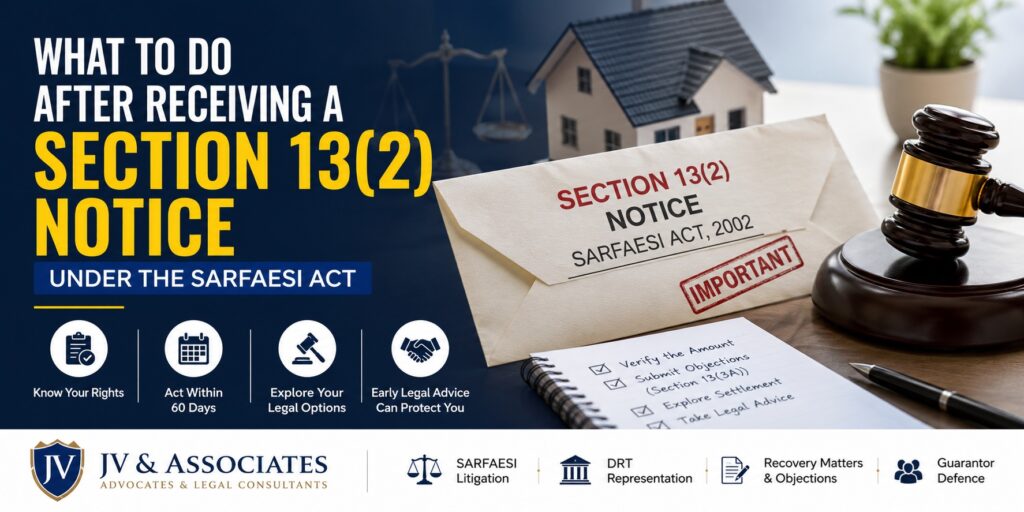
Many borrowers panic when they receive a notice from the bank under Section 13(2) of the SARFAESI Act, 2002.
A common reaction is:
Has the bank already taken my property?
The answer is usually No.
A Section 13(2) Notice is not the end of the road. However, it is the beginning of a statutory recovery process that can ultimately result in possession and auction of the secured asset if appropriate action is not taken.
Understanding your rights and available remedies at this stage is critical.
What Is a Section 13(2) Notice?
A Section 13(2) Notice is a demand notice issued by a bank or financial institution after classifying a loan account as a Non-Performing Asset (NPA).
Through this notice, the bank calls upon the borrower and guarantors to discharge the outstanding liability within 60 days.
The notice typically contains:
- Details of the loan account.
- Amount claimed by the bank.
- Description of secured assets.
- Warning regarding future SARFAESI action.
What Happens If You Ignore the Notice?
If no action is taken within the statutory period, the bank may proceed under Section 13(4) of the SARFAESI Act and take measures such as:
- Taking symbolic possession of the secured asset.
- Initiating physical possession proceedings.
- Filing proceedings under Section 14 before the District Magistrate.
- Bringing the property for auction.
Many borrowers approach lawyers only after receiving a possession notice or auction notice. In many cases, valuable opportunities are lost by waiting too long.
First Step: Verify Whether the Amount Claimed Is Correct
Borrowers often assume that the amount mentioned in the notice is final and unquestionable.
That is not always true.
The following issues frequently arise:
- Incorrect interest calculations.
- Unaccounted payments.
- Wrong debit entries.
- Penal interest disputes.
- Errors in loan statements.
A careful review of the bank’s claim should be undertaken immediately.
Second Step: Examine Whether the Account Was Properly Classified as NPA
In certain cases, borrowers may dispute:
- The date of NPA classification.
- The manner in which the account was classified.
- Whether restructuring discussions were pending.
- Whether payments were ignored by the bank.
Though not every dispute will succeed, it is important to identify possible legal and factual issues at the earliest stage.
Third Step: Submit Objections Under Section 13(3A)
The SARFAESI Act permits the borrower to submit a representation or objection to the bank.
Common objections include:
- Incorrect outstanding amount.
- Invalid NPA classification.
- Pending settlement proposals.
- Defects in security documents.
- Agricultural land exemptions.
- Limitation issues.
A properly drafted representation under Section 13(3A) can become an important document in future litigation before the Debt Recovery Tribunal (DRT).
Can a Borrower Approach the DRT Immediately After Receiving a Section 13(2) Notice?
Generally, the remedy before the Debt Recovery Tribunal arises after the bank takes measures under Section 13(4).
However, the period following receipt of the Section 13(2) notice is often the most important time for:
- Reviewing documents.
- Identifying legal defects.
- Preparing objections.
- Exploring settlement options.
- Assessing future litigation strategy.
Early legal advice can often prevent avoidable complications later.
What If Settlement Discussions Are Going On?
Many borrowers assume that ongoing settlement negotiations automatically stop SARFAESI proceedings.
This is not always the case.
Even while settlement discussions continue, the bank may proceed with statutory recovery measures unless an agreement is reached.
Therefore, borrowers should avoid relying solely on verbal assurances.
What About Guarantors?
A Section 13(2) Notice is often issued not only to the borrower but also to:
- Personal guarantors.
- Corporate guarantors.
Guarantors should not assume that the matter concerns only the principal borrower.
The consequences of SARFAESI proceedings can extend to guarantors and their secured assets.
Common Mistakes Borrowers Make
Mistake 1: Ignoring the Notice
Many borrowers wait until possession proceedings begin.
Mistake 2: Relying on Oral Assurances
Verbal discussions with bank officials may not stop statutory timelines.
Mistake 3: Filing Incomplete Objections
Poorly drafted objections often fail to address important legal issues.
Mistake 4: Seeking Advice Too Late
The scope of available remedies generally narrows as proceedings progress.
What Happens After the 60-Day Period?
If the dues remain unpaid, the bank may proceed under Section 13(4) and take measures such as:
- Symbolic possession.
- Physical possession proceedings.
- Auction proceedings.
At that stage, borrowers may become entitled to challenge the bank’s measures before the Debt Recovery Tribunal through a Securitisation Application under Section 17 of the SARFAESI Act.
When Should You Consult a SARFAESI Lawyer?
You should consider obtaining legal advice if:
- You have received a Section 13(2) Notice.
- The amount claimed appears incorrect.
- You are a guarantor.
- Settlement discussions have failed.
- The bank is threatening possession proceedings.
- The property is likely to be auctioned.
Early assessment often helps borrowers understand the available legal options before the matter reaches the possession or auction stage.
If you have received a Section 13(2) Notice and would like to understand your legal options, timely legal advice can make a significant difference to the course of the proceedings.