

Table of Contents
ToggleIntroduction
Disputes involving companies frequently raise a fundamental question: should the matter be decided by a civil court or by the National Company Law Tribunal (NCLT)?
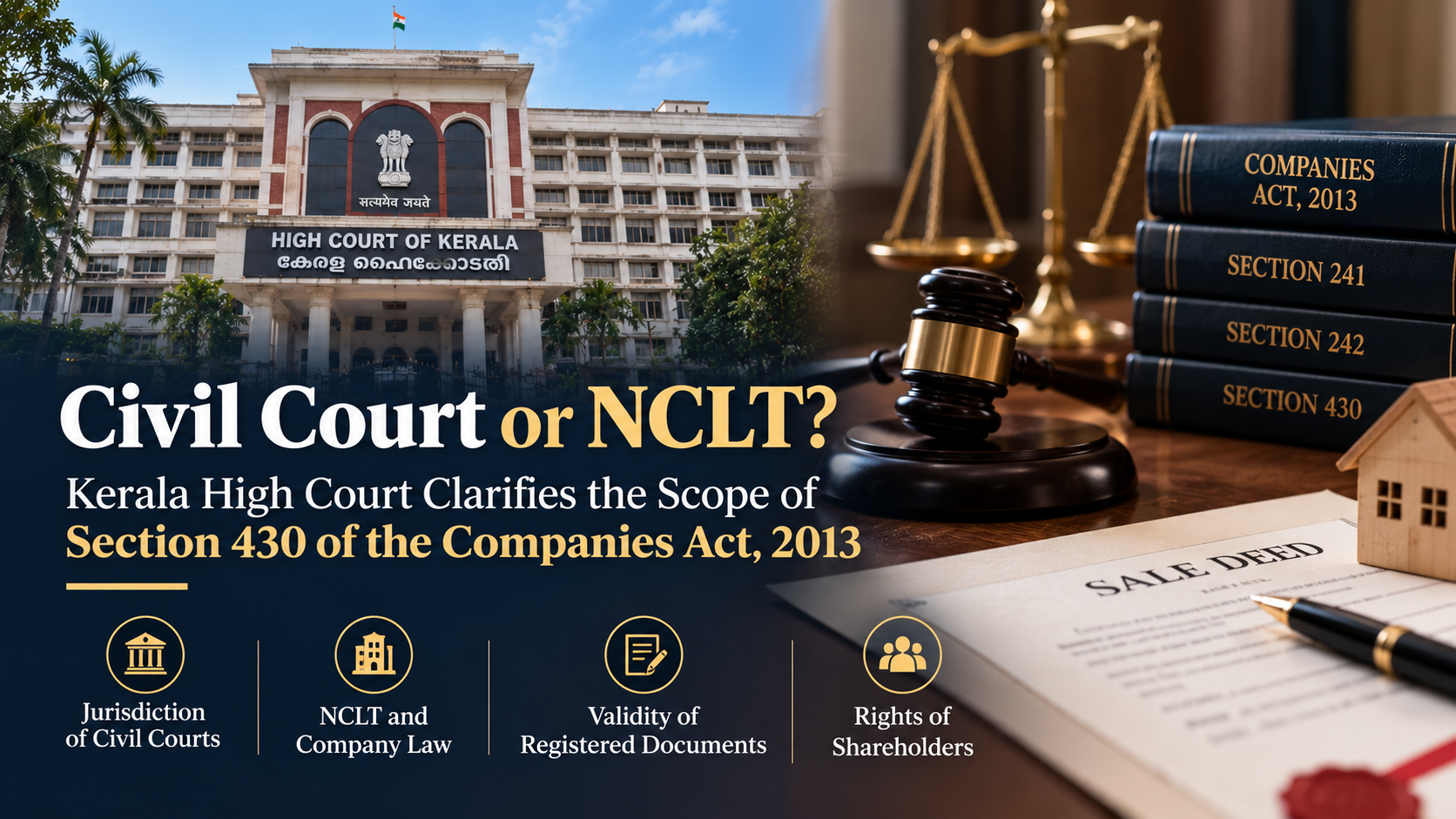
The question becomes particularly significant when a dispute involves both the internal affairs of a company and the validity of a transaction affecting its property. While Sections 241 and 242 of the Companies Act, 2013 empower the NCLT to grant relief in cases of oppression and mismanagement, Section 430 excludes the jurisdiction of civil courts in matters that the NCLT or the National Company Law Appellate Tribunal (NCLAT) is empowered to determine.
However, does this exclusion mean that every dispute involving a company or its shareholders must necessarily be brought before the NCLT?
The Kerala High Court examined this issue in its judgment dated 13 October 2026 in O.P.(C) Nos. 926 and 939 of 2026, reported as 2026:KER:78495. The Court held that the civil court’s jurisdiction is not automatically excluded merely because the dispute involves a company or allegations that may also touch upon its management.
The judgment is significant for shareholders, directors, companies and litigators dealing with disputes over company property, registered documents and the jurisdiction of specialised tribunals.
1. Background of the Dispute
The two original petitions arose from suits pending before the Commercial Court-II, Thrissur, in C.S. Nos. 31 and 37 of 2023.
The plaintiffs sought, among other reliefs, a declaration that the sale of property under a registered sale deed was not binding on the company and its shareholders. Their case was that the property had been transferred without the necessary concurrence of the majority shareholders and that the transaction was legally unsustainable.
The pleadings also raised allegations concerning the affairs of the company, including the manner in which the transaction had been effected and the handling of company funds and records.
The defendants disputed the plaintiffs’ claims. They subsequently challenged the maintainability of the civil suits, contending that Section 430 of the Companies Act, 2013 barred the jurisdiction of the civil court and that the appropriate remedy lay before the NCLT.
The Commercial Court accepted the objection and rejected the suits on the ground that the dispute fell within the jurisdiction of the NCLT.
Aggrieved by the orders dated 17 January 2026, the plaintiffs approached the Kerala High Court under Article 227 of the Constitution of India.
The principal question before the High Court was whether the reliefs sought in the suits fell within the statutory jurisdiction of the NCLT so as to exclude the jurisdiction of the civil court.
2. The Statutory Framework: Sections 241, 242 and 430
To understand the judgment, it is necessary to distinguish the powers conferred on the NCLT from the jurisdiction ordinarily exercised by civil courts.
A. Section 241: Relief in Cases of Oppression and Mismanagement
Section 241 of the Companies Act, 2013 permits eligible members to approach the NCLT when the affairs of a company are being conducted in a manner prejudicial or oppressive to members, prejudicial to public interest, or prejudicial to the interests of the company.
The provision is directed towards addressing specified forms of improper corporate conduct and changes in management or control that satisfy the statutory requirements.
B. Section 242: Powers of the NCLT
Section 242 empowers the NCLT to make appropriate orders where the statutory conditions for granting relief are satisfied.
The Tribunal may, among other things, regulate the future conduct of the company’s affairs, order the purchase of shares, restrict transfers or allotments of shares, modify certain agreements, remove directors in appropriate circumstances and make other orders considered just and equitable within the statutory framework.
These powers are broad. Nevertheless, they remain powers conferred by statute and must be exercised within the limits of the jurisdiction assigned to the Tribunal.
C. Section 430: Exclusion of Civil Court Jurisdiction
Section 430 provides that no civil court shall have jurisdiction to entertain a suit or proceeding concerning a matter that the NCLT or NCLAT is empowered to determine under the Companies Act or another law in force. It also restricts the grant of injunctions in respect of actions taken or proposed under powers conferred on those Tribunals.
The critical expression is “any matter which the Tribunal or the Appellate Tribunal is empowered to determine.”
The exclusion is therefore linked to the subject matter that the Tribunal is legally competent to decide. It does not necessarily follow that every dispute involving a company is excluded from the jurisdiction of civil courts.
3. The Kerala High Court’s Reasoning
In the judgment delivered by Justice Easwaran S. on 13 October 2026, the Kerala High Court examined the scope of the NCLT’s jurisdiction under Sections 241 and 242 alongside the reliefs claimed in the suits.
The Court emphasised that the NCLT is a statutory tribunal. Its jurisdiction and powers are derived from the legislation establishing it. The Tribunal cannot be assumed to possess every power ordinarily exercised by a civil court merely because a dispute concerns a company.
The Court observed that the NCLT’s jurisdiction under Sections 241 and 242 is directed towards disputes concerning the management of a company and the rights of its shareholders within the scope of those provisions.
The reliefs sought in the suits, however, included a declaration concerning the legal effect of a registered sale deed and whether that document was binding on the company.
The High Court found it difficult to conclude that the NCLT possessed jurisdiction under Sections 241 and 242 to grant such a declaration.
The Court accordingly held that the objection to the maintainability of the civil suits on the ground of Section 430 was unsustainable.
The central principle emerging from the decision is that the exclusion of civil court jurisdiction must be determined by examining the statutory powers of the specialised tribunal and the actual nature of the relief claimed.
4. Civil Courts Retain Jurisdiction Over Matters Not Entrusted to the NCLT
The judgment reiterates the importance of Section 9 of the Code of Civil Procedure, 1908, under which civil courts have jurisdiction to try suits of a civil nature unless their jurisdiction is expressly or impliedly barred.
A statutory tribunal may be created to decide disputes falling within a specialised field. Where the legislature has conferred exclusive jurisdiction on that tribunal over particular matters, civil courts cannot assume jurisdiction over those matters.
However, the existence of a specialised tribunal does not, by itself, extinguish the jurisdiction of civil courts over every dispute connected with the subject matter of the statute.
The Court stressed that exclusion of civil court jurisdiction must be founded on the statute. Where an implied exclusion is alleged, there must be a sufficient statutory basis for concluding that the civil court’s jurisdiction has been displaced.
In the present case, the High Court held that the power to grant a declaration that a registered sale deed was void or not binding on a company could not be treated as a power vested in the NCLT under Sections 241 and 242.
The decision therefore reinforces the distinction between:
- Proceedings seeking relief against oppression or mismanagement within the scope of Sections 241 and 242; and
- Civil proceedings seeking declaratory relief concerning the validity or binding effect of a registered document.
The appropriate forum must be determined by examining the substance of the dispute and the relief sought, rather than merely identifying a connection with a company or its shareholders.
5. Reliance on Saju George v. Saji Varghese
The High Court also considered its earlier decision in Saju George v. Saji Varghese, reported in 2026 (5) KHC 188.
That decision concerned the extent to which the establishment of a specialised tribunal under the National Green Tribunal Act, 2010, excluded the jurisdiction of civil courts over a claim for a declaratory right of easement.
The Court had recognised that a specialised tribunal could exercise only the powers conferred upon it by the relevant statute and that a claim falling outside those powers could remain within the jurisdiction of a civil court.
Applying the principle to the present dispute, the Kerala High Court concluded that the NCLT’s powers under Sections 241 and 242 could not be extended to a declaration that a registered sale deed was void and not binding on a company.
The judgment thus applies the broader principle that the jurisdiction of a specialised tribunal must be assessed by reference to its statutory mandate.
6. The Importance of the Relief Claimed
One of the practical lessons from the judgment is the importance of carefully identifying the actual relief sought in litigation involving a company.
A dispute may involve allegations of oppression, mismanagement, unauthorised transactions or improper handling of company property. Those facts may be relevant to proceedings before the NCLT. However, the mere presence of such allegations does not automatically answer the jurisdictional question.
The court must examine what the claimant is asking it to decide and whether the relevant statute empowers the specialised tribunal to grant that relief.
For example, the following questions may be material when determining the appropriate forum:
- Is the principal relief directed at regulating the company’s affairs or addressing oppression and mismanagement?
- Does the claimant seek a declaration concerning the validity or binding effect of a registered instrument?
- Is the relief expressly available to the NCLT under the Companies Act?
- Does granting the relief require the exercise of a power that the statute has not conferred on the Tribunal?
- Does the civil suit concern a matter that the NCLT is empowered to determine, thereby attracting Section 430?
These questions should be addressed by reference to the pleadings, the nature of the dispute, the reliefs claimed and the applicable statutory provisions.
The decision does not mean that every dispute involving a company’s property must be brought before a civil court. Nor does it mean that a party can avoid Section 430 merely by framing a claim as one for declaratory relief.
The governing consideration remains whether the matter, in substance, falls within the jurisdiction conferred on the NCLT by the Companies Act.
7. Limitation Is a Separate Issue from Jurisdiction
The defendants also contended that the suits were barred by limitation.
The High Court declined to decide that issue in the original petitions. Since the Commercial Court had rejected the suits on the ground that jurisdiction lay with the NCLT, the question of limitation had not been adjudicated by the trial court.
The High Court held that it would be impermissible to determine the limitation issue for the first time in the proceedings under Article 227 in those circumstances.
The defendants were left at liberty to raise the limitation objection before the civil court at the appropriate stage.
This aspect of the judgment is important. A conclusion that a civil court has jurisdiction does not mean that the suit is necessarily within limitation or that the claimant will succeed on the merits.
Jurisdiction, limitation and the substantive validity of the claim are distinct legal questions. Each must be considered in accordance with the applicable law and the procedural stage of the proceedings.
8. Final Decision of the Kerala High Court
The Kerala High Court allowed O.P.(C) Nos. 926 and 939 of 2026.
It set aside the orders dated 17 January 2026 passed by the Commercial Court-II, Thrissur, rejecting C.S. Nos. 31 and 37 of 2023 on the ground that the disputes fell within the jurisdiction of the NCLT.
The two suits were restored to the file of the Commercial Court-II, Thrissur, with a direction to proceed in accordance with law.
The High Court also made it clear that the defendants remained free to raise the issue of limitation before the Commercial Court at the appropriate stage.
The judgment did not finally determine whether the sale deed was invalid or whether the plaintiffs were entitled to the substantive reliefs claimed. Those matters remain for consideration in the restored suits, in accordance with law.
9. Practical Implications for Companies, Shareholders and Litigators
The decision offers several practical lessons for those involved in company-related litigation.
A. Identify the Statutory Scope of the NCLT’s Powers
Before invoking Section 430, parties should identify the specific statutory power under which the NCLT is said to be competent to determine the dispute.
A general assertion that the matter concerns company affairs may not, by itself, be sufficient.
B. Draft the Reliefs Carefully
The reliefs claimed in a plaint or an application can be central to the jurisdictional analysis. Pleadings should accurately reflect the legal nature of the dispute and the relief required.
The relief must be framed on the basis of the facts and the applicable law, not merely to secure a preferred forum.
C. Distinguish Corporate Mismanagement from Document-Related Claims
A transaction may give rise to allegations of oppression or mismanagement and may also raise an independent question about the validity or binding effect of a registered document.
The available remedies and the appropriate forum should be assessed carefully. In some disputes, the nature of the relief may be decisive in determining whether the civil court retains jurisdiction.
D. Avoid Assuming That Section 430 Creates a Universal Bar
Section 430 is an important jurisdictional provision, but its application depends on whether the matter is one that the NCLT or NCLAT is empowered to determine.
The statutory exclusion should not be treated as an automatic bar to every civil suit involving a company.
E. Keep Limitation and Jurisdiction Separate
Even where a civil court has jurisdiction, a limitation objection may remain open. Litigants should therefore assess limitation independently and ensure that proceedings are instituted and pursued within the applicable time limits.
Conclusion
The Kerala High Court’s judgment in O.P.(C) Nos. 926 and 939 of 2026 clarifies an important aspect of the relationship between civil courts and the NCLT under the Companies Act, 2013.
Section 430 excludes civil court jurisdiction in respect of matters that the NCLT or NCLAT is empowered to determine. However, the exclusion cannot be extended beyond the statutory jurisdiction of the specialised tribunal.
Where the relief sought is a declaration concerning the validity or binding effect of a registered sale deed, the court must examine whether the Companies Act empowers the NCLT to grant that relief. In the present case, the Kerala High Court concluded that the reliefs sought fell outside the NCLT’s powers under Sections 241 and 242 and restored the suits to the Commercial Court.
For practitioners, the judgment highlights the importance of analysing the statutory jurisdiction of the proposed forum, identifying the precise reliefs claimed and distinguishing questions of jurisdiction from limitation and the merits of the dispute.
The decision does not establish that civil courts have jurisdiction over every dispute involving company property. Its significance lies in reaffirming that the jurisdictional bar under Section 430 must be applied according to the statutory powers of the NCLT and the nature of the dispute before the court.
**************************
Case reference: O.P.(C) Nos. 926 and 939 of 2026, Kerala High Court, judgment dated 13 October 2026, 2026:KER:78495.
Disclaimer: This article is intended for general legal information and discussion. It is not a substitute for advice on the facts of a particular case. The full judgment and the applicable statutory provisions should be consulted when assessing the legal position in any specific dispute.