

Table of Contents
ToggleIntroduction
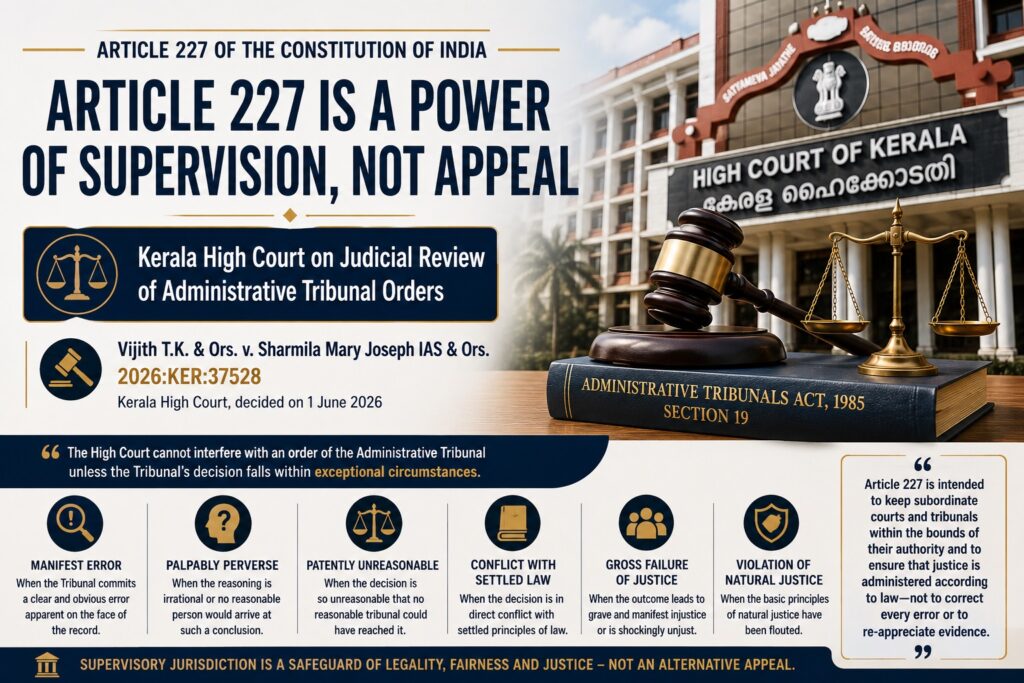
In Vijith T.K. & Ors. v. Sharmila Mary Joseph IAS & Ors., 2026:KER:37528, the Kerala High Court had occasion to revisit the scope and limits of its supervisory jurisdiction under Article 227 of the Constitution of India while examining a challenge to an order of the Kerala Administrative Tribunal passed under Section 19 of the Administrative Tribunals Act, 1985. The decision is a significant reaffirmation of the settled principle that the jurisdiction under Article 227 is supervisory and not appellate in nature. The Court held that interference with orders of the Administrative Tribunal is permissible only in exceptional circumstances, such as where the Tribunal has committed a manifest error, adopted reasoning that is palpably perverse or patently unreasonable, acted in direct conflict with settled principles of law, or where there has been gross and manifest failure of justice or violation of the principles of natural justice.
Article 227: A Power of Superintendence, Not Appeal
Article 227 confers upon every High Court the power of superintendence over all courts and tribunals within its territorial jurisdiction.
The judgment emphasises that this constitutional power is intended to maintain the efficiency, regularity and purity of the judicial process. The object is to ensure that subordinate courts and tribunals function within the limits of their authority and in accordance with law. However, the jurisdiction is supervisory and not appellate in nature.
The Court relied upon the decision of the Supreme Court in Shalini Shyam Shetty v. Rajendra Shankar Patil, (2010) 8 SCC 329, wherein it was held that interference under Article 227 must be kept to a minimum so that the ordinary functioning of courts and tribunals is not unnecessarily disrupted.
High Court Cannot Sit in Appeal Over Tribunal Findings
A significant aspect of the judgment is its reiteration that proceedings under Article 227 cannot be converted into an appellate forum.
The High Court observed that it cannot sit in appeal over findings recorded by the Administrative Tribunal merely because another view is possible on facts or law. Judicial review under Article 227 is not intended to provide a second round of adjudication on merits.
The Court referred to the decision in Sobhana Nair K.N. v. Shaji S.G. Nair, 2016 (1) KHC 1, where it was held that the jurisdiction under Article 227 is supervisory and not appellate and that interference is warranted only when the Tribunal’s decision suffers from manifest illegality or perversity.
Section 19 of the Administrative Tribunals Act and Judicial Review
The dispute arose out of proceedings initiated before the Kerala Administrative Tribunal under Section 19 of the Administrative Tribunals Act, 1985. The High Court noted that the jurisdiction exercised by Administrative Tribunals under Section 19 is akin to the writ jurisdiction exercised by High Courts under Article 226 of the Constitution.
Relying on Transport Commissioner, Madras-5 v. A. Radha Krishna Moorthy, (1995) 1 SCC 332, the Court observed that while exercising powers under Section 19, the Tribunal performs functions comparable to those exercised by a High Court in judicial review proceedings. Consequently, orders passed by the Tribunal are not to be lightly interfered with under Article 227.
Supreme Court Precedents on the Limits of Article 227
The judgment analyses several landmark decisions of the Supreme Court that define the contours of supervisory jurisdiction:
Shalini Shyam Shetty v. Rajendra Shankar Patil (2010) 8 SCC 329
The Supreme Court held that the object of superintendence is to maintain the smooth and orderly functioning of the judicial system. Interference should be exercised sparingly and only in appropriate cases.
Jai Singh v. Municipal Corporation of Delhi (2010) 9 SCC 385
The Supreme Court clarified that Article 227 cannot be exercised like a “bull in a china shop” to correct every error committed by subordinate courts or tribunals. The power is reserved for cases involving grave dereliction of duty, jurisdictional excess, or flagrant abuse of fundamental principles of law and justice.
K.V.S. Ram v. Bangalore Metropolitan Transport Corporation (2015) 12 SCC 39
The Court held that interference is justified only where there is patent perversity, gross and manifest failure of justice, or violation of the principles of natural justice.
When Can the High Court Interfere Under Article 227?
Synthesising the principles emerging from the above precedents, the Kerala High Court formulated the governing test for interference with orders of the Administrative Tribunal.
The Court held that no interference under Article 227 is warranted unless:
The Tribunal has committed a manifest error;
The reasoning adopted is palpably perverse;
The decision is patently unreasonable;
The decision is in direct conflict with settled principles of law;
There has been gross and manifest failure of justice; or
The basic principles of natural justice have been violated.
This formulation effectively encapsulates the modern jurisprudence governing Article 227 review.
Application of the Principle in the Present Case
Applying the above principles, the High Court examined whether the Kerala Administrative Tribunal had committed any jurisdictional error in closing a contempt petition after being informed that the Government had already considered and disposed of the representations that formed the subject matter of the Tribunal’s earlier directions.
The Court found that the Government had passed an order dealing with the representations and had explained the reasons why the benefits claimed by the applicants could not be immediately extended. The Government had also initiated a process through a committee to examine the issue further.
In such circumstances, the Tribunal’s decision to close the contempt proceedings could not be characterised as manifestly erroneous, perverse, unreasonable, or contrary to law. Nor could it be said that the Tribunal had violated any principle of natural justice. Accordingly, the High Court declined to interfere under Article 227.
Supervisory Jurisdiction is Not Correctional Jurisdiction
Perhaps the most important takeaway from the judgment is the Court’s reminder that Article 227 does not exist to correct every perceived mistake.
The supervisory jurisdiction of the High Court is intended to ensure legality, fairness, and jurisdictional discipline. It is not meant to provide a forum for re-examination of factual findings or substitution of the High Court’s views for that of the Tribunal.
Unless the impugned order falls within the narrow categories recognised by precedent, the High Court must resist the temptation to interfere.
Conclusion
The decision in Vijith T.K. & Ors. v. Sharmila Mary Joseph IAS & Ors., 2026:KER:37528, is a valuable restatement of the law governing judicial review of Administrative Tribunal orders under Article 227 of the Constitution.
The judgment reinforces that:
Article 227 confers supervisory and not appellate jurisdiction.
The High Court cannot re-appreciate evidence or substitute its own conclusions for those of the Tribunal.
Orders of the Administrative Tribunal can be interfered with only in exceptional cases involving manifest error, perversity, patent unreasonableness, conflict with settled law, gross failure of justice, or violation of natural justice.
Judicial discipline requires restraint in exercising supervisory powers over specialised tribunals.
The ruling thus strengthens the principle that supervisory jurisdiction is a constitutional safety valve, not an alternative appellate remedy.