

Table of Contents
ToggleIntroduction
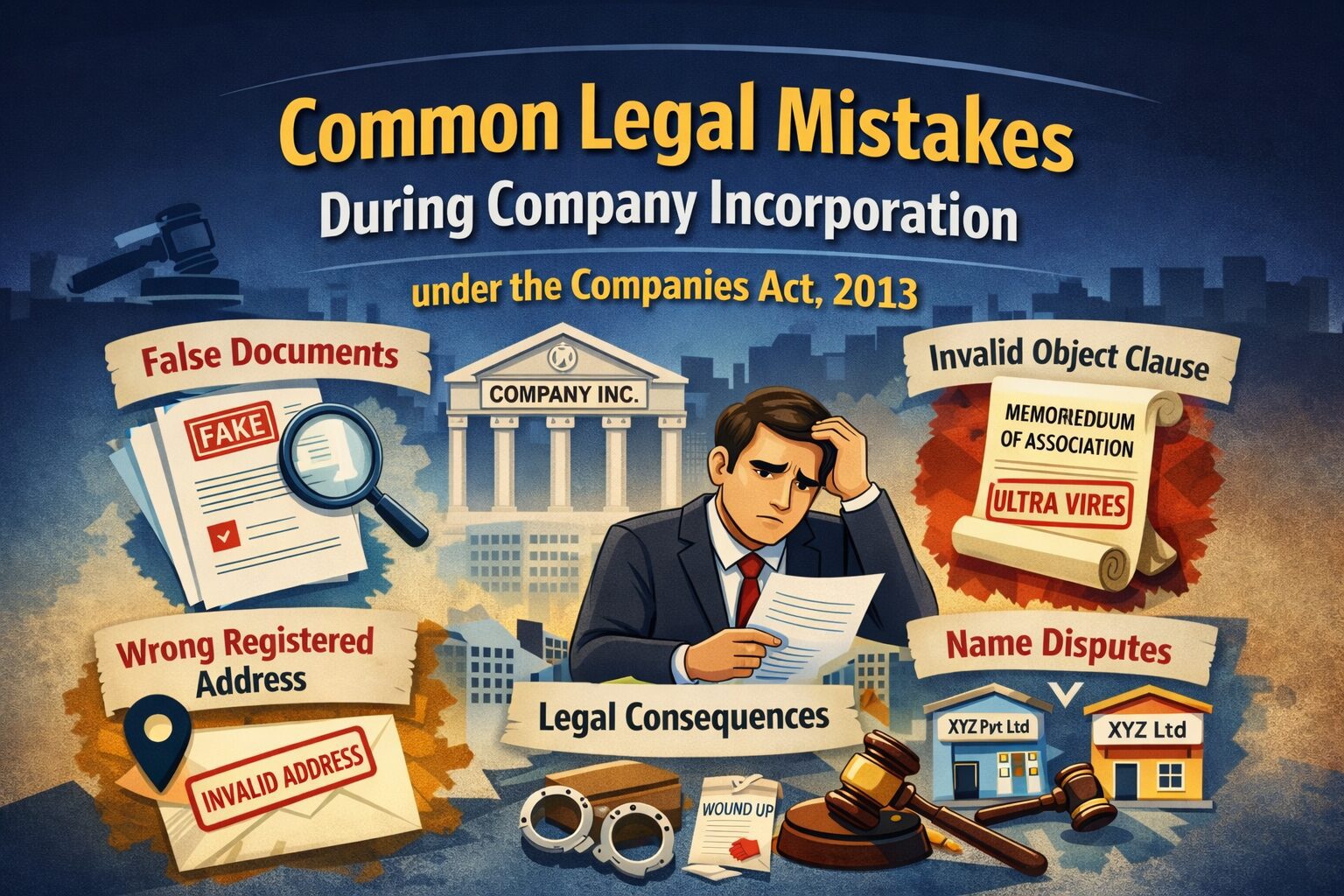
While incorporation of a company under the Companies Act, 2013 appears to be a technology-driven, form-based process, Indian courts and tribunals have consistently held that incorporation is a serious legal act carrying civil and criminal consequences.
Judicial experience shows that most regulatory actions, investigations, and shareholder disputes originate from defects at the incorporation stage. This article examines common legal mistakes during incorporation, supported by relevant judicial precedents, to highlight the risks faced by promoters, directors, and professionals.
1. Furnishing False or Incorrect Information at the Time of Incorporation
The Legal Mistake
Promoters often submit:
Incorrect subscriber details
Wrong registered office address
False declarations regarding past convictions or disqualifications
Such acts are frequently justified as “clerical” or “inadvertent” errors.
Legal Position
Section 7 of the Companies Act, 2013 empowers authorities to take action where incorporation is obtained by:
Furnishing false information
Suppressing material facts
Fraudulent representations
Case-Law Illustration
Delhi Development Authority v. Skipper Construction Co. (P) Ltd. (1996) 4 SCC 622
The Supreme Court held that corporate personality cannot be used as a shield to perpetuate fraud. Where incorporation itself is tainted with fraud, courts are justified in lifting the corporate veil and fixing personal liability.
2. Defective or Vague Objects Clause in the Memorandum of Association
The Legal Mistake
Copy-pasting generic object clauses without aligning them with the actual business model.
Why It Is Dangerous
The Memorandum defines the scope of corporate capacity. Acts beyond it expose the company and officers to regulatory and contractual risks.
Case-Law Illustration
Ashbury Railway Carriage & Iron Co. Ltd. v. Riche (1875) LR 7 HL 653
The House of Lords held that any act beyond the object clause is ultra vires and void.
Indian Application:
Though the Companies Act, 2013 provides flexibility, Indian courts still rely on this doctrine to determine validity of corporate acts, especially in disputes involving lenders and shareholders.
3. Adoption of a Company Name Violating Statutory or Trademark Restrictions
The Legal Mistake
Selecting a company name that:
Is deceptively similar to an existing company
Infringes a registered trademark
Creates misleading association with government bodies
Statutory Power
Sections 4 and 16 allow authorities to direct a company to change its name even after incorporation.
Case-Law Illustration
Montari Overseas Ltd. v. Montari Industries Ltd. (1996) 26 CLA 295 (Del)
The Delhi High Court restrained the use of a company name that was deceptively similar, holding that corporate name misuse amounts to passing off.
Practical Impact:
Companies have been forced to rebrand, amend MOA/AOA, and face injunctions—often years after incorporation.
4. Casual Adoption of Articles of Association (AOA)
The Legal Mistake
Blind adoption of model articles without addressing:
Share transfer restrictions
Control mechanisms
Dispute resolution provisions
Consequence
Internal disputes escalate quickly due to lack of clarity, landing before the NCLT under oppression and mismanagement.
Case-Law Illustration
VB Rangaraj v. VB Gopalakrishnan (1992) 1 SCC 160
The Supreme Court held that shareholder arrangements not incorporated into the Articles are unenforceable.
Insight:
Most shareholder disputes arise because promoters ignore this principle at incorporation.
5. Improper Registered Office and Shell-Company Exposure
The Legal Mistake
Providing non-functional or fictitious registered office addresses.
Enforcement Trend
Under Section 12, the Registrar may:
Conduct physical verification
Initiate strike-off proceedings
Case-Law Illustration
Alliance Commodities Pvt. Ltd. v. ROC (NCLT, Mumbai)
The Tribunal upheld strike-off action where the company failed to maintain a genuine registered office, observing that statutory compliance is foundational to corporate existence.
6. Underestimating the Legal Weight of Professional Declarations
The Legal Mistake
Treating declarations by advocates or professionals as routine formalities.
Case-Law Illustration
Institute of Chartered Accountants of India v. Mukesh R. Shah (2004) 7 SCC 579
The Supreme Court held that professionals certifying statutory compliance carry fiduciary and legal responsibility, and negligence can attract disciplinary and penal action.
Practical Warning:
Under Section 7(6), professionals can be proceeded against where incorporation is found fraudulent.
Conclusion
Judicial precedents clearly establish that company incorporation is not a mechanical process but a legally sensitive exercise. Courts and tribunals will not hesitate to:
Lift the corporate veil
Impose personal liability
Order strike-off or winding-up
Most company law litigation can be prevented by careful legal scrutiny at the incorporation stage. Engaging an advocate early ensures statutory compliance, risk mitigation, and long-term corporate stability.