

Table of Contents
ToggleIntroduction
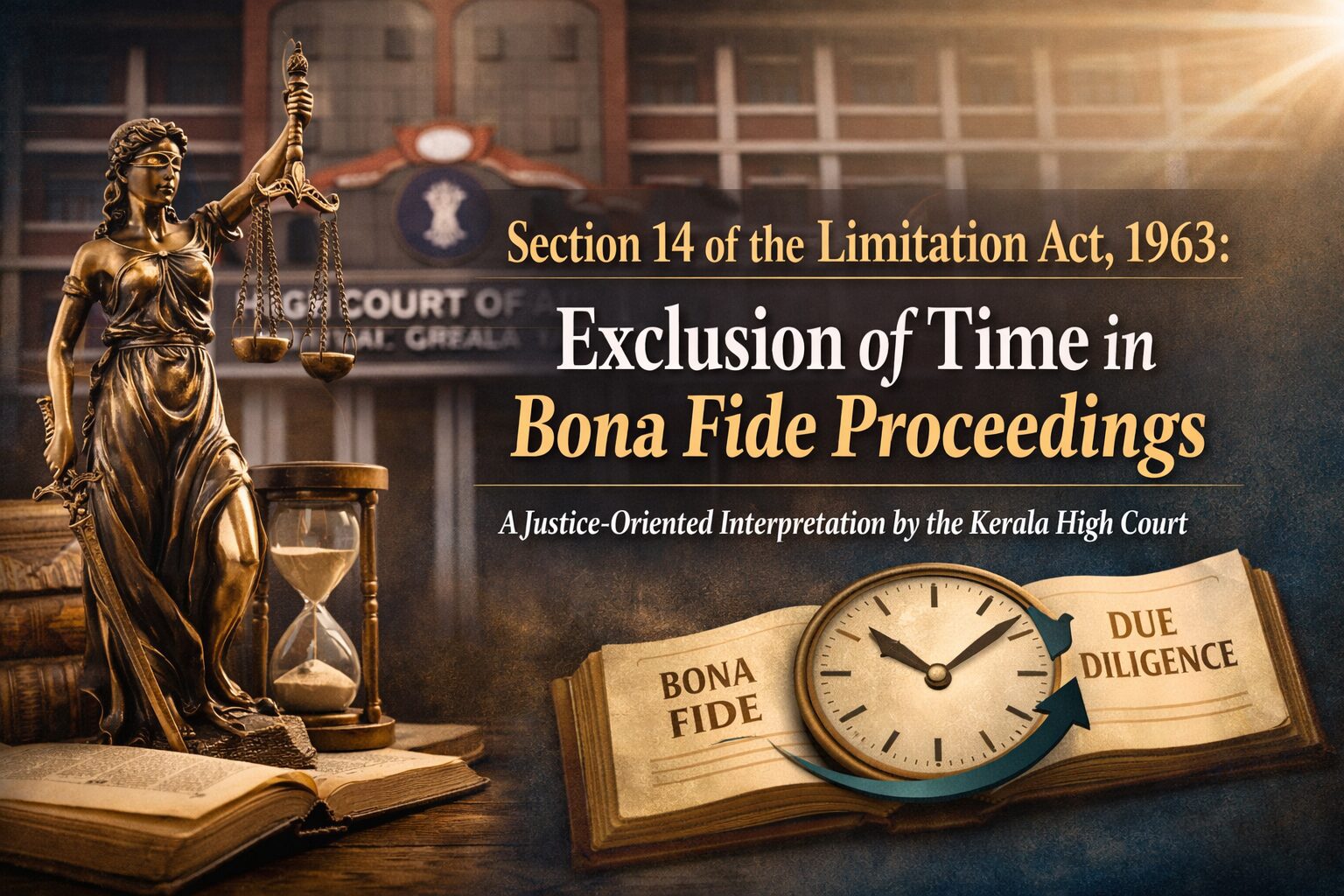
Limitation law, though procedural in nature, often determines substantive rights. Courts are frequently confronted with a delicate balance between strict statutory limitation and equitable justice. Section 14 of the Limitation Act, 1963 occupies a unique position in this balance, embodying a legislative commitment to fairness by permitting exclusion of time spent in bona fide proceedings pursued with due diligence but ending without adjudication on merits.
In W.P.(C) No. 35658 of 2024, decided on 15 January 2026, the Kerala High Court examined this principle in depth while dealing with the rigid limitation framework under the Kerala Municipality Act and the Tribunal Rules. Though ultimately dismissing the writ petition on limitation grounds, the Court delivered an important reaffirmation of the justice-advancing scope of Section 14, especially in situations where litigants initially approach the High Court within time.
Factual Background
The petitioner, a senior citizen, challenged demolition proceedings initiated by the Kollam Municipal Corporation under Section 406 of the Kerala Municipality Act, 1994, alleging illegal construction of a toilet in his property.
A final demolition order was passed on 08.08.2022, which was appealable before the Tribunal for Local Self Government Institutions within 30 days, with a further condonable period of one month under Rule 8(3) of the Tribunal Rules, 1999.
Instead of availing the statutory appeal, the petitioner approached the High Court in October 2024, nearly two years later, seeking to quash the demolition notice and consequential proceedings.
The Limitation Bar and Writ Jurisdiction
The Court reiterated settled law that once:
the statutory limitation period expires, and
the maximum condonable period is also exhausted,
neither the Tribunal nor the High Court can revive the remedy, even under Article 226 of the Constitution.
Relying on a consistent line of precedents, including decisions of the Supreme Court and earlier Kerala High Court judgments, the Court held that writ jurisdiction cannot be used to circumvent legislative limitation mandates.
The Crucial Turn: Section 14 of the Limitation Act
While affirming the strict bar on entertaining time-barred writ petitions, the Court addressed an important residual question of justice:
What happens when a litigant approaches the High Court within the statutory limitation period, bona fide and with due diligence, but the writ petition ultimately fails without a decision on merits?
Answering this, the Court expressly endorsed the principle articulated by the Allahabad High Court in Atlantics Intelligence Ltd. v. Union of India, namely:
“The principle of Section 14 of the Limitation Act is a principle based on advancing the cause of justice, which would certainly apply to exclude time taken in prosecuting proceedings which are bona fide and with due diligence pursued, which ultimately end without a decision on the merits of the case.”
The Kerala High Court unequivocally agreed with this proposition and held that:
Section 14 is not confined to civil suits alone
It applies to statutory remedies and appellate proceedings
The High Court may, in appropriate cases, relegate the litigant to the statutory forum, excluding the time spent in bona fide writ proceedings
This acknowledgment is significant because it preserves access to justice even within a rigid limitation regime.
Scope and Conditions for Application of Section 14
From the judgment, the following principles emerge clearly:
Bona fide prosecution:
The earlier proceeding must have been initiated honestly and in good faith.Due diligence:
The litigant must not be guilty of negligence, inaction, or strategic delay.Failure without adjudication on merits:
The prior proceeding should have ended on technical or jurisdictional grounds.Initial approach within limitation:
Section 14 relief is available only when the litigant approached the wrong forum within the original limitation period.
Where these conditions are satisfied, exclusion of time under Section 14 becomes a constitutional and equitable necessity, not a discretionary indulgence.
Application to the Present Case
Despite recognising the breadth of Section 14, the Court declined its application in the petitioner’s case because:
The writ petition itself was filed long after the statutory and condonable limitation periods had expired.
There was no earlier bona fide proceeding pursued within time that could justify exclusion.
Nevertheless, the Court’s reasoning clearly establishes that had the writ petition been filed within limitation, the petitioner could have legitimately sought exclusion of time under Section 14 if relegated to the appellate forum later.
Judicial Sensitivity and Legislative Concern
In a rare and poignant observation, the Court highlighted the harsh consequences of rigid limitation rules on ordinary citizens, particularly the poor and uneducated. While acknowledging its lack of power to rewrite statutory rules, the Court urged the State to reconsider the restrictive proviso to Rule 8(3), recognising that the right of first appeal is a valuable substantive right.
This contextual reflection reinforces why Section 14 exists — to prevent injustice caused by procedural rigidity.
Conclusion
This judgment stands as an important reaffirmation that Section 14 of the Limitation Act is a remedial and justice-oriented provision, designed to protect litigants who act in good faith but choose an incorrect procedural path.
While courts must respect statutory limitation, they are equally bound to ensure that procedural law does not defeat substantive justice. Section 14 acts as that critical bridge — and the Kerala High Court’s clear endorsement of its principle strengthens its applicability across public law and statutory adjudication.
Citation: Kerala High Court, W.P.(C) No. 35658 of 2024, judgment dated 15 January 2026