

Introduction
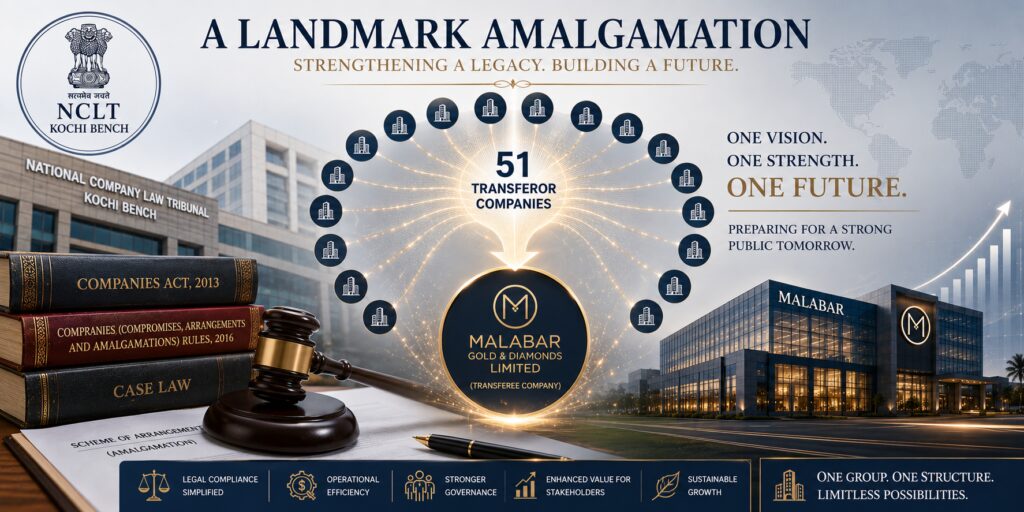
The recent Order dated 25.03.2026 passed by the Hon’ble National Company Law Tribunal, Kochi Bench in CA(CAA)/02/KOB/2026 involving Malabar Gold and Diamonds Limited and 51 transferor companies is arguably one of the largest amalgamation exercises in India in terms of the number of companies merged under a single scheme of arrangement.
The Scheme was presented under Sections 230 to 232 of the Companies Act, 2013 before the NCLT, Kochi Bench, for amalgamation of 51 transferor companies into Malabar Gold and Diamonds Limited, the transferee company.
This transaction assumes even greater significance considering the reported plans of Malabar Gold Group to explore an Initial Public Offering (IPO) in the coming years. Corporate restructuring and consolidation of group entities into a unified corporate structure are often regarded as important preparatory steps for enhanced governance, operational efficiency, regulatory compliance, and investor confidence before a potential public listing.
Legal Framework Governing Mergers and Amalgamations
- Mergers and amalgamations in India are principally governed by:
1. Sections 230 to 232 of the Companies Act, 2013;
2. Companies (Compromises, Arrangements and Amalgamations) Rules, 2016;
3. Relevant provisions of the Income Tax Act, 1961;
4. SEBI Regulations (in case of listed companies);
5. Competition Act, 2002, where applicable.
Sections 230 to 232 empower the NCLT to sanction schemes of compromise, arrangement, merger, demerger, and amalgamation between companies and their shareholders and creditors.
Under the statutory scheme:
- The companies prepare a Scheme of Arrangement;
- Applications are filed before the jurisdictional NCLT;
- Meetings of shareholders and creditors are convened or dispensed with;
- Notices are issued to statutory authorities including the Registrar of Companies, Regional Director, Official Liquidator, and Income Tax Department;
- Upon approval by requisite majority and satisfaction of statutory compliances, the NCLT sanctions the scheme.
The National Company Law Tribunal , Kochi Bench order extensively dealt with the convening and dispensation of meetings of shareholders, secured creditors, and unsecured creditors of the respective companies involved in the scheme.
Scale of the Present Amalgamation
The present scheme involved:
- 51 Transferor Companies; and
- 1 Transferee Company, namely Malabar Gold and Diamonds Limited.
Thus, a total of 52 companies formed part of the composite amalgamation proceedings before the NCLT.
Considering the sheer number of entities involved under a single scheme, this amalgamation stands out as one of the largest consolidation exercises in India in terms of number of companies merged together.
Companies Involved in the Scheme
The transferor companies included:
- Aesthetic Gold Ornaments Private Limited
- Al-Ahali Business Trade Links Private Limited
- Blaze Gold Jewels Private Limited
- Blossom Gold Collections Private Limited
- Ecomate Packaging Private Limited
- Emerald Gold Souk (India) Private Limited
- Eminent Jewel Arcade Private Limited
- Fort-In Infragold Collections Private Limited
- Gehana Gold Palace Private Limited
- Glisten Gold Collections Private Limited
- Luster Gold Palace (India) Private Limited
- Malabar Business Centre Private Limited
- Malabar Cochin Arcade Private Limited
- Malabar Collections Private Limited
- Malabar Creations Private Limited
- Malabar Crystals and Diamonds Private Limited
- Malabar Dazzle India Private Limited
- Malabar Diamond Gallery Private Limited
- Malabar Equipments and General Traders Private Limited
- Malabar Gold Jewels (Tirur) Private Limited
- Malabar Gold Palace Private Limited
- Malabar Gold Super Market (Kannur) Private Limited
- Malabar International Gold Designs Private Limited
- Malabar Jewels and Gems Private Limited
- Malabar Kodungallur Sona Bazar Private Limited
- Malabar Mangalore Arcade Private Limited
- Malabar Ornaments Private Limited
- Malabar Packaging Private Limited
- Malabar Precious Jewels (India) Private Limited
- Malabar Retna Mahal Private Limited
- Malabar Royal Designs (Hyderabad) Private Limited
- Malabar Ruby Private Limited
- MBMG Diamonds Private Limited
- MG Precious Stone Trading Ventures Private Limited
- MGD Holdings Private Limited
- Northern Gold Collections Private Limited
- Palatial Gold Ornaments Private Limited
- Patina Gold Ornaments Private Limited
- Prominent Jewel Arcade Private Limited
- Prosper Jewel Arcade Private Limited
- Riches Jewel Arcade Private Limited
- Sheen Golden Jewels (India) Private Limited
- Sparkle Gold Retail Ventures Limited
- Splendour Gold Collections Private Limited
- Swarna Kamal Jewels (India) Private Limited
- Thas Displays Private Limited
- TN Thangamaaligai Private Limited
- Travancore Gold India Private Limited
- Unify Retail Ventures Limited
- Unity Jewel Arcade Private Limited
- Vajra Creations Private Limited
All the above entities were proposed to be amalgamated with Malabar Gold and Diamonds Limited.
Benefits and Rationale of the Amalgamation
The NCLT order records in detail the commercial rationale and anticipated benefits of the scheme. The Tribunal noted that the amalgamation would bring the entire jewellery business and allied activities under one unified corporate structure.
Some of the key benefits specifically highlighted in the order include:
1. Entire Jewellery Business Under One Roof
The scheme sought to consolidate manufacturing, trading, retail, wholesale, packaging, support, and allied jewellery operations into a single corporate entity.
2. Elimination of Cross Holdings and Inter-Corporate Transactions
The amalgamation would reduce multiple inter-company dealings and simplify group structure and accounting systems.
3. Economies of Scale
Pooling of resources and consolidation of operations would enable better utilisation of infrastructure, manpower, technology, and finance.
4. Improved Access to Capital
The combined entity would be able to access larger funding at competitive rates and improve financial strength.
5. Technology and Digital Transformation
The scheme specifically recognised the importance of technology absorption,
digital process automation,
and operational integration.
6. Reduction in Compliance Costs
Consolidation of multiple entities would significantly reduce:
- legal compliances,
- regulatory filings,
- administrative duplication,
- and governance costs.
7. Enhanced ESG and Governance Standards
The order also notes improvement in environmental, social, and governance (ESG) practices through a unified corporate framework.
8. Human Resource Integration
The scheme envisaged:
uniform HR policies,
skill development,
training opportunities,
equal growth avenues,
and streamlined workforce management.
9. Customer Experience and Enterprise Value
The amalgamation aimed to improve customer experience, strengthen branding, enhance enterprise value and provide better returns to stakeholders.
These objectives and benefits are specifically extracted from the rationale portion of the NCLT order.
Role of Independent Scrutinisers
An important aspect of large amalgamation proceedings is the conduct of meetings of shareholders and creditors under the supervision of independent professionals appointed by the NCLT.
In the present matter, the Hon’ble Tribunal directed appointment of independent practising professionals as scrutinisers for the meetings to ensure transparency, fairness, and compliance with statutory requirements.
Adv. John Vadassery had the privilege of serving as one of the NCLT-appointed Scrutinisers in connection with the meetings conducted pursuant to the Scheme.
Significance from an IPO Perspective
Large-scale corporate restructuring exercises are frequently undertaken before proposed public listings. Consolidation of group entities into a single flagship company helps in:
- simplifying corporate structure;
- improving financial transparency;
- reducing related party transactions;
- streamlining governance;
- enhancing valuation efficiency;
- and improving investor perception.
Against this backdrop, the present amalgamation assumes strategic significance in light of the proposed future IPO plans of the Malabar Gold Group.
Conclusion
The amalgamation involving 51 transferor companies into Malabar Gold and Diamonds Limited represents a landmark corporate restructuring exercise before the NCLT, Kochi Bench. The scale of the transaction, the number of entities involved, and the commercial rationale underlying the scheme make it one of the most notable amalgamation proceedings in recent Indian corporate history.
The scheme demonstrates how mergers and amalgamations under the Companies Act, 2013 can be effectively utilised for operational integration, governance enhancement, cost optimisation, and long-term strategic growth.