

Table of Contents
ToggleIntroduction
Reduction of share capital is an important corporate restructuring mechanism recognised under the Companies Act, 2013. Companies may resort to capital reduction for various legitimate business purposes, including restructuring of shareholding patterns, elimination of excess capital, or exit of minority shareholders.
A recurring issue in such proceedings has been whether a valuation report from a registered valuer is mandatory for obtaining approval of reduction of share capital.
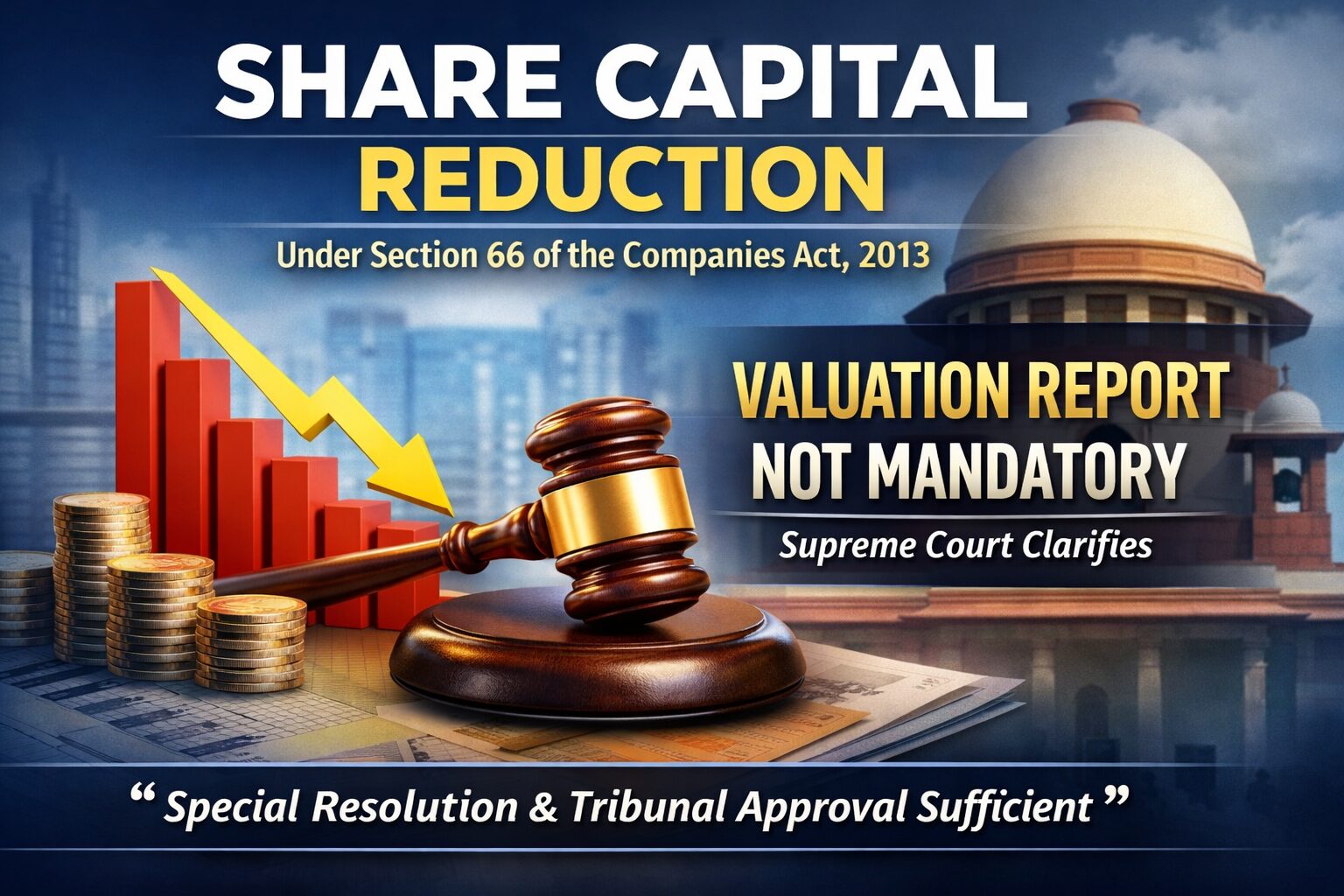
The Supreme Court of India, in a recent decision, has clarified that a valuation report is not a statutory requirement under Section 66 of the Companies Act, 2013.
In Pannalal Bhansali v. Bharti Telecom Limited & Ors., the Court observed:
“Reduction of share capital can be achieved by a special resolution and confirmation by the Tribunal, without a report of valuation from an approved/registered valuer.”
Background of the Case
The dispute arose out of a proposal by Bharti Telecom Limited to reduce its share capital by cancelling shares held by certain minority shareholders.
The company proposed:
Cancellation of 28,457,840 equity shares held by minority shareholders.
Payment of ₹163.25 per share for equity shares having a face value of ₹10.
Approval of the proposal through a special resolution passed with more than 99.90% shareholder approval.
As required under Section 66 of the Companies Act, the company approached the National Company Law Tribunal for confirmation of the reduction.
Certain minority shareholders challenged the proposal alleging that:
The reduction unfairly targeted minority shareholders.
The share price offered was inadequate.
The valuation mechanism adopted by the company was flawed.
Decision of the NCLT
The National Company Law Tribunal examined the scheme and observed that the company had deducted Dividend Distribution Tax while computing the share value.
The Tribunal held that such deduction was unjustified and directed that the minority shareholders be paid ₹196.80 per share instead of ₹163.25.
The company accepted the modified valuation and complied with the Tribunal’s order.
However, some minority shareholders continued to challenge the reduction, eventually leading to appeals before the Supreme Court.
Key Issue before the Supreme Court
The principal legal issue was:
Whether a valuation report from a registered valuer is mandatory for reduction of share capital under Section 66 of the Companies Act, 2013.
The appellants argued that absence of such valuation rendered the reduction process unfair and invalid.
Supreme Court’s Observations
A Bench comprising Justice Sanjay Kumar and Justice K. Vinod Chandran rejected the challenge and upheld the reduction process.
The Court clarified that:
Section 66 does not mandate a valuation report from a registered valuer.
The statutory requirements are limited to:
Passing of a special resolution by shareholders, and
Confirmation by the Tribunal.
The Court further emphasized that where a reduction proposal is approved by an overwhelming majority of shareholders, courts should ordinarily respect the commercial wisdom of the shareholders.
Judicial intervention would be warranted only if the scheme is shown to be:
fraudulent,
oppressive,
unfair to minority shareholders, or
prejudicial to creditors.
Scope of Tribunal’s Powers
The judgment reiterates that the Tribunal’s role in capital reduction proceedings is primarily supervisory.
While examining an application under Section 66, the Tribunal must ensure that:
the statutory procedure is complied with,
creditors’ interests are protected, and
the proposal is not unfair or oppressive.
However, the Tribunal should not act as a valuation authority or substitute its own commercial judgment for that of the shareholders, unless there are compelling reasons to do so.
Significance of the Judgment
This decision provides important clarity for companies and corporate practitioners.
1. Valuation report not mandatory
The ruling confirms that Section 66 does not prescribe valuation by a registered valuer as a statutory requirement.
2. Reinforcement of shareholder democracy
The judgment reinforces the principle that commercial decisions approved by a large majority of shareholders should ordinarily be respected.
3. Limited judicial interference
Courts and tribunals should interfere only where the reduction is unfair, fraudulent, or oppressive.
4. Greater flexibility for corporate restructuring
The ruling facilitates smoother implementation of capital restructuring strategies, particularly in closely held companies.
Conclusion
The Supreme Court’s decision in Pannalal Bhansali v. Bharti Telecom Limited clarifies an important aspect of corporate law.
The Court has reaffirmed that reduction of share capital under Section 66 of the Companies Act, 2013 can be effected through a special resolution of shareholders and confirmation by the Tribunal, and that a valuation report from a registered valuer is not a mandatory statutory requirement.
The judgment strengthens the principle that corporate decisions taken by shareholders in accordance with law should not be lightly interfered with, while preserving the Tribunal’s power to safeguard the interests of minority shareholders and creditors.
Case Reference:
Pannalal Bhansali v. Bharti Telecom Limited & Ors.
Civil Appeal No. 7655 of 2025 with connected appeals
Neutral Citation: 2026 INSC 213
Decision dated: 10 March 2026
Bench: Justice Sanjay Kumar and Justice K. Vinod Chandran
Court: Supreme Court of India