

Table of Contents
TogglePractical Experience with Filing of Form DIR-12 before the Registrar of Companies
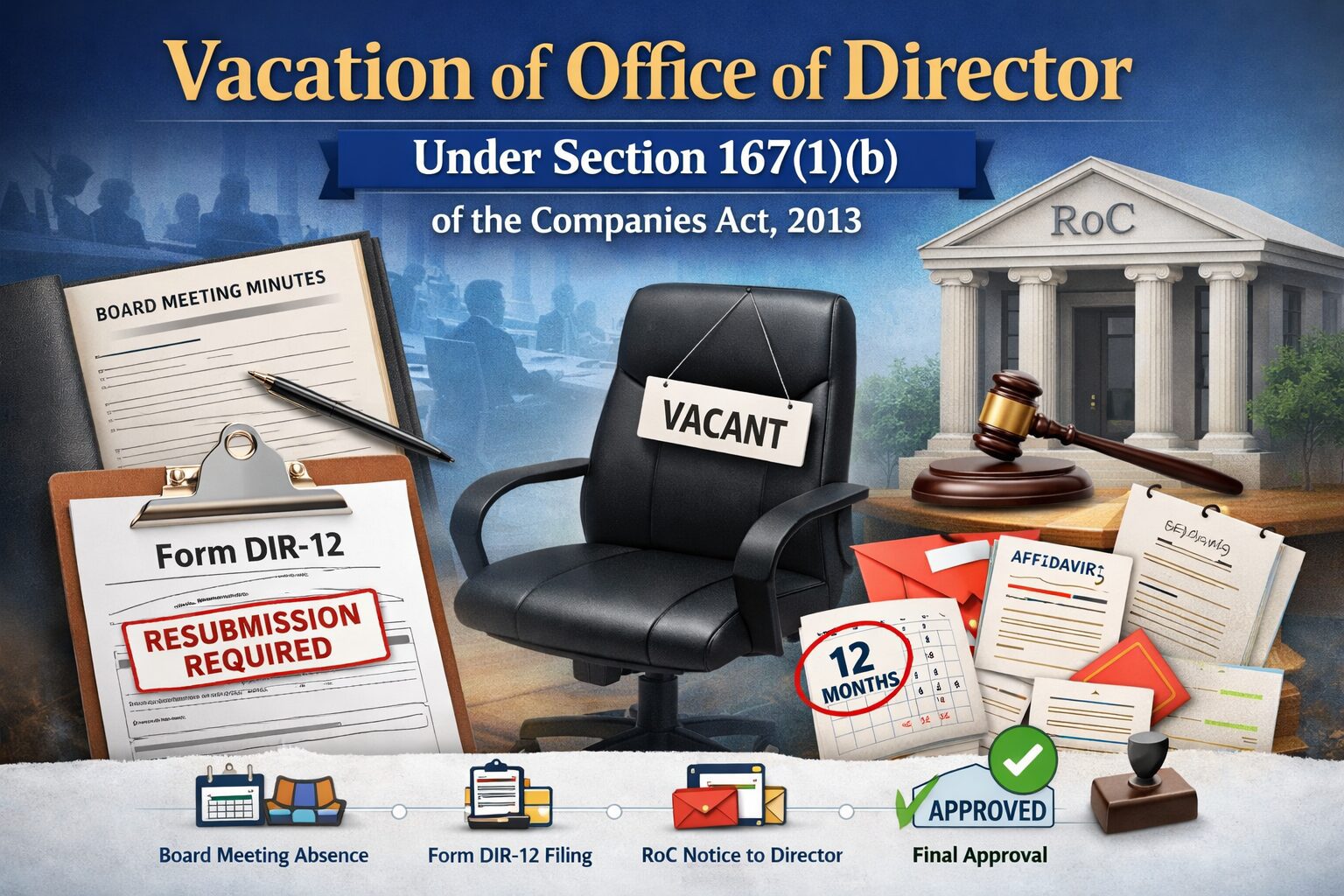
The automatic vacation of office of a director due to absence from Board Meetings is one of the important compliance provisions under the Companies Act, 2013. Many companies and professionals assume that the process is simple because the law states that the office becomes vacant automatically. However, in practice, the Registrar of Companies (RoC) may require substantial documentary evidence before accepting the cessation through Form DIR-12.
This article explains the legal provision and also narrates a recent practical experience with the Registrar of Companies, Kerala, which highlights the procedural diligence expected from companies.
1. Legal Provision – Section 167(1)(b)
Section 167(1)(b) of the Companies Act, 2013 provides:
“The office of a director shall become vacant in case he absents himself from all the meetings of the Board of Directors held during a period of twelve months with or without seeking leave of absence of the Board.”
Important points emerging from the provision:
The vacation of office is automatic if the director does not attend any Board Meeting for a continuous period of 12 months.
The absence may be with leave of absence or without leave.
Once the condition is satisfied, the director ceases to hold office by operation of law.
The company is required to intimate the Registrar of Companies through Form DIR-12.
2. Corporate Compliance Requirement
Once the conditions under Section 167(1)(b) are triggered, the company generally undertakes the following steps:
Verify the Board Meeting records to confirm that the director has not attended any meeting for a period of 12 months.
Ensure proper notices of Board Meetings were issued to the concerned director.
Pass a Board Resolution noting that the office of the director has become vacant under Section 167(1)(b).
File Form DIR-12 with the Registrar of Companies attaching supporting documents.
Though the vacation occurs automatically, the filing of DIR-12 is necessary to update the MCA records.
3. Practical Experience in Filing DIR-12
Recently, our company filed Form DIR-12 intimating the cessation of a director under Section 167(1)(b).
The filing included:
Board Resolution noting the vacation of office
Postal receipts evidencing dispatch of Board Meeting notices to the concerned director
However, the Registrar of Companies marked the form for resubmission, seeking additional documents and confirmations.
4. Additional Documents Required by the RoC
The Registrar of Companies required the following documents to be submitted along with the resubmitted DIR-12:
1. Minutes of Board Meetings
Copies of all Board Meeting minutes during the relevant 12-month period when the director remained absent.
2. Attendance Register
Copy of the Board Meeting Attendance Register for the concerned period.
3. Affidavit from the Company
The company was required to submit an affidavit confirming the following facts:
The concerned director had not attended any Board Meetings from the specified date.
The director had been duly given notices of all Board Meetings by post and through personal communications.
Due to his continuous absence for twelve months, his office stood vacated under Section 167(1)(b) and the Board had resolved to report the vacancy to the Registrar.
No litigation or complaint was pending in any forum relating to the vacation of the directorship.
The company was regular in filing financial statements and annual returns with the Registrar of Companies.
The company had not accepted deposits nor defaulted in repayment.
The company had not issued debentures nor defaulted in redemption or interest payments.
The company had complied with Section 167 read with Section 164 of the Companies Act, 2013.
After providing the above documents and affidavit, the company resubmitted Form DIR-12.
5. Opportunity of Hearing Given by RoC to the Director
Subsequently, the Registrar of Companies issued a communication to the concerned director, granting him an opportunity to submit objections.
The RoC clarified that:
Any objections should be strictly confined to the provisions of the Companies Act, 2013 and the Rules thereunder.
The RoC would not examine inter-se disputes between directors or shareholders.
The director was required to submit his response within 7 days, along with documentary proof.
The communication further stated that if no response was received within the stipulated time, it would be presumed that the director had no objection to the processing of Form DIR-12.
6. Final Outcome
The Registrar of Companies waited for a response from the director.
Since no objection was received, the Registrar proceeded to approve Form DIR-12, thereby recording the cessation of the director in the MCA records.
7. Practical Lessons for Companies and Professionals
This experience highlights several important compliance aspects:
1. Maintain Proper Board Meeting Records
Companies should maintain:
Proper Board Meeting minutes
Attendance registers
Records of Board Meeting notices
These documents become crucial evidence.
2. Preserve Proof of Service of Notice
If a director later disputes the cessation, the company must prove that Board Meeting notices were duly served.
3. Ensure Compliance History is Clean
The RoC may verify whether the company:
Filed annual returns and financial statements regularly
Has any deposit or debenture defaults
4. Expect RoC Scrutiny
Though Section 167(1)(b) provides automatic vacation, the RoC may still conduct procedural verification before approving DIR-12.
5. Natural Justice Principle
The RoC may provide the concerned director an opportunity to raise objections, ensuring compliance with principles of natural justice.
8. Conclusion
Section 167(1)(b) of the Companies Act, 2013 provides a mechanism for ensuring that directors actively participate in the governance of the company. Continuous absence from Board Meetings for twelve months results in automatic vacation of office.
However, as seen from the above practical experience, the procedural compliance required by the Registrar of Companies can be detailed and evidence-based. Companies and professionals must therefore maintain proper records and documentation to successfully process the cessation through Form DIR-12.
Proper documentation, transparent governance practices, and timely compliance will ensure that such filings are processed smoothly by the Registrar of Companies.