

Bombay High Court Clarifies the Interplay Between SARFAESI and IBC Interim Moratorium in Arrow Business Development Consultants Pvt. Ltd. v. Union Bank of India & Ors., decided on 10 December 2025
Table of Contents
Toggle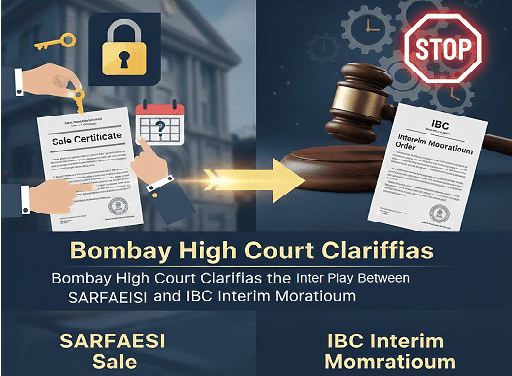
Introduction
In a significant judgment clarifying the interplay between the SARFAESI Act, 2002 and the Insolvency and Bankruptcy Code, 2016 (IBC), the Bombay High Court has held that ownership of a secured asset does not pass to an auction purchaser merely upon issuance of a sale notice or confirmation of sale, but only upon issuance of the sale certificate. The Court further ruled that once an interim moratorium under Section 96 of the IBC comes into effect, further steps under SARFAESI—including acceptance of balance sale consideration—are barred.
Background of the Case
The dispute arose out of enforcement proceedings initiated by Union Bank of India under the SARFAESI Act against residential property owned by the borrowers. After the account was classified as a Non-Performing Asset (NPA), the Bank issued a demand notice under Section 13(2), took symbolic possession, and subsequently issued an auction sale notice under Rule 8(6) of the SARFAESI Rules.
The property was auctioned on 30 May 2025, and Arrow Business Development Consultants Pvt. Ltd. emerged as the successful bidder. While part payments were made before June 9, 2025, a personal insolvency application under Section 94 of the IBC was filed by one of the borrowers on 9 June 2025, triggering an interim moratorium under Section 96.
Despite the moratorium, the Bank accepted the remaining auction payments and issued a sale certificate on 20 June 2025. When possession was not handed over, the auction purchaser approached the Bombay High Court seeking enforcement of its alleged ownership rights.
Core Legal Issue
The principal question before the Court was:
Whether, after the 2016 amendment to Section 13(8) of the SARFAESI Act, ownership of a secured asset stands extinguished upon issuance of the sale notice, or only upon issuance of the sale certificate—particularly when an interim moratorium under Section 96 of the IBC intervenes.
Key Findings of the Court
1. Ownership Passes Only Upon Issuance of Sale Certificate
Relying on authoritative Supreme Court precedents, including Indian Overseas Bank v. RCM Infrastructure Ltd., the Court held that:
A SARFAESI sale is a statutory sale governed strictly by Rules 8 and 9 of the SARFAESI Rules.
Ownership of the secured asset is transferred only upon issuance of the sale certificate under Rule 9(6).
Neither issuance of the sale notice nor confirmation of sale results in transfer of ownership.
2. Effect of the 2016 Amendment to Section 13(8) SARFAESI Act
The Court clarified an often-misunderstood aspect of Section 13(8):
The 2016 amendment only curtails the borrower’s right of redemption, advancing the cut-off point to the date of publication of the sale notice.
Loss of the right of redemption does not amount to loss of ownership.
Ownership is a “bundle of rights”, and extinguishment of one facet (redemption) does not destroy ownership itself.
3. Interim Moratorium Under Section 96 IBC Has Wide Effect
Drawing from Dilip B. Jiwrajka v. Union of India, the Court emphasized that:
Interim moratorium under Section 96 takes effect immediately upon filing of the insolvency application, not upon admission.
It applies “in respect of any debt”, making it broader than the moratorium under Section 14.
Once Section 96 is triggered, no legal action or proceeding—directly or indirectly relating to the debt—can continue.
4. Acceptance of Balance Sale Consideration Was Illegal
Since most auction payments were made after the interim moratorium came into force, the Court held:
The Bank could not have accepted the balance auction amounts.
Consequently, issuance of the sale certificate during the moratorium was legally impermissible.
As the sale was not lawfully completed, no ownership vested in the auction purchaser.
5. Celir LLP Judgment Distinguished
The Court carefully distinguished the Supreme Court’s ruling in Celir LLP v. Bafna Motors, noting that:
Celir LLP dealt only with extinguishment of redemption rights, not with IBC moratorium implications.
It did not dilute the settled principle that ownership transfers only upon issuance of a sale certificate.
Final Outcome
The Bombay High Court concluded that:
The SARFAESI sale did not stand completed.
The auction purchaser was not entitled to possession of the secured asset.
Issues regarding refund of the auction amount were left open to be agitated in appropriate proceedings.
Significance of the Judgment
This ruling is a crucial reaffirmation that:
SARFAESI enforcement cannot override IBC moratorium protections.
Banks must exercise extreme caution when insolvency proceedings—especially personal insolvency—are initiated.
Auction purchasers acquire enforceable ownership only upon lawful completion of sale, not merely by confirmation or payment.
Conclusion
The judgment strikes a careful balance between creditor enforcement rights and insolvency protections, reinforcing that statutory discipline and procedural timelines under the IBC cannot be bypassed through SARFAESI actions. It serves as an important precedent for banks, insolvency professionals, and auction purchasers alike.