

The Indian corporate framework recognises that companies—especially closely-held companies—often face internal disputes arising from power imbalance, exclusion of minority shareholders, and misuse of managerial authority. To address these issues, the Companies Act, 2013, provides a specialised remedy under Sections 241–244 for cases involving oppression and mismanagement. These provisions empower members of a company to approach the National Company Law Tribunal (NCLT) when the conduct of those in control is unfair, prejudicial, or detrimental to the company or its minority shareholders.
Table of Content
Toggle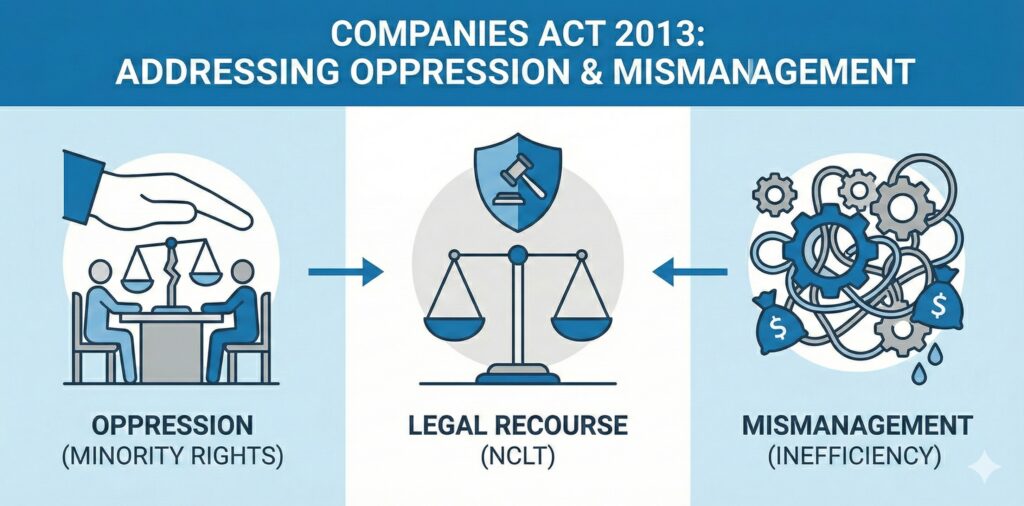
Meaning of Oppression
Oppression refers to conduct that is burdensome, harsh, wrongful, or inequitable. It generally involves actions that violate the principles of fair dealing and prejudice the interests of minority shareholders.
Common examples include:
Removing or excluding a shareholder from management without fair cause
Issue of further shares to dilute minority shareholding
Denial of legitimate information, notices, or participation in corporate affairs
Diversion of business or assets for personal gain
Conduct lacking probity, fairness, and transparency
Oppression is not merely illegal action; it includes conduct contrary to the standards of fair corporate management.
Meaning of Mismanagement
Mismanagement refers to conduct of the company’s affairs that is prejudicial to the interests of the company, its shareholders, or the public.
Instances may include:
Gross financial mismanagement
Diversion or siphoning of funds
Persistent defaults or violations of statutory requirements
Acting in a manner likely to cause serious injury to the company
Lack of proper internal controls leading to losses
Mismanagement need not always be intentional—negligent or reckless administration also qualifies when it harms the company.
Right to Apply: Section 244
A petition under Section 241 can be filed only by members who meet the eligibility criteria under Section 244:
At least 100 members, or
Members holding at least 10% of issued share capital
However, the Tribunal may waive these requirements in appropriate cases.
The waiver jurisdiction ensures that genuine minority grievances are not blocked due to numerical restrictions.
Role of the NCLT
Once satisfied that oppression or mismanagement exists, the NCLT has wide remedial powers under Section 242, including:
Regulation of the company’s affairs
Setting aside wrongful share allotments
Removal or appointment of directors
Restriction on transfer or dilution of shares
Ordering purchase of shares by majority or company
Even superseding the board if necessary
The objective is corrective, not punitive—NCLT aims to restore fairness, prevent further prejudice, and ensure proper corporate governance.
Cautions and Practical Considerations Before Filing a Case
Filing an oppression and mismanagement petition is serious litigation that requires careful preparation. Here are important cautions:
1. Ensure the dispute truly amounts to ‘oppression’ or ‘mismanagement’
Routine disagreements between shareholders do not qualify.
Mere violation of the law or Articles, unless oppressive, is not enough.
The conduct must be continuous, not isolated or trivial.
Courts look for lack of probity, unfairness, and prejudice—not simply illegality.
2. Gather documentary evidence
NCLT proceedings are largely document-driven.
Ensure you collect:
Board minutes, AGM/EGM notices
Emails and communications
Financial statements showing irregularities
Shareholding records
Proof of exclusion, dilution, diversion, or mismanagement
Without strong documents, petitions often fail.
3. Ensure locus standi under Section 244
Confirm that you meet the shareholding/signatory thresholds.
If not, prepare a waiver application with justification.
In many recent cases, lack of proper locus has led to dismissal.
4. Examine whether ‘clean hands’ are required
The petitioner must not be guilty of misconduct themselves.
Oppression and mismanagement petitions often fail when:
The petitioner has participated in the disputed decision
The petitioner has unclean or inequitable conduct
5. Attempt internal remedies (if possible)
While not mandatory, it helps to show that:
You raised grievances internally
The board or shareholders refused to act
Oppression is ongoing and unavoidable
This strengthens the case.
6. Consider the relief you want
The petition must clearly state:
What remedy you seek from the NCLT
How the proposed remedy will end the oppression
Why alternative remedies (like civil suits or arbitration) are inadequate
Ambiguous reliefs weaken the petition.
7. Injunction strategy
If urgent, you may need interim relief such as:
Maintaining shareholding status quo
Restraining board meetings or share allotments
Freezing assets or preventing fund diversion
Timing is crucial—delay can cause irreversible prejudice.
8. Avoid using the petition for personal disputes
NCLT discourages:
Family quarrels not related to company affairs
Settled technical violations
Using the petition as a pressure tactic
The dispute must genuinely relate to prejudicial corporate conduct.
9. Maintain confidentiality and professionalism
Corporate disputes can damage reputation.
Always ensure:
Communication is fact-based, not emotional
No defamatory allegations without proof
You avoid public statements harming the company
Conclusion
Oppression and mismanagement under the Companies Act, 2013 provide a robust mechanism to protect minority shareholders and ensure fair corporate governance. However, these petitions require serious groundwork, clear evidence, and a well-prepared legal strategy. When filed carefully, the remedy is powerful—capable of restoring fairness, preventing abuse of power, and safeguarding the company’s long-term health.