

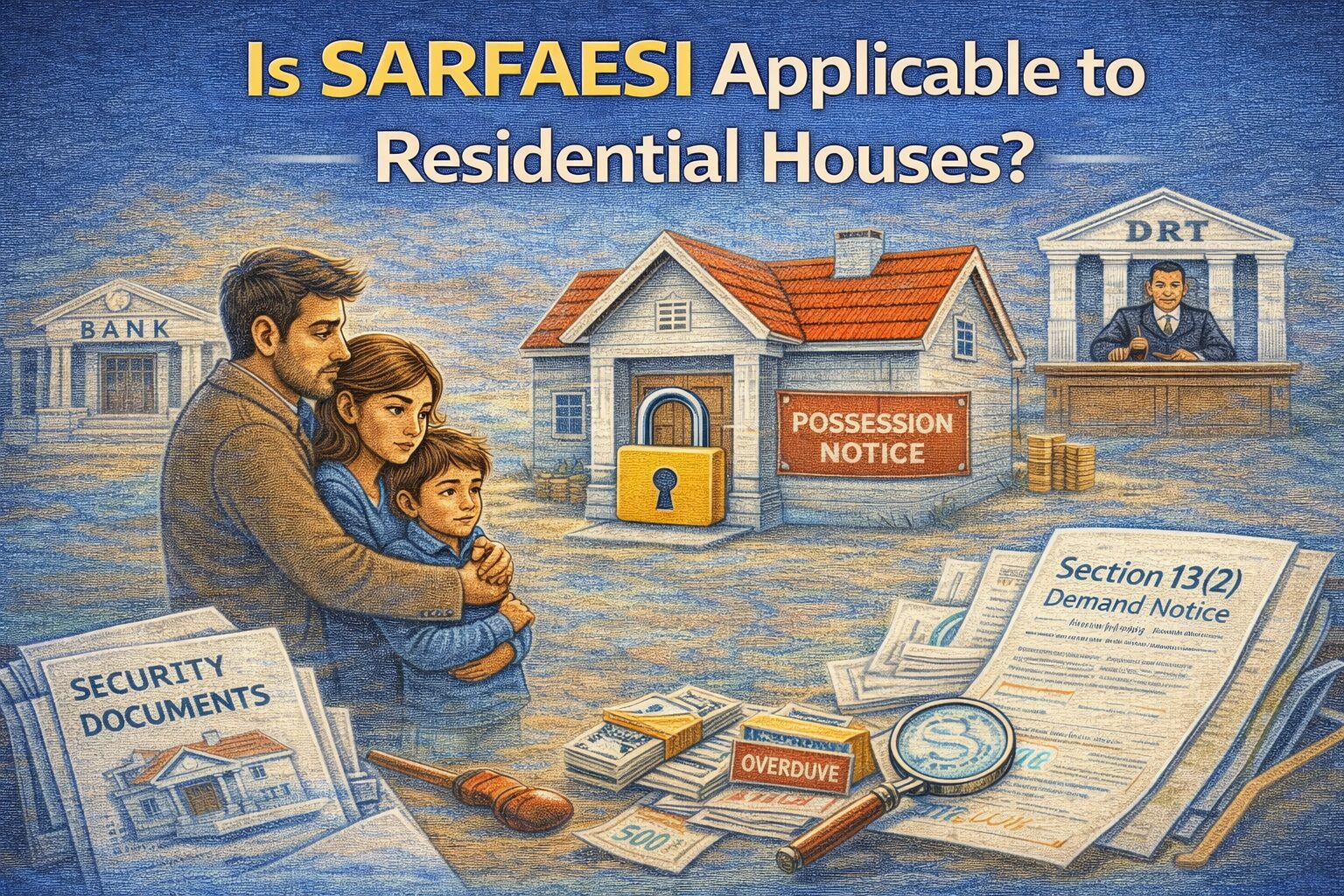
One of the most common fears among borrowers is whether their residential house can be taken by banks under the SARFAESI Act, 2002. Many believe that residential properties enjoy blanket protection. In reality, the applicability of SARFAESI to residential houses depends on specific legal conditions, not on the nature of use alone.
This article explains when SARFAESI applies to residential houses, when it does not, and what remedies borrowers have.
Table of Contents
ToggleBasic Rule: SARFAESI Can Apply to Residential Houses
Yes, SARFAESI is applicable to residential houses, provided:
The house is offered as security for a loan, and
The loan account is classified as a Non-Performing Asset (NPA)
👉 The Act does not exempt residential properties merely because they are used for living.
Why Residential Houses Are Covered Under SARFAESI
SARFAESI is concerned with:
Security interest, not usage of property
If a borrower:
Creates a mortgage over a residential house, and
Defaults in repayment
The bank acquires a statutory right to enforce that security, regardless of whether the borrower resides there.
Common Situations Where SARFAESI Applies to Residential Houses
SARFAESI proceedings can be initiated against:
Houses mortgaged for housing loans
Residential houses given as collateral for business loans
Houses mortgaged by guarantors
Jointly owned residential houses (to the extent of borrower’s share)
Important Exception: Agricultural Residential Houses
SARFAESI does not apply to:
Agricultural land, including farmhouses or residential structures forming part of agricultural land
Courts look at:
Revenue records
Nature of land classification
Actual use
If the residential house is part of agricultural land, SARFAESI action is illegal.
Residential House vs “Home” – Legal Misconception
❌ Many borrowers believe:
“SARFAESI cannot be used against my home.”
✔ Legal position:
There is no concept of emotional or personal protection under SARFAESI. Once a residential house is mortgaged, it becomes a secured asset like any other.
Procedure Followed for Residential Houses
For residential houses, banks must strictly follow:
NPA classification
Section 13(2) demand notice (60 days)
Consideration of objections under Section 13(3A)
Possession under Section 13(4)
Magistrate assistance under Section 14 (for physical possession)
Any deviation renders the action challengeable before DRT.
Borrower’s Rights in Case of Residential House
Borrowers have the right to:
Receive proper statutory notices
File objections
Continue occupation during symbolic possession
Challenge possession and auction before DRT
Redeem the property before auction
Can a Borrower Be Evicted from a Residential House Immediately?
No.
Immediate eviction is not permitted
Symbolic possession is usually taken first
Physical possession requires Section 14 proceedings
Due process must be followed.
Special Considerations by Courts
Courts may show caution where:
Minor defaults exist
Procedural violations are evident
Property is the only residential house
However, sympathy alone is not a legal defence.
Common Grounds to Challenge SARFAESI on Residential Houses
No valid NPA classification
Improper service of notice
Agricultural land wrongly proceeded against
Co-owner rights ignored
Mechanical Section 14 order
Practical Advice for Homeowners
Never assume your house is automatically protected
Verify whether SARFAESI prerequisites are met
Act immediately after receiving notice
Do not wait until police-assisted possession
Seek legal advice early
Conclusion
SARFAESI is applicable to residential houses if they are mortgaged as security, irrespective of personal use or emotional value. The law prioritises security interest over property usage. However, strict procedural safeguards exist, and illegal or premature action against residential houses can be successfully challenged before the DRT.
FAQs
Q. Can SARFAESI be used against my only residential house?
Yes, if it is mortgaged and SARFAESI conditions are met.
Q. Can banks evict families immediately?
No. Due process under SARFAESI must be followed.
Q. Is agricultural residential property protected?
Yes. Agricultural land is exempt from SARFAESI.