

Table of Contents
ToggleIntroduction
In a significant decision reinforcing the structural distinction under the Insolvency and Bankruptcy Code, 2016 (IBC), the Supreme Court has held that:
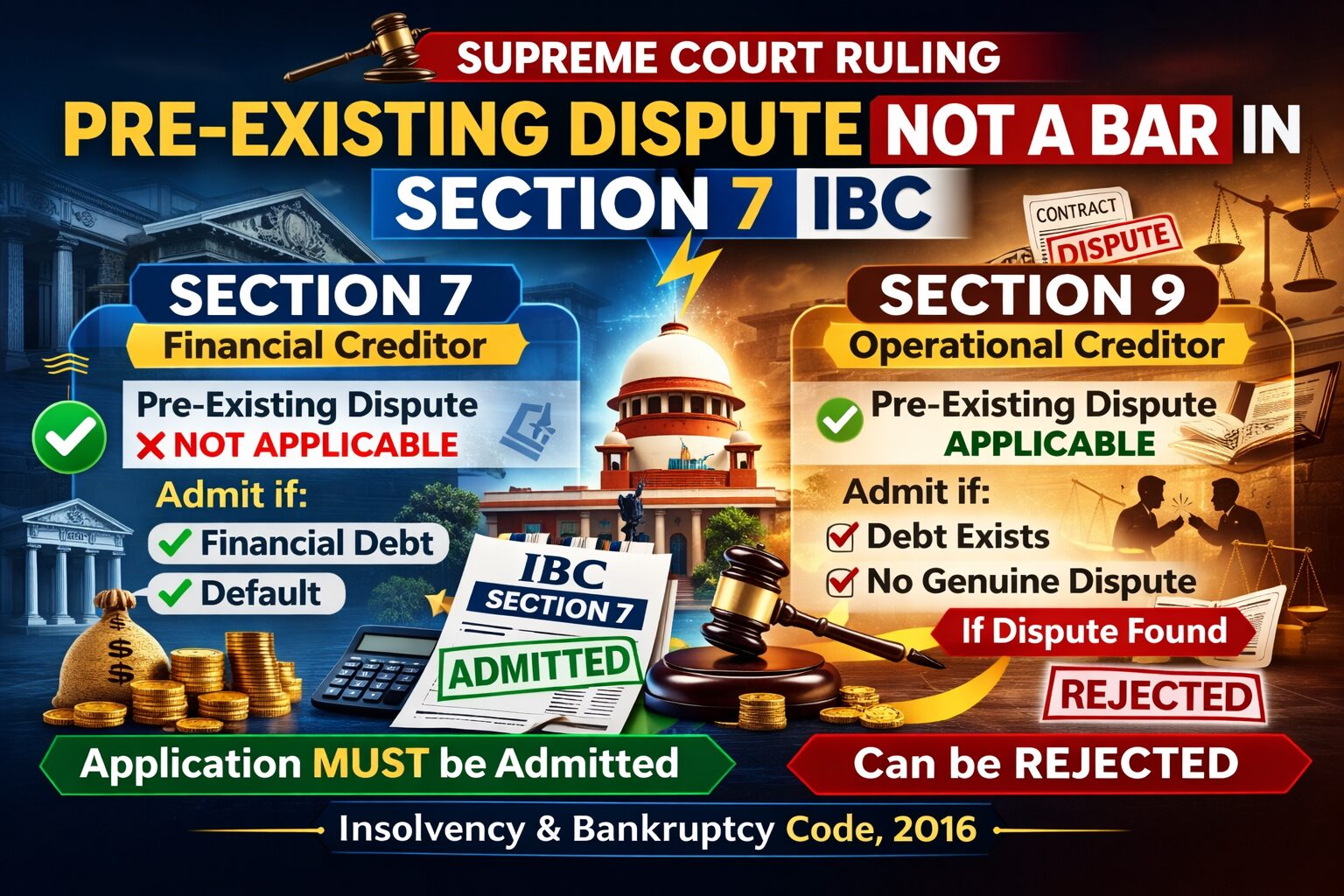
The concept of a “pre-existing dispute”, which may bar admission of a Section 9 application by an operational creditor, has no bearing on an application filed by a financial creditor under Section 7 of the Code.
The ruling came in Catalyst Trusteeship Ltd. v. Ecstasy Realty Pvt. Ltd., where the Court set aside concurrent findings of the NCLT and NCLAT and directed admission of a Section 7 petition.
Facts of the Case
Issuance of Debentures
The respondent company proposed a large residential-cum-retail project in Mumbai.
It issued ₹850 crore worth of redeemable non-convertible debentures.
₹600 crore (Series A) was subscribed and disbursed in March 2018.
A Debenture Trust Deed (DTD) dated 27.03.2018 governed the transaction.
Catalyst Trusteeship Ltd. was appointed as debenture trustee.
Default and Restructuring Attempt
By 2022:
Significant amounts were overdue.
The respondent began discussions for restructuring with one debenture holder (ECL Finance Ltd.).
Emails were exchanged proposing an 18-month moratorium.
However:
No formal modification of the DTD was executed.
The mandatory procedure under Clause 33 of the DTD (requiring written approval of debenture holders via special resolution) was not followed.
Majority debenture holders later rejected the restructuring proposal.
A recall notice for over ₹1203 crore was issued, and the debenture trustee filed a Section 7 application before the NCLT.
Proceedings Before NCLT & NCLAT
The NCLT dismissed the Section 7 petition, assuming a moratorium was operative.
The NCLAT affirmed, inferring restructuring had been accepted and default was engineered.
The debenture trustee appealed to the Supreme Court.
Supreme Court’s Core Legal Clarification
The Court reaffirmed the principle laid down in Innoventive Industries v. ICICI Bank:
Under Section 7, the Adjudicating Authority must only examine:
Whether a financial debt exists, and
Whether a default has occurred.
It is irrelevant whether disputes are raised about restructuring or negotiations, so long as debt is “due” and default is established.
The Court categorically observed:
The doctrine of “pre-existing dispute”, which can defeat a Section 9 application by an operational creditor, has no role in Section 7 proceedings by a financial creditor.
Section 7 vs Section 9 – The Structural Distinction
Section 9 (Operational Creditor)
Requires issuance of demand notice under Section 8.
If the corporate debtor shows existence of a pre-existing dispute, admission must be rejected.
The adjudicating authority examines genuineness of dispute.
Section 7 (Financial Creditor)
No demand notice mechanism.
No enquiry into pre-existing disputes.
Only existence of financial debt and default is relevant.
Disputes about restructuring cannot indirectly defeat admission.
The Court warned that allowing “dispute-like” objections in Section 7 proceedings would dilute the Code’s framework.
Why the Restructuring Argument Failed
The respondent’s entire defence was based on alleged restructuring via email exchanges.
The Court found:
No written amendment to the DTD.
No approval via special resolution.
No compliance with modification procedure under Clause 33.
No written waiver.
No novation under Section 62 of the Contract Act.
No authorization for one debenture holder to bind others.
Thus, the supposed moratorium had no legal foundation.
Rejection of ‘Indirect Dispute’ Defence
The Supreme Court emphasized:
A corporate debtor may show that debt is not due or that no default occurred.
However, this cannot become an indirect attempt to import the “pre-existing dispute” doctrine of Section 9 into Section 7 proceedings.
The Code treats financial and operational creditors differently for deliberate policy reasons.
Findings of Perversity
The Court held that:
The NCLT and NCLAT ignored binding contractual terms.
They relied on assumptions unsupported by evidence.
Their findings were “glaring and manifestly perverse”.
Accordingly:
Both orders were set aside.
The Section 7 petition was restored and directed to be admitted.
Key Takeaways
Pre-existing dispute is relevant only under Section 9.
It has no application to Section 7 petitions by financial creditors.
Section 7 requires proof only of:
Financial debt, and
Default.
Contractual modification must strictly comply with agreed procedure.
Informal negotiations cannot defeat a valid insolvency petition.
Conclusion
This judgment strengthens the doctrinal clarity of the IBC framework. By firmly separating Sections 7 and 9, the Supreme Court has prevented the misuse of dispute-based defences in financial creditor proceedings and reinforced the Code’s objective of swift resolution of financial defaults based on objective evidence.
The decision stands as a definitive affirmation that Section 7 insolvency proceedings cannot be derailed by invoking the “pre-existing dispute” doctrine meant exclusively for Section 9 cases.