

Table of Contents
ToggleIntroduction
In a significant ruling with far-reaching economic implications, the Supreme Court in Omkara Assets Reconstruction Pvt. Ltd. v. Amit Chaturvedi & Ors. (2026) addressed the intersection between proceedings under the Companies Act, 1956 and the Insolvency and Bankruptcy Code, 2016 (IBC).
The Court restored Corporate Insolvency Resolution Process (CIRP) proceedings that had been stalled on the ground of “judicial discipline,” and emphatically held:
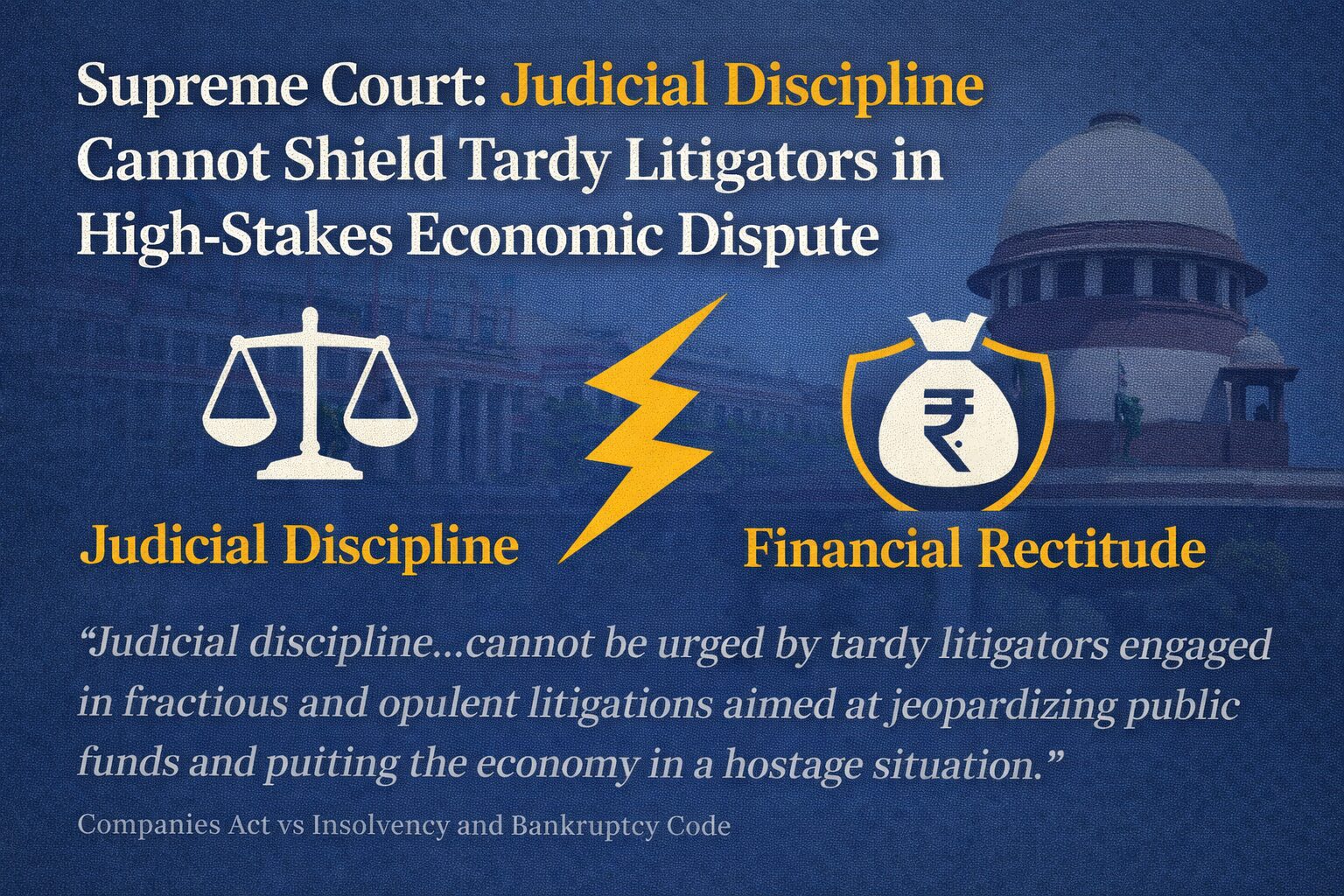
Judicial discipline, though a cornerstone of justice, equity and fairness, cannot be invoked by tardy litigators engaged in fractious and opulent litigation aimed at jeopardising public funds and holding the economy hostage.
This judgment underscores that procedural propriety cannot be weaponised to frustrate economic revival or undermine financial rectitude.
Facts of the Case
The predecessor of the appellant (Stressed Assets Stabilization Fund of IDBI Bank) had extended two term loans in 1999 and 2000.
Default commenced from 1 January 2003.
The outstanding debt had ballooned to over ₹154 crores.
The financial creditor initiated proceedings under Section 7 of the IBC before the NCLT for commencement of CIRP.
The Corporate Debtor resisted initiation of CIRP on the ground that:
A Scheme of Arrangement (SOA) under Sections 391–394 of the Companies Act was pending before the Punjab & Haryana High Court.
The creditor allegedly suppressed this fact before the Adjudicating Authority.
The NCLT rejected this contention and admitted the Section 7 application, invoking the overriding effect of Section 238 of the IBC.
However, the NCLAT kept the IBC proceedings in abeyance, citing the pendency of the High Court proceedings. This effectively stalled the moratorium and restored control to the existing management.
The Supreme Court was called upon to decide whether such deference was justified.
Defunct Scheme of Arrangement: A Timeline of Delay
The Court carefully analysed the procedural history of the SOA:
The creditors’ meeting report was recorded in 2008.
The mandatory second motion was not filed within the prescribed time under the Companies (Court) Rules, 1959.
Even when a delayed motion was filed, it languished for years.
The sanction order was eventually passed only in 2019, more than a decade later.
The statutory requirement of filing the order before the Registrar within 30 days was not complied with.
Consent earlier granted by creditors had been withdrawn.
Meanwhile, proceedings under SARFAESI and before the DRT were initiated.
The Court found that statutory timelines were flagrantly ignored and the scheme had become redundant, inoperative, and defunct.
IBC’s Overriding Effect
The Supreme Court reaffirmed that:
The IBC is a special statute aimed at revival of companies.
Section 238 gives it overriding effect over inconsistent provisions of other laws.
Proceedings under Section 7 IBC are independent and must be tested on their own merits.
The Court relied upon prior precedents including A. Navinchandra Steels (P) Ltd. v. Srei Equipment Finance Ltd. and Sunil Kumar Sharma v. ICICI Bank Ltd. to reiterate that insolvency proceedings cannot be derailed merely because other proceedings are pending.
Judicial Discipline vs. Financial Rectitude
The most striking aspect of the judgment lies in its normative emphasis.
While acknowledging that judicial discipline preserves institutional integrity, the Court clarified that it cannot:
Reward procedural lethargy,
Protect management responsible for financial collapse,
Or enable strategic delays that jeopardise public funds.
The Court observed that cases of this nature affect not merely private parties but:
Public financial institutions,
Economic stability, and
Rehabilitation of industry in the national interest.
The Court warned against allowing economic recovery mechanisms to be stalled by litigants seeking to exploit procedural technicalities.
Transfer of Proceedings and Jurisdictional Issues
The Court further noted that:
With the coming into force of the Companies (Transfer of Pending Proceedings) Rules, 2016, such matters should have been transferred to the Tribunal.
The belated second motion was neither reserved for orders nor validly maintained.
Even otherwise, compromise or arrangement under Section 230 of the Companies Act, 2013 can be considered within IBC proceedings at an appropriate stage.
Thus, pendency before the High Court could not justify stalling CIRP.
Final Decision
The Supreme Court:
Set aside the order of the NCLAT,
Restored the NCLT order admitting the Section 7 application,
Revived the moratorium,
Directed the Interim Resolution Professional (IRP) to proceed,
Vacated interim protection given to management.
The appeal was allowed in full.
Key Takeaways
IBC prevails over inconsistent provisions of the Companies Act.
Defunct or inoperative schemes cannot stall insolvency proceedings.
Judicial discipline cannot be invoked to protect delay tactics.
Economic cases require balancing public funds, creditor rights, and industrial revival.
Revival under IBC takes precedence unless corporate death is inevitable.
Conclusion
This judgment sends a clear message: procedural technicalities cannot be allowed to defeat substantive economic justice. While judicial discipline remains fundamental to the rule of law, it cannot be stretched to shield litigants whose conduct undermines financial probity and threatens economic stability.
By restoring CIRP, the Supreme Court reaffirmed the primacy of the IBC’s objective—revival in the larger national and economic interest—over strategic litigation aimed at prolonging corporate control at public cost.