

Table of Contents
ToggleIntroduction
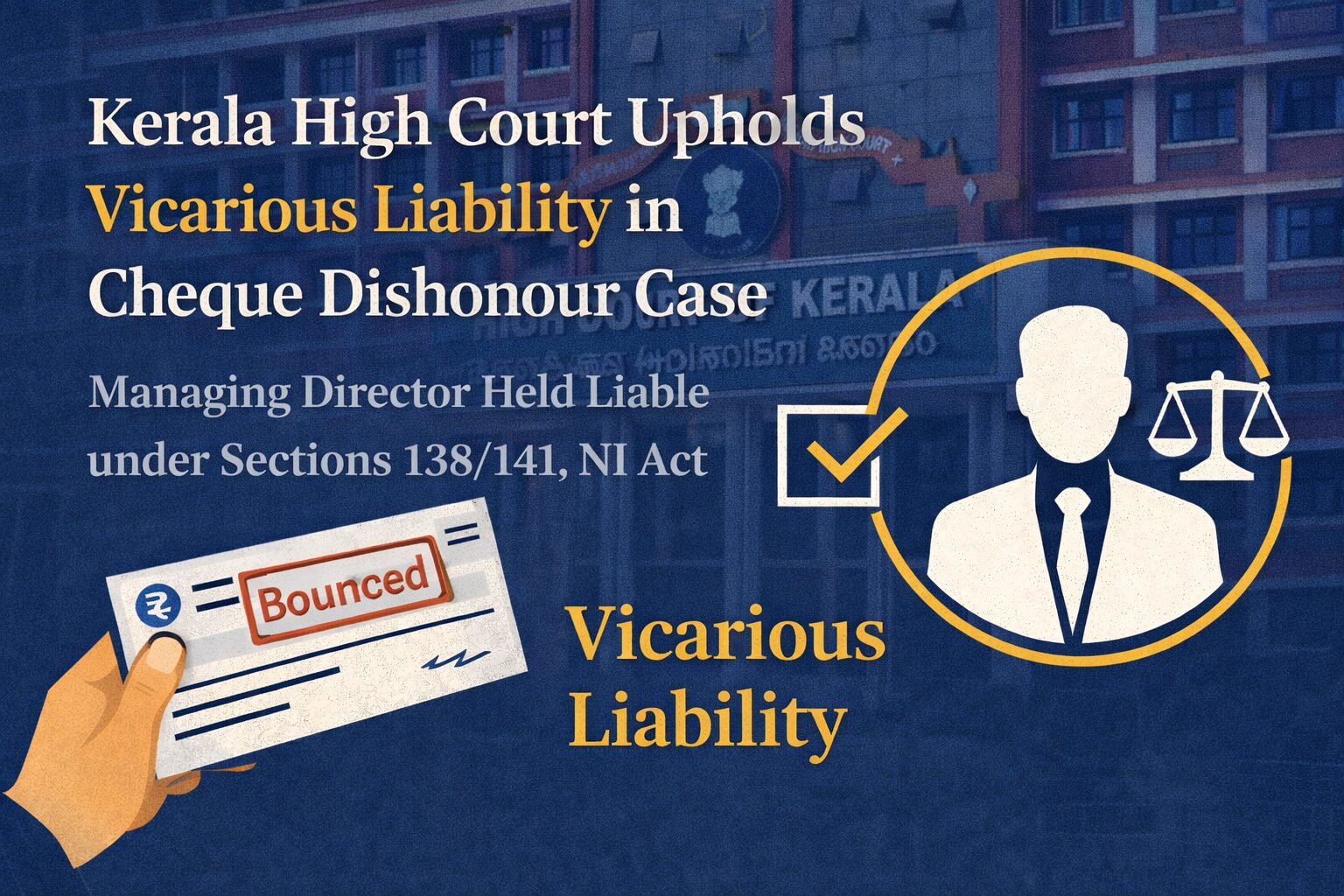
In V.J. Joseph v. The India Cements Limited & Ors. (2026), the Kerala High Court revisited the scope of vicarious criminal liability under Sections 138 and 141 of the Negotiable Instruments Act, 1881. The Court reaffirmed that when a cheque is issued by a company, criminal liability can be fastened on its officers only if they were in charge of and responsible for the conduct of the company’s business at the time of commission of the offence.
Dismissing the criminal revision petition, the High Court upheld the conviction of the Managing Director, holding that the statutory requirements for vicarious liability stood fully satisfied on facts and evidence.
Factual Background
The complainant, The India Cements Limited, is a company engaged in the manufacture and distribution of cement. The first accused was a private limited company, and the second accused was its Managing Director, admittedly in control of the company’s day-to-day affairs.
During the course of regular business transactions:
Cement was supplied on a credit basis
Towards partial discharge of liability, the Managing Director issued three cheques of ₹2 lakhs each on behalf of the company
The cheques were dishonoured due to insufficiency of funds
Statutory notice was issued and acknowledged
In the reply notice, the accused admitted the transaction and liability and sought time to pay, but failed to do so
These facts were supported by documentary evidence and admissions on record.
Proceedings Before the Courts Below
The Judicial First Class Magistrate Court convicted the accused under Section 138 NI Act and imposed imprisonment and compensation
The Sessions Court, in appeal, confirmed the conviction but modified the substantive sentence
The Managing Director approached the High Court in revision, challenging both conviction and sentence
Core Legal Issue
The principal question before the High Court was:
Whether the Managing Director could be held vicariously liable under Sections 138 and 141 of the NI Act for dishonour of cheques issued by the company?
Vicarious Liability Under Section 141 NI Act
The Court reiterated the settled legal position that Section 141 does not create automatic or deemed liability for all directors or officers of a company. Instead, criminal liability can be imposed only if the following twin requirements are satisfied:
The accused was in charge of the company, and
The accused was responsible for the conduct of the business of the company, at the time when the offence was committed.
The Court relied on the Supreme Court decision in Hitesh Verma v. Health Care at Home India Pvt. Ltd. (2025),which authoritatively lays down these twin conditions.
Application of the Principle to the Present Case
On facts, the High Court found that:
The revision petitioner was the Managing Director of the company
He was in charge of the day-to-day affairs of the company
He was the signatory to the dishonoured cheques
Admissions in the reply notice and during examination under Section 313 CrPC confirmed issuance of cheques towards an existing liability
These facts clearly established not only the commission of the offence under Section 138, but also the active and responsible role of the Managing Director, thereby attracting vicarious liability under Section 141.
Limited Scope of Revisional Jurisdiction
The High Court emphasised that in revision, it does not act as a second appellate court. Since:
The findings of the Magistrate and Sessions Court were based on proper appreciation of evidence
There was no perversity or illegality in the conclusions
the High Court found no ground to interfere with the conviction or sentence.
Decision
The Criminal Revision Petition was dismissed, and:
The conviction under Section 138 NI Act
The finding of vicarious liability under Section 141
And the modified sentence imposed by the Sessions Court
were all affirmed.
Key Takeaways on Vicarious Liability
Vicarious liability under the NI Act is not automatic
Managing Directors who control day-to-day affairs and sign cheques are squarely covered by Section 141
Admissions in reply notices and Section 313 CrPC statements are crucial
Specific pleadings and proof of responsibility at the relevant time are essential
Revisional courts will not reappreciate evidence unless findings are perverse
Conclusion
This judgment reinforces the principle that corporate officers who exercise real control over a company’s affairs cannot escape criminal liability for cheque dishonour. By upholding the Managing Director’s conviction, the Kerala High Court has reaffirmed the balance struck by the Negotiable Instruments Act—protecting commercial credibility while ensuring liability is fastened only on those truly responsible for the offence.